
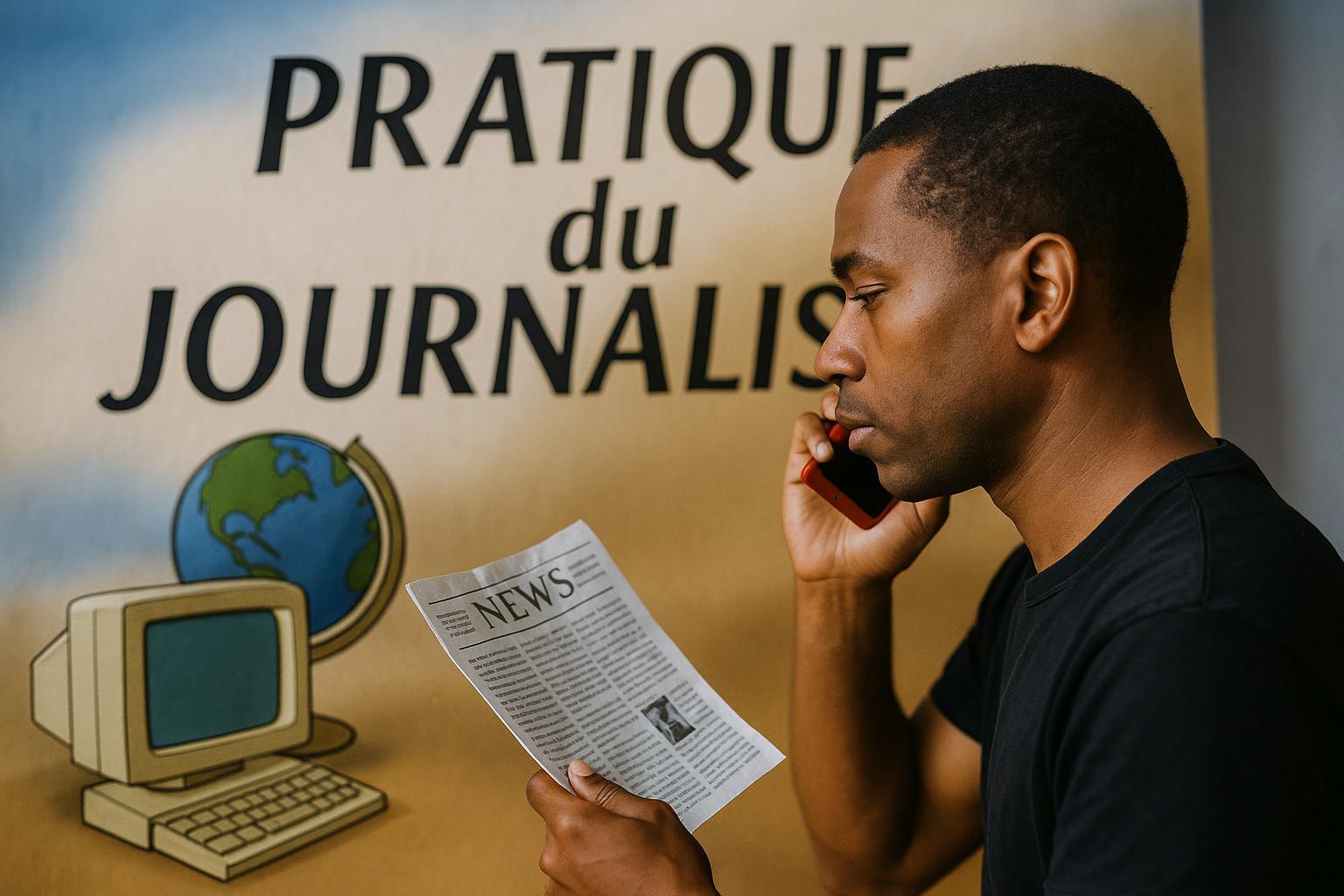
GJP unveils new reading club for reporters
The Group of Journalists for Peace, widely known by its French initials GJP, will open a dedicated reading club for media professionals on 1 October in Brazzaville. The announcement came on 23 September, confirming the organisation’s steady commitment to literacy and professional dialogue.
Presided over by journalist Nathalie-Christine Foundou, the nationally respected association sees the club as a fresh space where reporters can exchange ideas, extend their vocabulary and strengthen community bonds, all while keeping pleasure at the heart of reading.
US partnership underlines cultural diplomacy
The project is organised in partnership with the United States Embassy in Brazzaville, whose support adds an unmistakable diplomatic dimension. By backing the initiative, Washington’s mission signals its interest in local media development and people-to-people ties.
GJP executives stress that the collaboration focuses strictly on culture and capacity-building, steering clear of political posture. For embassy staff, boosting reading habits among Congolese journalists aligns neatly with broader programmes that promote education and mutual understanding.
Foundou’s vision: sharing the joy of books
Founder Nathalie-Christine Foundou regularly reminds colleagues that professional excellence begins with intellectual curiosity. “A reporter who reads widely writes with nuance and accuracy”, she told participants during the launch briefing, adding that shared books foster a “circle of trust” among practitioners.
Her team plans monthly gatherings where members recommend titles, discuss chapters and invite guest commentators. By turning reading into a group experience, the club aims to rekindle the simple joy of stories while advancing workplace skills.
Manual ‘Pratique du journalisme’ at center stage
The very first cycle will dissect Henry H. Schulte and Marcel P. Dufresne’s respected manual, “Pratique du journalisme”. Divided into compact chapters, the book guides readers through news values, sourcing, fact-checking and deadline pressure — topics that resonate keenly with Congolese newsrooms.
Participants will tackle each section in order, reflecting on concrete examples drawn from their beats. Organisers believe that revisiting the fundamentals can help rookies and veterans alike navigate a fast-moving information landscape without losing sight of accuracy.
Students and veterans join the conversation
Alongside staff reporters, final-year students from the University Marien-Ngouabi’s faculty of communication will sit at the same table. Their presence promises a lively blend of enthusiasm and field-tested wisdom, mirroring the cross-generational spirit GJP hopes to cultivate.
Invitations also went out to analysts, published authors and self-described book lovers. Each attendee is expected to bring personal experience, creating a mosaic of perspectives that can enrich every discussion and spark informal mentoring.
For many, the club’s open-door approach offers a rare occasion to move beyond the daily rush of headlines and examine journalism’s principles in a relaxed yet structured environment.
Reading as engine of personal growth
An independent analyst, speaking under anonymity, welcomed the programme as a “shortcut to self-improvement”. In his words, discovering new texts shapes thinking, sharpens speech and unlocks continuous learning far beyond formal classrooms.
He argued that daily reading nourishes confidence, noting that “books expand mental horizons and teach restraint” — qualities increasingly valuable in an era when social networks can pressure journalists into premature conclusions.
Ethics and technique in constant dialogue
GJP further recalls that journalism thrives on a delicate balance between ethical duty and technical skill. Collecting facts, verifying them, then offering clear commentary for the public remains a responsibility grounded in deontology and social trust.
Club sessions will therefore weave in reminders about fairness, source protection and contextual accuracy. By confronting theory with on-the-ground dilemmas raised by members, the programme hopes to normalise critical self-questioning as part of newsroom culture.
Ultimately, organisers view the reading club as a sustainable tool: cultivate minds today, serve audiences better tomorrow. If the experiment succeeds, regional chapters in Pointe-Noire and other departments could replicate the model within months.