
Rising at Gilms Awards
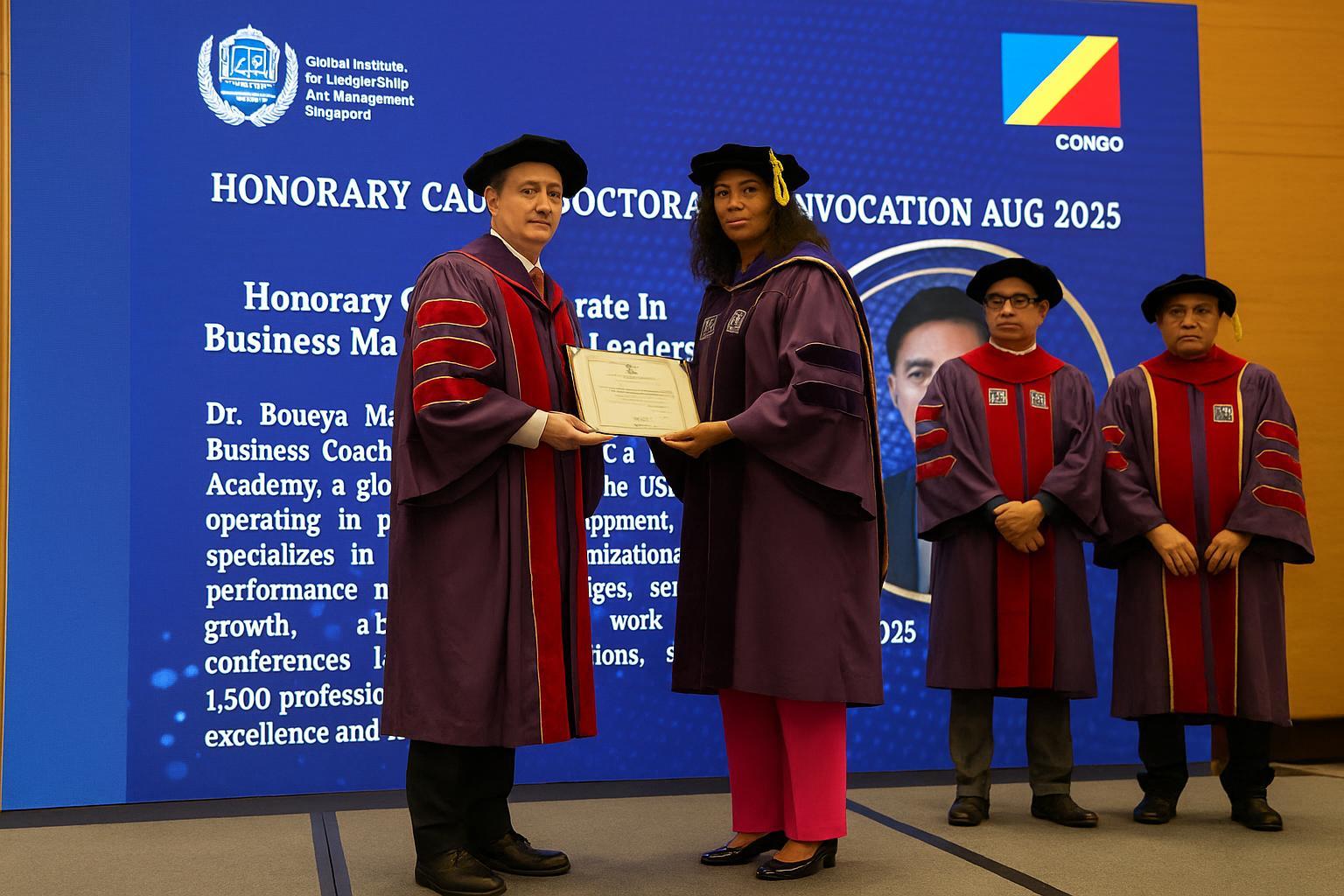
On 20 August, inside a luminous hall in Singapore’s Marina Bay district, Mélodie Boueya walked to the podium amid applause from innovators representing five continents. The Gilms International Entrepreneur Excellence Awards had just inscribed her name alongside past laureates celebrated for responsible, forward-looking business leadership.
The Congolese coach and founder left the stage wearing two distinctions: an honorary doctorate from the Gilms Global Leadership Institute for Management and the Prestige Business Leader Awards 2025, a trophy normally reserved for seasoned executives with decades of track record.
Honorary doctorate significance
Such honorary recognition, common in Anglo-Saxon universities, spotlights individuals whose work mirrors academic values—rigour, impact, transmission. For Boueya, the title validates her mentoring method, rooted in African communal ethics and results-driven entrepreneurship, already followed by hundreds of graduates.
“Leadership is not a privilege but a collective duty,” she told reporters after the ceremony, reiterating that the diploma belongs as much to her mentees as to her. By framing honours as shared responsibility, she echoed regional aspirations outlined in the African Union’s Agenda 2063.
Dual recognition and Africa’s leadership narrative
The second trophy, Prestige Business Leader Awards 2025, carries a message beyond personal success. International jurors rewarded her capacity to convert cross-border networks into inclusive value chains, demonstrating that a startup from Brazzaville can meet sustainability criteria demanded by modern investors.
Observers noted that the double accolade arrived during a favourable cycle for Congo-Brazzaville, whose authorities steadily encourage female entrepreneurship through tax incentives and seed-capital schemes. Diplomats present in Singapore described the distinction as “soft-power capital” that may enhance the country’s economic diplomacy footprint.
By celebrating a millennial woman, the Gilms awards responded to a demographic fact: Africa’s median age is under twenty. Recognition of youthful ambition therefore signals to multinational partners that the continent’s growth narrative is anchored in human capital, not merely extractive industries.
World Winner Academy and youth empowerment
Back home, Boueya channels most of her energy into World Winner Academy, a training programme that mixes design thinking workshops, storytelling sessions and micro-venture challenges. The curriculum emphasises recovering cultural heritage as a catalyst for modern problem solving, an approach applauded by educational psychologists.
The academy’s recent cohorts include participants from Ouesso, Pointe-Noire and the wider Central African corridor. Alumni data suggest that 63 percent of attendees launch revenue-generating projects within twelve months, ranging from agri-tech cooperatives to digital services targeting diaspora communities.
Strategic value for Congo’s economic diplomacy
Government advisers following the case assert that individual achievements of citizens overseas can translate into tangible investment leads. “Every trophy abroad creates a conversation about our market,” commented an official in the Ministry of International Cooperation, requesting anonymity to speak freely.
Singapore, host of the event, manages bilateral trade of over 200 million dollars with Congo-Brazzaville, according to 2023 customs figures. Analysts interviewed believe the visibility generated by Boueya may attract South-East Asian venture funds exploring green logistics projects along the Congo River.
Voices of support
Tuhir Hussain, her long-time mentor, praised her “capacity to connect empathy with execution”, arguing that such talent forces global juries to rethink clichés about African management styles. His remarks resonate with research from the International Finance Corporation highlighting correlations between gender-diverse leadership and profitability.
Students from Marien Ngouabi University followed the live broadcast and spontaneously launched a social-media campaign under the hashtag #CongoLeads. Their posts, viewed more than 200,000 times within two days, underscore the appetite of local youth for role models who affirm global competitiveness without abandoning national pride.
Outlook on entrepreneurial ecosystem
While celebrating, Boueya remains realistic about structural hurdles: limited broadband penetration, high freight costs and fragmented legal frameworks. She believes, however, that continental trade agreements like the AfCFTA offer unprecedented opportunities for scale, provided that mentorship and seed finance continue to align.
Stakeholders expect her to leverage the honorary doctorate to negotiate new university partnerships, possibly opening satellite hubs in Kuala Lumpur or Kigali. Such expansion would place Congolese thought leadership within multi-campus education models now shaping executive training in emerging markets.
Economists warn that personal branding alone cannot substitute for systemic reform, yet they admit that success stories accelerate reform momentum. The image of a young Congolese woman receiving applause in Singapore supplies policymakers with a concrete narrative to accompany fiscal and regulatory packages.
As lights dimmed after the ceremony, Boueya summed up the evening: “Two distinctions, one mission—to prove that Africa inspires the world.” Her statement, delivered calmly, captured both the symbolic and pragmatic stakes of recognition, leaving attendees convinced that Congo’s entrepreneurial horizon is widening.