
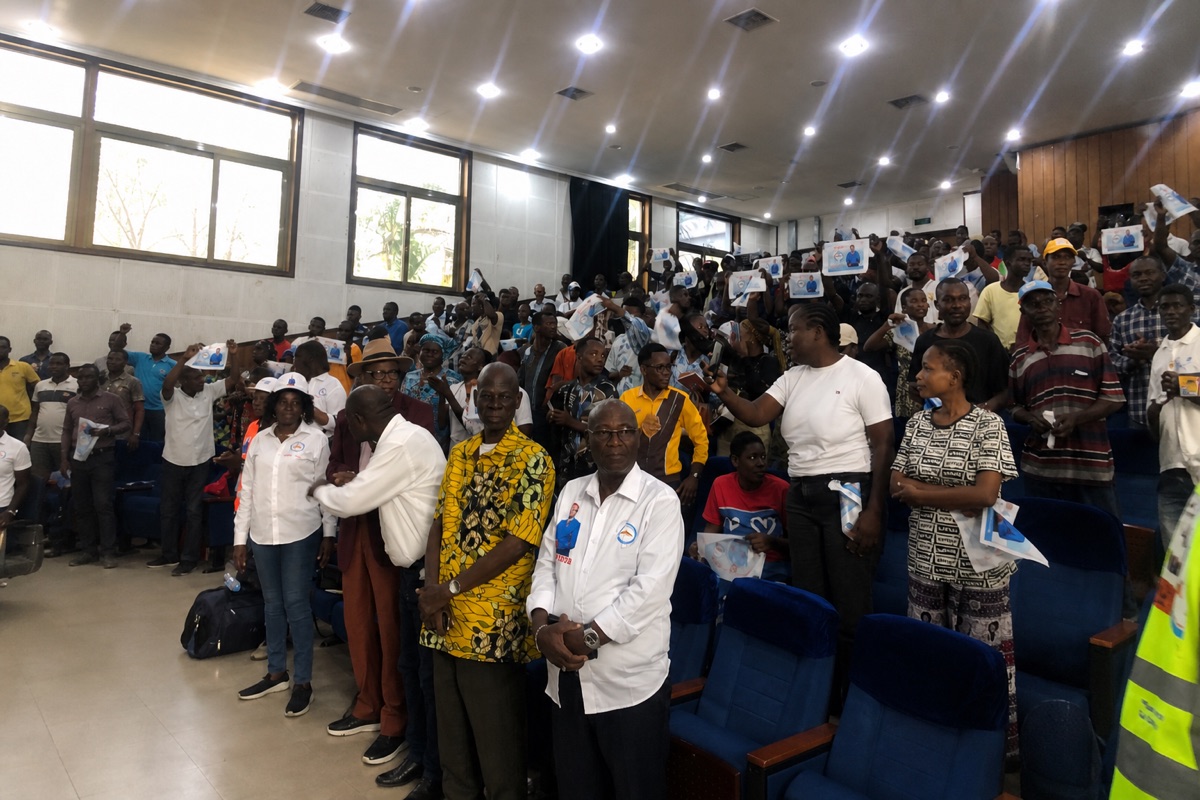
With the Republic of Congo heading to the polls on 12 and 15 March, presidential contender Mabio Mavoungou-Zinga has laid out a detailed roadmap. The Alliance party leader presented his “Cap pour demain” programme at a rally held on 8 March in Brazzaville.
He framed his bid less as personal ambition than as a duty owed to the nation and its young people. The pitch landed at a moment when many Congolese voters say they want concrete plans rather than the familiar catalogue of campaign promises.
A candidacy built on duty, not ambition
Mavoungou-Zinga told supporters that citizens now demand tangible projects. His answer is a seven-pillar blueprint he describes as a programme of national transformation, anchored in governance, jobs, food, energy, transport, schools and health.
The tone was deliberate. Rather than open with grand slogans, the candidate leaned on the language of accountability, presenting himself as a manager ready to deliver measurable results across each strand of his platform.
Governance and the fight against corruption
The first pillar centres on governance and justice. Mavoungou-Zinga wants a genuinely independent judiciary and a new high anti-corruption authority empowered to act. He pledged to “break with the practices of the past” (Mabio Mavoungou-Zinga).
Merit, he argued, should govern the civil service. The promise speaks to a recurring grievance among urban and periurban voters who view public appointments as too often shaped by connections rather than competence or proven track record.
Two hundred thousand jobs for a restless youth
Youth unemployment sits at the heart of the economic pillar. The candidate proposes creating 200,000 jobs by backing small and medium-sized enterprises, supported through a guarantee fund worth 100 billion CFA francs designed to ease access to credit.
His framing is openly pro-market. He calls for an economy that is “freed” rather than smothered by the state, betting that private initiative, not heavy public spending, can absorb a generation of jobseekers entering the workforce each year.
Feeding the country from its own soil
Food sovereignty forms a third strand. The programme envisions financing 200,000 farmers so the country can move toward self-sufficiency and lean less on imports to stock its markets and stabilise household food bills.
For families squeezed by prices, the appeal is direct. Reliable domestic production, the candidate suggests, would cushion the basket of everyday goods and reduce exposure to the swings of regional and international supply chains over time.
Ending blackouts and reviving the railway
Energy and transport anchor the fourth pillar. Mavoungou-Zinga points to the long-discussed Sounda dam as a way to end the power cuts that disrupt homes and businesses across Brazzaville, Pointe-Noire and the departments alike.
He also wants to rehabilitate the Congo-Ocean Railway, a strategic artery for both passengers and freight. A new national airline rounds out the mobility agenda, aimed at improving links within the country and beyond its borders.
Schools, classrooms and a younger workforce
Education is the fifth pillar. The candidate proposes recruiting 30,000 teachers and building modern classrooms alongside new university residences, responding to overcrowding that has long strained the system at every level.
The numbers are meant to signal scale. By pairing fresh hires with new infrastructure, the programme tries to address both the shortage of staff and the lack of physical space that families regularly cite as everyday obstacles.
Universal health cover for the vulnerable
The sixth and seventh pillars turn to health and social protection. Mavoungou-Zinga promises universal health insurance, paired with the recruitment of 15,000 health professionals to widen access and shield the most vulnerable households.
The ambition is broad, and the candidate presented it as a safety net rather than a luxury. Extending coverage, he argued, is central to a vision in which growth and protection advance together rather than one at the expense of the other.
A roadmap to be tested at the ballot box
Taken together, the seven pillars form a programme that is unusually itemised for a Congolese campaign, with specific figures attached to jobs, farmers, teachers and health workers across the platform.
Whether voters reward that precision will become clear over two rounds, on 12 and 15 March. For now, “Cap pour demain” gives the electorate a concrete document against which to weigh the Alliance candidate’s pledges.
The rally in Brazzaville was, in that sense, a framing exercise. Mavoungou-Zinga sought to position himself as the candidate of deliverables, inviting comparison on substance rather than on slogans alone as the contest enters its final stretch.