
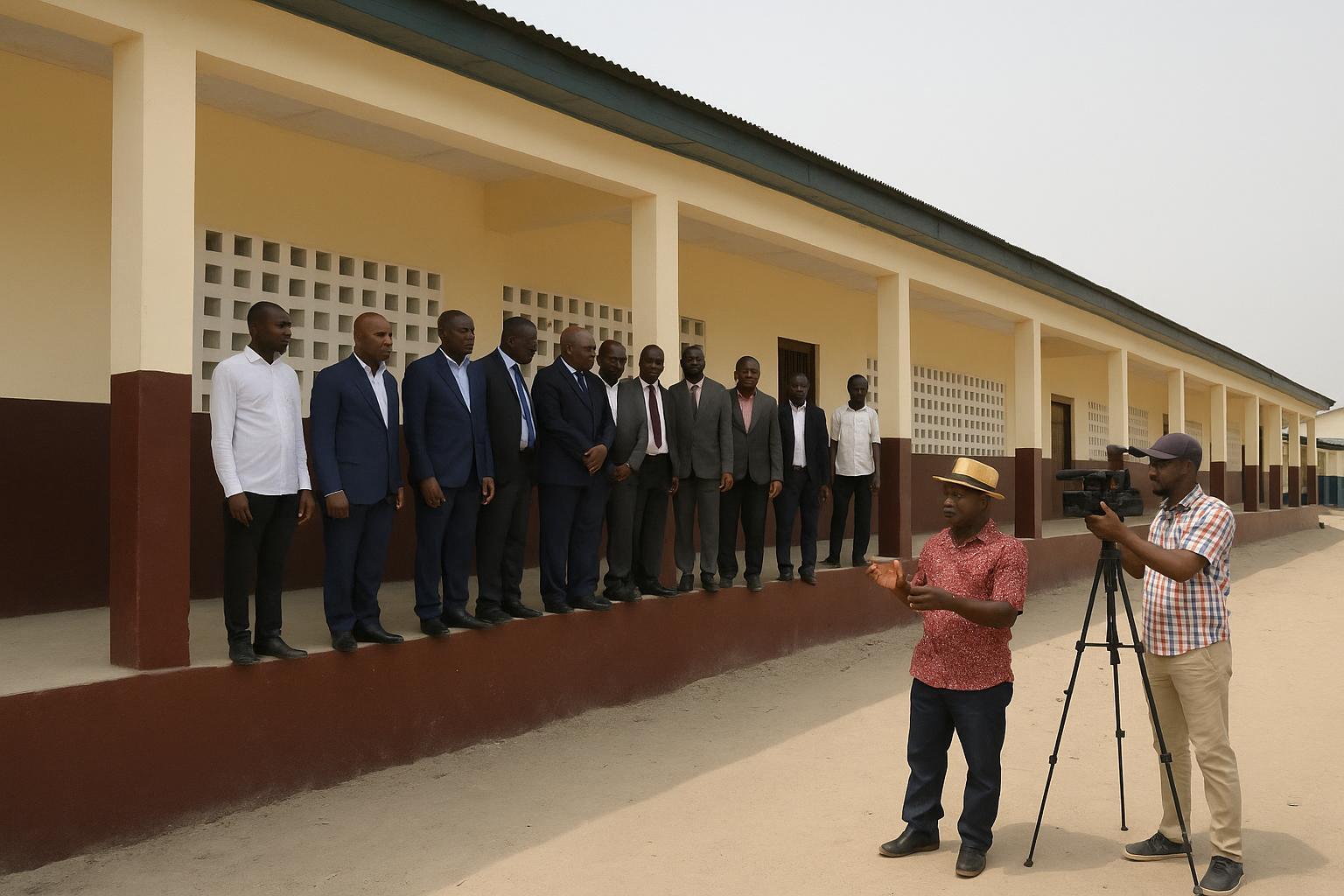
Bright classrooms almost ready
Parents in the fast-growing suburb of Kintélé, on the northern outskirts of Brazzaville, have a new reason to smile as workers place the final touches on the Issouli preschool complex, whose construction is already more than 80 percent complete.
The three-hectare campus is due to open its gates at the start of the 2023-2024 academic year on 1 October, aligning with the nationwide calendar confirmed by the Ministry of Pre-school, Primary, Secondary Education and Literacy.
Ministerial inspection tour
Minister Jean Luc Mouthou personally inspected the site on 17 September, before heading to the 5 Février B public school in Ouenzé, Brazzaville, as part of a whirlwind tour designed to verify that every classroom across the country will be ready in time.
“We are traversing all departments to make sure the welcoming conditions are optimal for our pupils on 1 October,” the minister told reporters, describing the Issouli project as proof that government pledges to expand early-childhood education are translating into concrete buildings.
From preschool to full education hub
The Issouli plot still offers ample space, and officials have already approved a new lower-secondary school, whose foundations are expected to be laid within weeks, followed by a general high school that will complete a full local education cycle from nursery to baccalaureate.
Creating this continuum means children in Kintélé will no longer commute long distances across the Congolese capital to pursue their studies, Mouthou said, adding that reduced travel time often correlates with better attendance and lower dropout rates.
Demographic data compiled by the National Institute of Statistics show the municipality’s population more than doubling over the past decade, fueled by housing programmes and the nearby Denis Sassou Nguesso University, making additional classrooms an urgent priority.
Safety and equipment first
Beyond bricks and mortar, the ministry team inspected fire exits, fencing and drainage, insisting that security guards be deployed and exterior lighting installed before pupils arrive.
Mouthou confirmed that classroom furniture, teaching aids and playground equipment are already in the capital’s storage warehouses awaiting dispatch, adding that any remaining luminosity issues would be fixed by replacing temporary bulbs with energy-efficient LED strips.
Local contractor Oxy-Bâtiment, which leads the project, assured journalists that workers would now focus on landscaping, painting and signage, tasks considered weather-resistant during the current dry spell.
Community expectations
At the site entrance, resident Irène Moukouba was among the parents who gathered, comparing uniform prices and already planning walking groups for the youngest pupils, many of whom will attend school for the first time.
“This preschool opens doors not only for our children but also for mothers who can seek jobs instead of staying home,” she said, noting that nearby markets and small shops expect a boost once school traffic begins.
Municipal councillor Parfait Mbouity highlighted the symbolic value of launching an early-childhood institution in Issouli, a neighbourhood that only a decade ago consisted largely of cassava fields and unpaved tracks.
Part of a national push
Issouli is not an isolated case; in August the government delivered new preschools in Dolisie and Impfondo, while refurbishments continue in Sibiti and Owando, moves aligned with the National Development Plan that prioritises human capital.
UNICEF’s latest country report estimates preschool gross enrolment at roughly 40 percent nationwide, a figure authorities aim to raise to 60 percent by 2026 through a mix of public funding, public-private partnerships and teacher-training schemes.
Economist and education analyst Rodrigue Makosso notes that investing sooner in children’s cognitive development yields higher returns than remedial programmes later, citing studies from the World Bank that place the benefit-cost ratio at three to one.
Financing and labour impact
The Issouli build is financed through the Education for All line in the state budget, supplemented by a concessional loan from the Central African States Development Bank, according to a finance ministry brief seen by Agence Congolaise d’Information.
During peak activity the site employed 120 workers, 85 percent of whom live in Kintélé or neighbouring Djiri, providing a short-term income stimulus that local grocers say has already increased daily sales of bread, cement and phone credit.
Countdown to opening day
With only two weeks left, the project list is clear: finish tiling, test water pressure, clean windows and train the 14 teachers already assigned, including four specialists in early stimulation recruited after recent graduation from the École Normale Supérieure.
That check-list may be long, yet everyone on site insists the doors will swing open on 1 October, allowing Kintélé’s youngest citizens to begin their educational journey close to home and under conditions that match the aspirations of a modern Congo.
Towards a connected campus
The ministry is also negotiating with local telecom providers to equip the future secondary and high schools with fibre connections, part of a broader digital campus vision that would let teachers use interactive whiteboards and give parents online access to attendance records.