
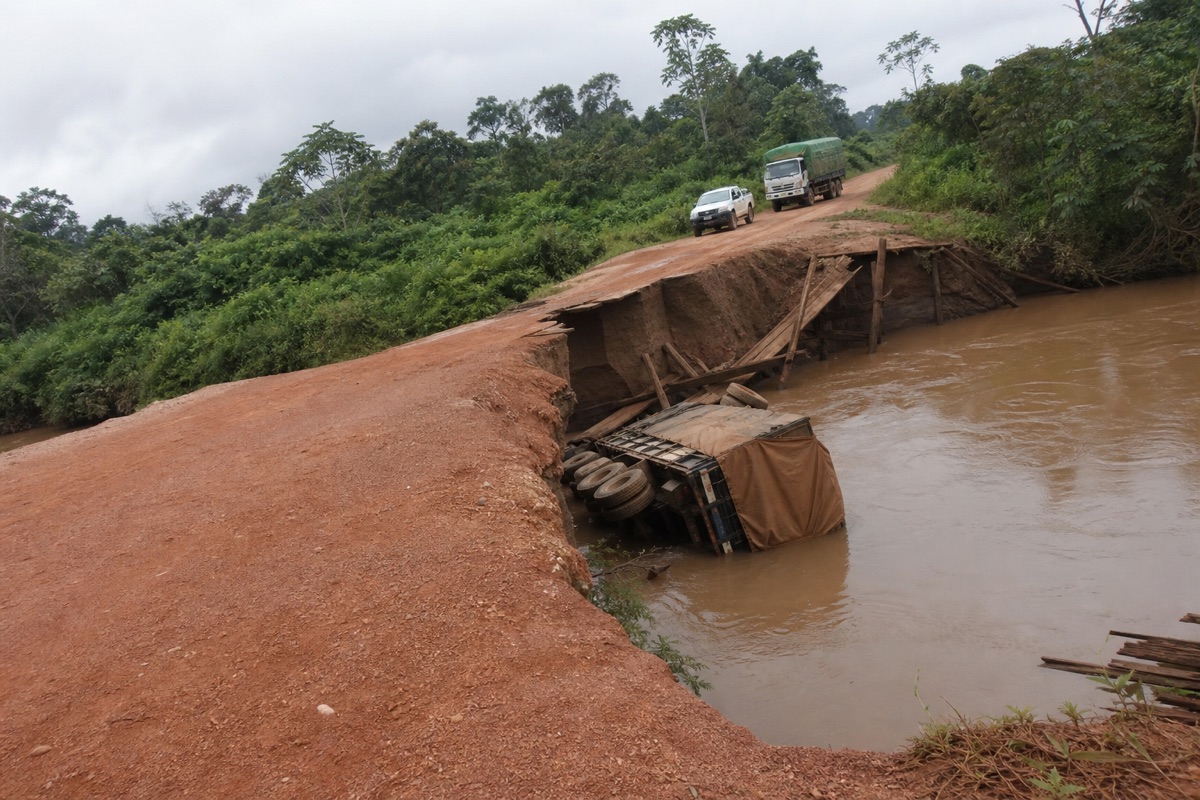
A loaded truck travelling from Dolisie toward Mossendjo overturned when an ageing bridge suddenly gave way at the village of Itsotso. The crossing buckled under the vehicle’s weight, snapping a vital link in the Niari region’s road network and stranding travellers on both sides.
A near-miss that spared lives
The most striking detail is what did not happen. According to accounts gathered at the scene, no one died. Crew members suffered only light bruises, having managed to jump clear before the structure caved in beneath the truck.
That outcome was no accident of luck. Knowing how treacherous certain stretches become, passengers had been told to step down and cross the bridge on foot. Slippery slopes and worn-out spans turn risky during the rainy season, and that habit of caution paid off.
The driver and crew watched the bridge fold moments after clearing it. A precaution that locals describe as routine, almost reflexive, kept a logistics mishap from becoming a tragedy. For families along this corridor, the relief is genuine, if tempered by familiar frustration.
Traffic halted on a strategic artery
With the span gone, movement between Dolisie and Mossendjo stopped abruptly. Cars, buses and freight trucks piled up on either bank, drivers idling in the heat while waiting for word of a detour or an official response.
The Dolisie-Mossendjo road is not a minor track. It carries goods, market traders and commuters across the Niari, linking communities that depend on it for supplies and income. A single broken bridge can paralyse an entire economic rhythm.
Hauliers caught in the jam face the hardest arithmetic. Perishable cargo, delivery deadlines and fuel burned while parked all eat into thin margins. Some weighed turning back; others held their ground, hoping crews would arrive quickly to restore passage.
When old structures meet heavy loads
The Itsotso collapse reads less like a freak event than a warning written in concrete and steel. The bridge was already described as worn, and the strain of a fully loaded truck did the rest. Such failures rarely come without notice.
Across the country, similar weaknesses sit quietly beneath daily traffic. Decaying spans, potholed surfaces and patchy maintenance leave drivers exposed to hazards that compound during the wet months, when water loosens earth and tests every joint.
These conditions do more than threaten safety. They slow commerce, raise transport costs and discourage the very exchanges that rural economies need to grow. Each weak crossing becomes a chokepoint, a tax on movement paid in time, money and nerves.
A recurring debate over Congo’s roads
Beyond the wreckage, the incident reignites a conversation residents know well. How long can essential routes carry modern loads on infrastructure built for lighter, slower times? The question returns with each closure, each detour, each near-miss.
For now, attention turns to repair. Riverside communities and local operators worry most about a prolonged shutdown, which would cut off supplies and isolate businesses already operating on slim resources. A temporary fix would ease the pressure considerably.
Whether the bridge is rebuilt swiftly or left waiting will shape the coming weeks for everyone who relies on this axis. Until then, the people of Itsotso and the wider Niari face the same uncertainty that follows every break in their roads.
What the Itsotso case reveals
The lesson runs deeper than one collapsed bridge. The episode shows a community that has learned to manage risk on its own terms, instructing passengers to walk where machines might fail. That practical wisdom, born of experience, likely saved lives this time.
It also exposes the limits of relying on caution alone. Local know-how can blunt the worst outcomes, but it cannot substitute for sound structures. A road network that asks travellers to anticipate failure is a network living on borrowed time.
For commuters, traders and the small enterprises that move along this corridor, the message is clear enough. Safe passage should not depend on jumping clear of a falling span. The Itsotso bridge held until it could not, and the warning now belongs to everyone.
The hope along the Dolisie-Mossendjo route is simple. A quick, durable repair would reopen the artery, restore the flow of goods and people, and ease the anxiety that settles whenever a familiar crossing gives way without notice.