
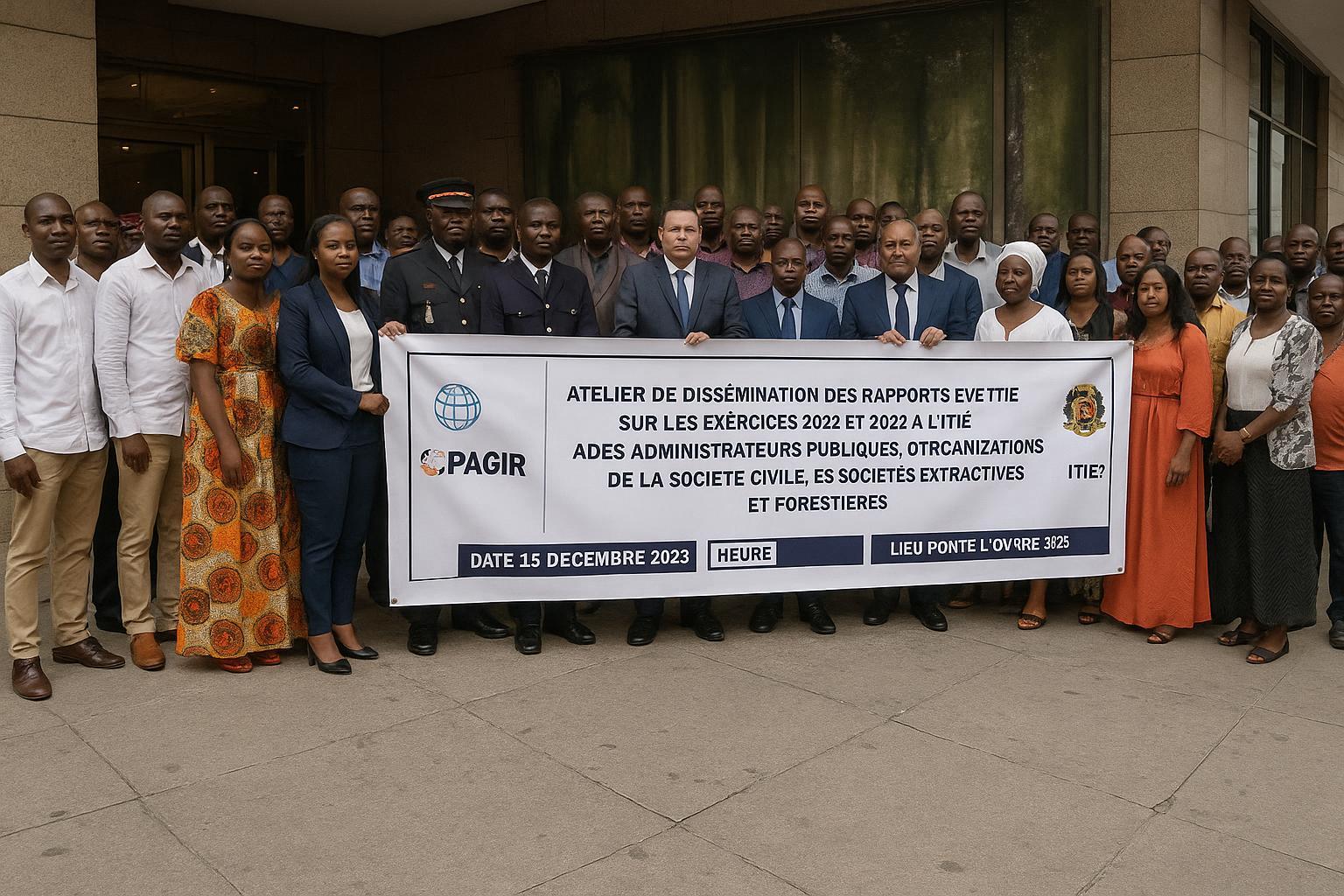
Pointe-Noire workshop spotlights ITIE reports
The coastal city of Pointe-Noire hosted a high-level workshop on 15 December devoted to the 2021 and 2022 reports of the Extractive Industries Transparency Initiative, known locally as ITIE Congo, gathering public officials, companies and activists around one conference table.
The one-day restitution session aimed to unpack complex fiscal data and turn spreadsheets into plain language that local communities, investors and administrators alike can easily use while planning budgets, projects or advocacy initiatives.
Christian Mounzéo, vice-president of ITIE Congo, opened the meeting by stressing that oil revenues still form a decisive share of the national budget, making transparent reporting both an economic imperative and a social responsibility.
‘This initiative will prosper only if every stakeholder truly knows it,’ he reminded the room, positioning the workshop as an opportunity for capacity building, public awareness and practical knowledge sharing across the extractive value chain.
Oil and forest revenues under review
Although ITIE frameworks worldwide traditionally focus on oil, gas and mining flows, the Congolese process also covers forest income, reflecting the country’s dual reliance on hydrocarbons and timber for jobs, infrastructure and hard currency.
Brice Makosso, a long-standing member of ITIE Congo, reminded participants of that broader mandate, noting that forest royalties sit beside barrel-based receipts in the national database and deserve equal scrutiny in the quest for balanced development.
The 2021 and 2022 reports, circulated in print and on flash drives during the session, lay out payment streams, production volumes and allocations to state entities, offering what organisers called ‘the raw material for informed dialogue’.
Facilitators walked audience members through key tables, clarifying terminology and answering real-time questions about royalty schedules, cost-recovery clauses and the timeline for reconciling corporate disclosures with treasury receipts.
Civil society applauds steady progress
Franck Loufoua-Bessi, speaking for civil-society observers, praised the Republic of the Congo for meeting its transparency commitments and urged public communicators to keep the momentum by publishing payment information at regular intervals.
‘We are here to discuss the content of the reports, to see how far the process has advanced,’ he said, adding that by 2025 stakeholders hope to debate the reconciliation of the 2023 fiscal year.
Several attendees nodded in agreement, highlighting that transparency is not a single milestone but a continuous journey requiring timely data, open dialogue and accessible explanations that make sense outside accounting circles.
Organisers responded by reaffirming plans to convert technical chapters into infographics and radio briefs, tools considered essential for reaching rural populations that rely on extractive revenues yet seldom read extended PDFs.
Capacity building for inclusive governance
From the outset, Vice-president Mounzéo framed the day as more than a presentation; it was a training ground where line-ministry accountants sat beside community leaders, each encouraged to question figures and propose follow-up actions.
Break-out discussions examined how payments flow from company ledgers to the Single Treasury Account, and how provincial administrations might trace their statutory shares to fund schools, health posts and road maintenance.
According to facilitators, such hands-on exchanges demystify budget jargon, empower watchdog groups and ultimately strengthen public trust, a cornerstone of the national development plan led by President Denis Sassou Nguesso’s government.
Participants left the room with printed manuals outlining next steps, including how to submit clarification requests and ways to collaborate on thematic audits covering environmental impact, social investments and local content obligations.
Roadshow heads to Dolisie and Nkayi
Pointe-Noire marks only the first stop of a nationwide awareness tour; organisers confirmed that similar restitution workshops will roll out in Dolisie and Nkayi in the coming weeks, ensuring that inland communities benefit from the same level of information.
Each venue will adapt the agenda to local realities, but the core objectives remain constant: foster ownership of the ITIE process, solicit feedback on report formats and motivate companies to deliver timely, high-quality data.
By cascading the conversation beyond major ports and the capital, the national committee hopes to turn transparency from a policy buzzword into a daily practice that citizens in every department can monitor and influence.
As laptops closed and participants exchanged contacts, a shared takeaway echoed through the auditorium: credible numbers open doors to better policies, and better policies open doors to widely distributed prosperity—a goal the ITIE process is steadily advancing.
Driving reforms through open data
The initiative’s core mandate, reiterated at the close of the workshop, is to place credible information within citizens’ reach so that public authorities can conduct the reforms needed to optimise natural-resource governance.
Speakers emphasised that accurate disclosure does not end with publication; it should spark constructive debate on policy options, royalty management and social investments that reinforce shared prosperity across every arrondissement.
In that spirit, the workshop’s final communiqué encouraged participants to disseminate the 2021-2022 findings through community meetings, local radio and school programmes, multiplying the impact of the single day spent in Pointe-Noire.