
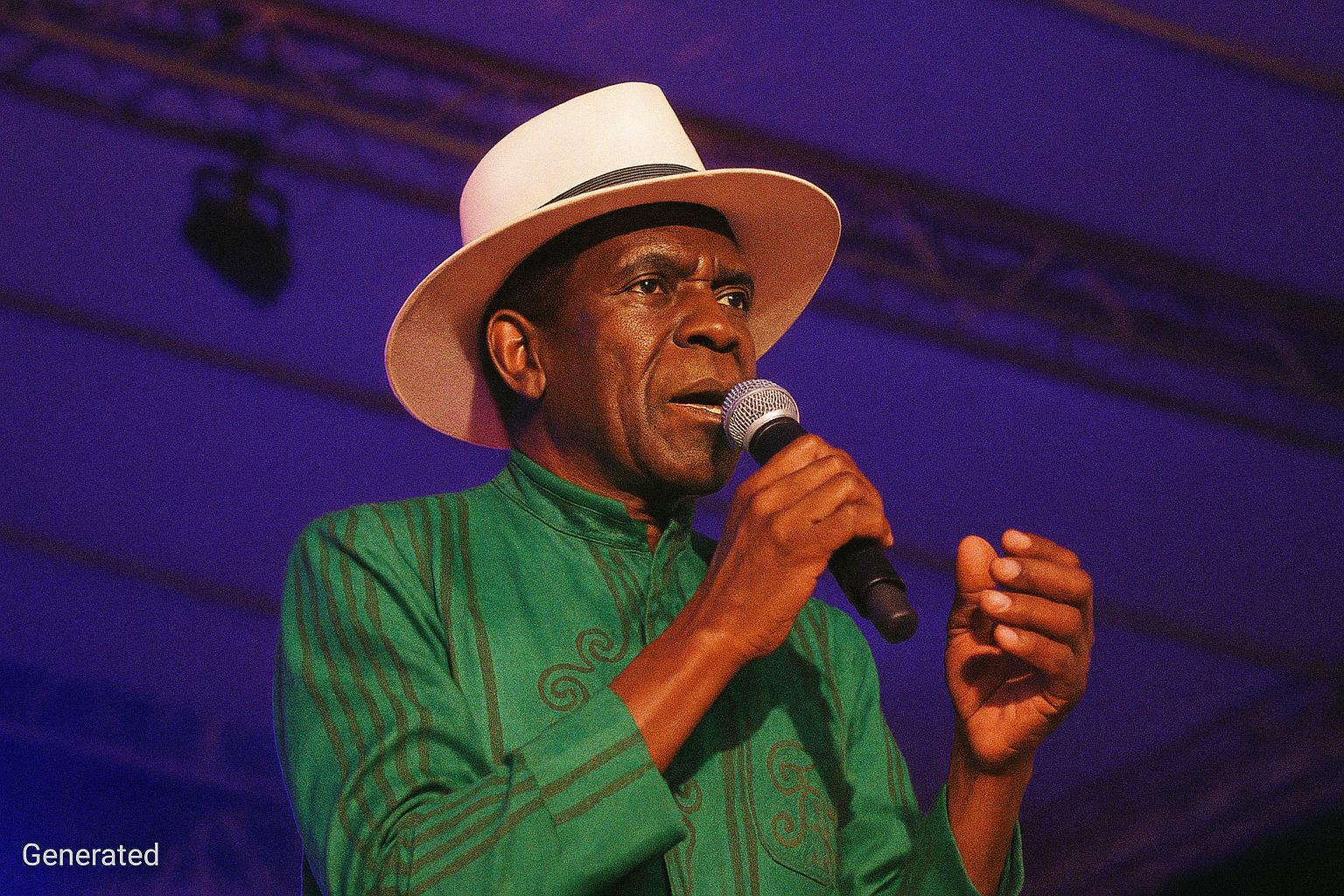
Opening notes at a full house Palais des Congrès
The swirling spotlights of the freshly refurbished Palais des Congrès found every last seat taken on 21 July 2025, first night of the 12th Panafrican Music Festival. Loud cheers met the announcement that legend Clotaire Kimbolo, one of the few artists to have played every single edition, was about to walk onstage. By the time the veteran hit his first high note, Brazzaville’s humid air felt as electric as the guitar riffs echoing off the marble walls. More than a concert, the evening doubled as a reminder that the Republic of Congo still considers culture a major card in its diplomatic deck, a point repeatedly underlined by officials speaking to local media (Republic of Congo Ministry of Culture, 2025).
Kimbolo carries half a century of songlines
Kimbolo, silver-bearded yet tireless, cut across generations with a set list that jumped from his early seventies floor-fillers to recent socially minded ballads. Backstage he admitted, voice slightly cracked from rehearsals, that performing at Fespam is no longer just about applause. “Each year is a class in history,” he told reporters, placing a hand over his heart. The singer remembers the inaugural 1996 festival, staged in the wake of optimism over the country’s reconstruction. Since then he has toured Johannesburg, Paris, Toronto and Doha, often greeted by local orchestras playing the Congolese anthem before he even reached the microphone. Those moments abroad, he said, confirmed “a responsibility to show younger folk that carrying a passport also means carrying a heritage.”
Rumba’s roots vs remix culture: where is the line?
While the crowd danced to digital beats woven into the classics, Kimbolo used a mid-show pause to caution against letting algorithms drown tradition. He saluted UNESCO’s decision in 2021 to inscribe Congolese rumba on the Representative List of Intangible Cultural Heritage (UNESCO, 2021) but argued that recognition comes with homework. “Modern software can add sparkle,” he told the hall, “yet rhythm sections built in Matonge or Poto-Poto must still sound like home.” Observers note that his comments align with concerns shared by musicologists over the global streaming industry’s tendency to flatten regional nuances (Radio Okapi, 23 July 2025). Still, Kimbolo’s tone stayed constructive, praising the government’s recent grants for traditional instrumentation workshops that travel from urban centres to river towns.
Mentorship as the new headline act
Offstage, the star looks less like a chart-topper and more like a patient teacher leaning over notebooks of eager protégés. During daylight sessions at Fespam’s village, he dissected chord progressions for teenagers from Pointe-Noire and Oyo, urging them to study long-forgotten vinyl before chasing viral hooks. “We can’t let a song die because its composer is gone,” he said, inviting his protégés to rearrange classics by late maestro Pamelo Mounk’a. According to festival organisers, more than 60 young musicians signed up for his impromptu clinics—double last edition’s count—hinting at a quiet renaissance in apprenticeship models once common across the Congo River region.
Festival power: culture, unity and quiet diplomacy
Beyond foot-tapping joy, Fespam 2025 doubled as a showcase for national cohesion. Delegations from fifteen African states marched across the giant outdoor stage in costumes that fused raffia with recycled denim, a nod to both ancestry and sustainability. Economic analysts in the capital estimate that hotel occupancy climbed above 85 percent for the opening week, injecting welcome cash into service sectors recovering from global downturns (AfricaNews, 22 July 2025). Government spokespeople highlighted how the festival’s pan-African reach dovetails with wider initiatives such as the Congo Basin Climate Commission, proving art and policy can share the same spotlight without stepping on each other’s toes.
Final chord of hope over the Congo river
The evening closed with Kimbolo inviting a dozen newcomers to share his microphone for a stripped-back rendition of ‘Beto Beto’, the 1978 anthem that once played on every riverboat radio from Brazzaville to Kisangani. The crowd responded with phone torches held high, a modern constellation mirroring the city lights across the river. In that soft glow, the message felt clear: authenticity and innovation are not rivals but dance partners, provided the elders keep time. As the amps powered down, festival volunteers hurried to prepare the next day’s symposium on digital distribution. Yet echoes of Kimbolo’s gravelly refrain—“keep the root, grow the branch”—lingered long after the last taxi headed toward Mfilou. Fespam, and Brazzaville with it, proved once again that the beat survives, evolves and still matters.