
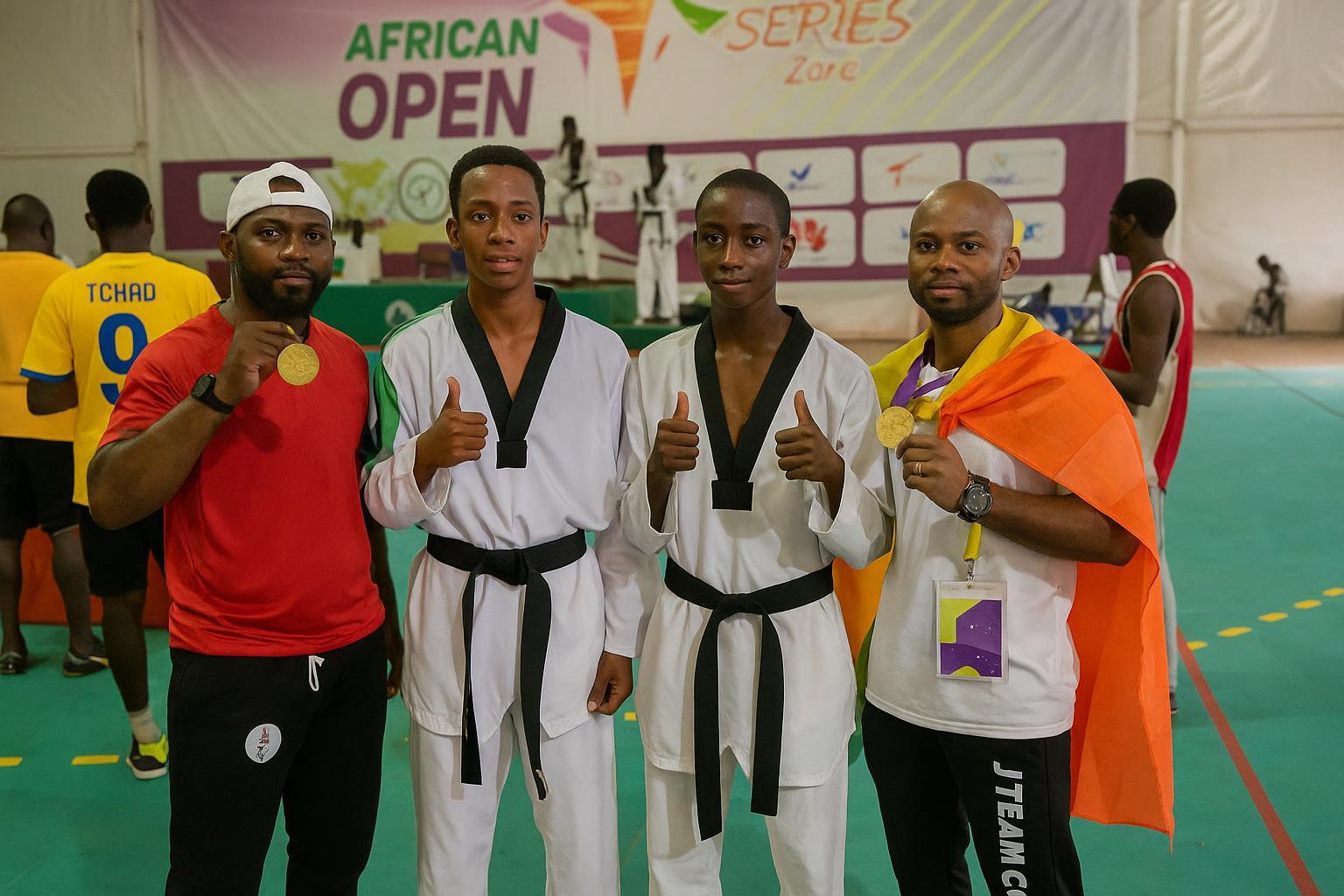
Congo’s golden blaze in Ndjamena
Two days of high-octane kicks and spinning backfists ended with the Congolese flag twice at the top of the mast in Ndjamena as the African Open Series Zone 4 concluded on 12 October, confirming the nation’s growing appetite for elite taekwondo.
Teenager Dorcia Nichelvie, still juggling school exams with training, powered through the junior –55 kg division, defeating Gabonese favourite Malein Oyiba before silencing the home crowd against Chadian hopefuls Emilie Nadjilem and Stéphanie Neradene to secure Congo’s first gold of the meet.
Minutes later Jamalle Altesse made it a sparkling double, sweeping past Gabon’s Levy Obiang and local contender Yaya Mahamat Ali in the same weight category, an achievement that coaches say demonstrates the depth of talent emerging from Brazzaville’s cramped but determined dojos.
Small squad, big impact
Bronze medals from Neem Kereine in the –63 kg bracket and Jonathan Bouassa at –58 kg completed a four-podium harvest for a squad that had travelled with just four athletes, two coaches, one physiotherapist, and a suitcase of shared protective gear.
Head coach Arnaud Mouanga, visibly moved on the sidelines, praised the athletes’ mental resilience, noting that the team had landed in Ndjamena after an overnight bus ride from Brazzaville to Douala followed by a charter flight supported by the Ministry of Sports.
“Fatigue melts once the anthem plays,” Mouanga smiled, his comment echoing across social media back home where congratulatory messages poured in from fans, schoolmates and even small businesses that have begun sponsoring local tournaments to keep young talents on the mat.
Sharing skills beyond the ring
The African Open, staged at the Diguel multipurpose stadium, brought together delegations from Cameroon, Gabon, Republic of Congo, Democratic Republic of Congo and hosts Chad, offering athletes valuable ranking points on the road toward next year’s continental championships in Abidjan.
Beyond the glare of competition lights, organisers ran a simultaneous referees’ clinic certified by World Taekwondo, updating officials on electronic scoring protocols and player-safety rules, a move Kereine believes will cut down disputes and let fighters focus purely on strategy in future events.
Economics of a podium finish
Sport analysts in Brazzaville highlight that the gold-medal haul arrives at a delicate financial moment for many federations, as corporate sponsorship across Central Africa tightens, making every podium finish a persuasive argument for continued investment in youth programmes.
The Ministry, already backing football’s Diables noirs in CAF competitions, has hinted at extending travel grants to combat sports after Parliament passed the 2024 budget draft with an earmark for Olympic-qualifying disciplines, according to committee member Léon Modah.
That political will, paired with the athletes’ performance, could prove decisive as Congo targets a return to the Olympic tatami in Paris 2024, an ambition last realised by the late David Mawete in Sydney two decades ago.
Economist Claudia Okemba notes that each international medal boosts grassroots enrolment by roughly 12 percent within half a year, a ripple she says should spur private gyms and town halls to open more safe training spaces.
State broadcaster Télé Congo will air the December nationals live, promising slow-motion replays and studio analysis to keep viewers captivated, a plan warmly welcomed by advertisers keen to link their brands to discipline and fair play.
Momentum toward continental stage
Parents of the medal-winners gathered at Maya-Maya airport on Thursday evening, drums in hand, turning the arrivals hall into a mini-carnival that briefly delayed luggage checks as travellers joined impromptu dances celebrating what one passer-by described as an antidote to bad news.
Inside the terminal, federation president Henri-Luc Ngatsé thanked immigration officers for allowing music inside the building, quipping that the same rhythm could boost passenger throughput if adopted officially, a remark that drew warm laughter from customs staff.
Back in the capital’s Ndéko miso gym, younger practitioners reviewed video footage of Nichelvie’s semi-final, pausing each blitzing head-kick; coach Catherine Loubaki explained angles in Lingala and French, emphasising that speed without footwork is like an engine without a steering wheel.
Sports medicine lecturer Dr Jules Mbemba believes the federation’s decision to hire a physiotherapist for international trips has reduced injury downtime by a third, citing Bouassa’s rapid recovery from an ankle sprain sustained during sparring in August.
Looking ahead, the coaching staff plans a six-week altitude camp in Ouesso to mimic the energy demands of Abidjan’s coastal humidity, followed by joint sessions with Cameroonian fighters in Yaoundé aimed at sharpening counter-attack timing against taller opponents.
The athletes themselves are seizing the momentum; Nichelvie has opened a TikTok channel offering stretches for beginners, while Altesse, a computer-science undergraduate, is coding a multilingual scoring app he hopes to test during the national championships in December.
From Ndjamena’s dust to Brazzaville’s river breeze, the four-medal campaign resonates as a reminder that perseverance, strategic support and smart collaboration can lift Congolese sport onto bigger stages, one spinning heel-kick at a time.