
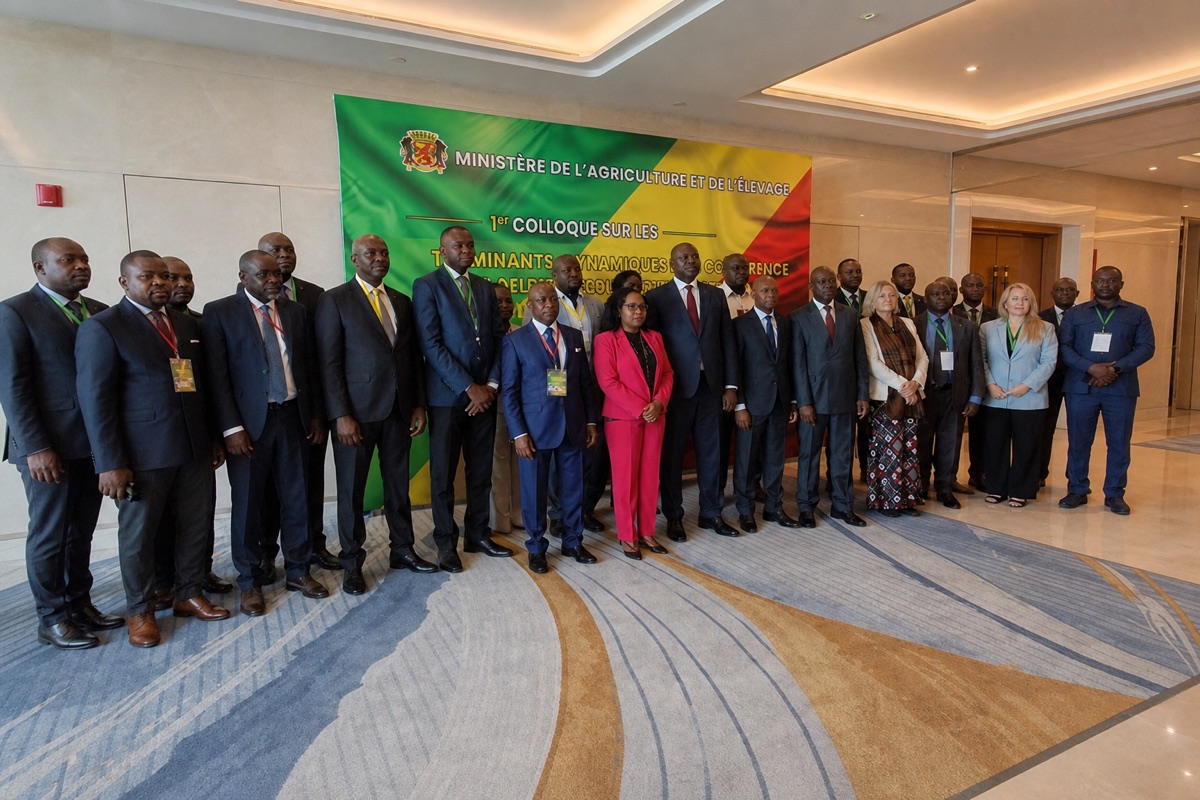
For the first time, the Republic of Congo turned a spotlight squarely on rising prices. The Ministry of Agriculture and Livestock convened officials, bankers and scholars in Brazzaville to dissect what actually drives inflation across the country, and how households end up paying the bill.
A First-of-Its-Kind Gathering on Rising Prices
The inaugural forum unfolded on Tuesday, 12 May 2026, at the Hilton Twin Towers hotel in Brazzaville. It was organised by the Ministry of Agriculture and Livestock alongside partner institutions, marking the country’s first dedicated debate on the subject (Les Échos Congo Brazzaville).
The room reflected the breadth of the issue. Ministry staff sat beside finance and trade officials, BEAC analysts, business leaders, academics, researchers, students and agricultural professionals. The mix signalled an attempt to treat inflation as a shared national concern rather than a purely technical matter.
Opening and closing ceremonies were chaired by Agriculture Minister Professor Valentin Ngobo. He was joined by BEAC Deputy Governor Michel Dzombala and Customs Director-General Guénolé Mbongo Koumou, a line-up that placed monetary, fiscal and trade authorities at the same table.
Three Lenses on a Stubborn Problem
Rather than chasing a single culprit, organisers split the discussion into three thematic blocks. The structure aimed to move the conversation from broad theory toward concrete, market-level realities that ordinary buyers recognise.
The first block examined the macroeconomic backdrop and the global forces feeding price pressure. The second looked at how those pressures travel through supply chains and markets. The third turned to sector-by-sector analysis, paired with competitive solutions meant to ease costs for consumers.
That progression matters. It allowed participants to connect distant shocks to the price of a basket of goods, tracing the path from international conditions down to the stalls and shops where Congolese families actually feel the difference.
Numbers That Tell a Calmer Story
The data presented offered a measure of relief. Inflation averaged 2.7% year-on-year at the close of 2025, a sharp retreat from the punishing peaks recorded in 2023, when the rate reached 24.89% (Les Échos Congo Brazzaville).
December 2025 specifically registered inflation of 2.07%. That figure sits just below the 3.0% convergence benchmark set by the Central African Economic and Monetary Community (CEMAC), suggesting the country has, for now, pulled price growth back within a more manageable range.
Still, the tone was not triumphant. A single calm month does not erase the memory of double-digit pressure, and the very existence of the forum hinted that authorities want durable answers rather than a temporary dip in the charts.
What the Minister Wants Next
Minister Ngobo used the platform to argue for targeted action. He pressed for tax exemptions on essential goods, a measure intended to shield the most basic items in the household budget from added cost.
He also called for stronger coordination across ministries. The point was practical: agriculture, finance, trade and customs each shape prices in different ways, and pulling those levers in isolation tends to blunt their combined effect on everyday spending.
That emphasis on joined-up government fits the makeup of the event itself. With the central bank, customs and several ministries represented, the forum looked less like a seminar and more like a first attempt to align the institutions whose decisions land on receipts.
Why This Matters for Households and Businesses
For families across Brazzaville, Pointe-Noire and the departments, the stakes are concrete. Inflation decides whether a salary stretches to the end of the month, and whether staple foods stay within reach for those on tighter incomes.
Small businesses watch the same figures with equal attention. Stable prices make planning possible, from setting margins to deciding whether to hire. Volatile costs, by contrast, push owners toward caution and can quietly slow local commerce.
The agricultural angle is telling. By placing the Ministry of Agriculture at the centre, the forum acknowledged that food prices weigh heavily in the inflation story, and that boosting domestic production could be one route toward steadier shelves.
A Conversation Meant to Continue
Billing the event as a first edition carries an implicit promise of more to come. The deeper value may lie less in a single set of conclusions than in establishing a recurring space where evidence shapes policy.
For a country emerging from a recent inflation shock, that habit could prove useful. If the dialogue holds, the gathering at the Hilton Twin Towers may be remembered as the moment Congo-Brazzaville began treating price stability as a long-term project rather than a passing alarm.