
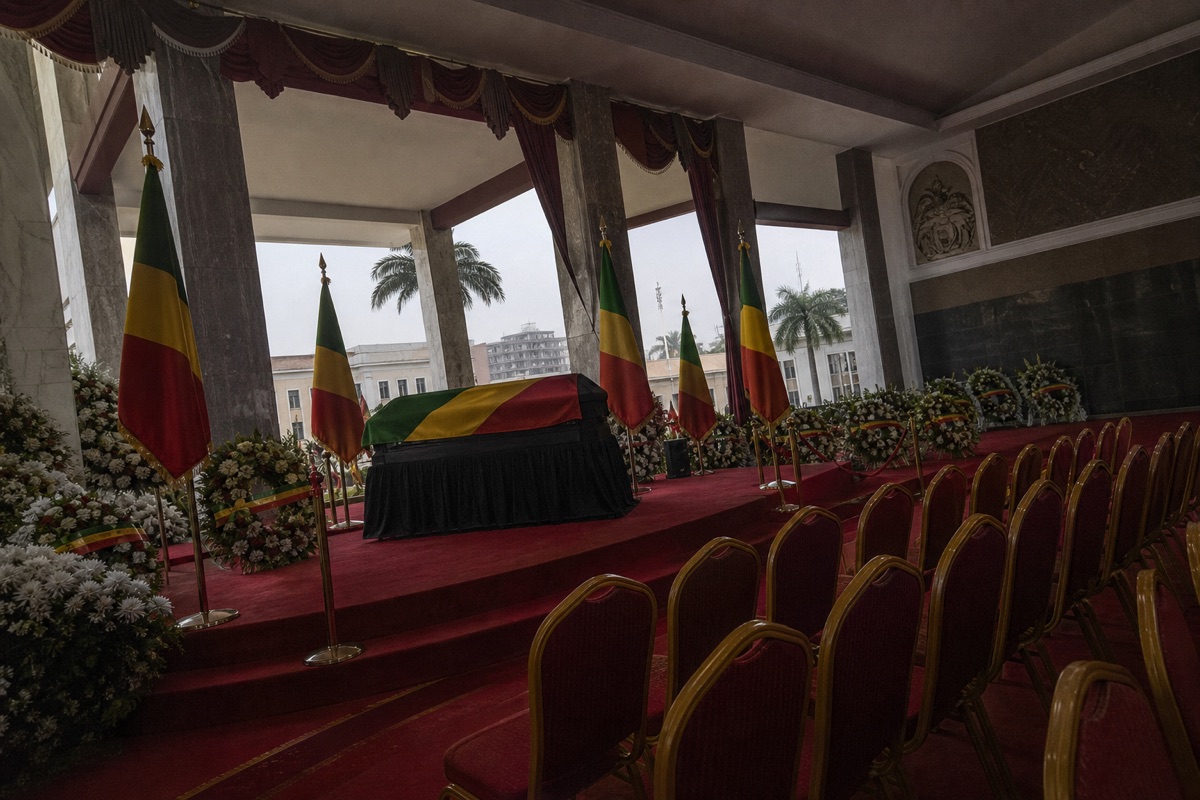
A National Farewell in Brazzaville
The Congolese Party of Labour gathered in Brazzaville on 11 April to honour one of its own. Jean Jacques Mouanda, prefect of the Plateaux department and a member of the party’s Central Committee, had died on 5 April. He was 69 years old.
The ceremony drew the highest levels of the state. President Denis Sassou N’Guesso attended in person, a gesture that signalled how closely the late official had been tied to the ruling party’s machinery across decades of public service in Congo-Brazzaville.
A Career Rooted in Local Service
Mouanda was born on 4 November 1957 in Dolisie, in the country’s south. He carried the marks of a generation that combined party loyalty with administrative ambition, moving steadily from regional assemblies toward the demanding role of departmental prefect.
His path led him abroad for higher studies. At Jean-Moulin Lyon 3 University in France, he earned certifications in francophone studies and in decentralisation, a field that would shape much of his later work managing local affairs back home.
The record of his offices reads like a map of Congolese governance. He served as president of the Niari departmental council between 2008 and 2017, anchoring his early reputation in the region surrounding his birthplace and its everyday administrative concerns.
He then won election as deputy for Kimongo, holding the seat from 2017 to 2022. From the legislature he moved into prefectural duties, first in the northern Likouala department before his appointment to lead the Plateaux, where he would spend his final posting.
Remembered as a Builder of Cohesion
Tributes from within the party framed his legacy in human terms. Michel Mahinga, a PCT official, described Mouanda as “an actor of social cohesion and local development,” words that captured the quieter administrative labour behind a long career.
That description was not merely ceremonial. Colleagues pointed to a man who had spent years translating policy into the practical business of running departments, balancing party expectations with the needs of communities far from the capital’s corridors.
His commitment extended beyond official titles. He founded the Bana Dol association, a personal initiative that tied him to his Dolisie roots and reflected the kind of grassroots engagement that the party chose to emphasise in its farewell.
The state had recognised his contribution during his lifetime. He received the Order of Merit in 1999 and, a decade later, the Order of Peace in 2009, distinctions that marked successive phases of a steady public ascent.
Mourning Across Two Cities
The geography of his passing carried its own weight. Mouanda died in Djambala, the administrative seat of the Plateaux department he was governing, a detail that placed his final days within the territory he had been charged to serve.
Yet his return was to the south. His funeral was held on 13 April in Dolisie, the city where his story began nearly seven decades earlier. The arc of his life thus closed where it had opened, in the Niari region he knew best.
Between the Brazzaville tribute and the Dolisie burial, the days following his death traced a deliberate national choreography. The party honoured him at the centre of power, then accompanied him home, joining institutional respect with a more intimate, local farewell.
A Generation of Officials in Focus
Mouanda’s career offers a window into how the PCT has long cultivated its administrators. Loyalty, regional roots and technical training abroad combined in a single profile, producing officials who could move between elected mandates and appointed posts with little friction.
His trajectory also underlines the importance of the departments in Congolese political life. From Niari to Likouala and finally the Plateaux, his assignments reflected a system that rotates trusted figures through the country’s far-flung administrative units.
For residents of the Plateaux, the loss is more immediate. A prefect is the visible face of the state in daily matters, and the sudden absence of a sitting departmental head leaves a practical gap that the central authorities will need to fill in the coming period.
The presidential presence at the Brazzaville ceremony suggested that gap will not go unmanaged. By appearing alongside party leaders, Sassou N’Guesso underscored both personal regard and the institutional continuity that the PCT has worked to maintain through such transitions.
In the end, the homage paid to Jean Jacques Mouanda spoke to more than one man’s record. It illustrated how a long-serving cadre is remembered in Congo-Brazzaville, where party, state and region converge around the figures who hold the machinery of local government together.