
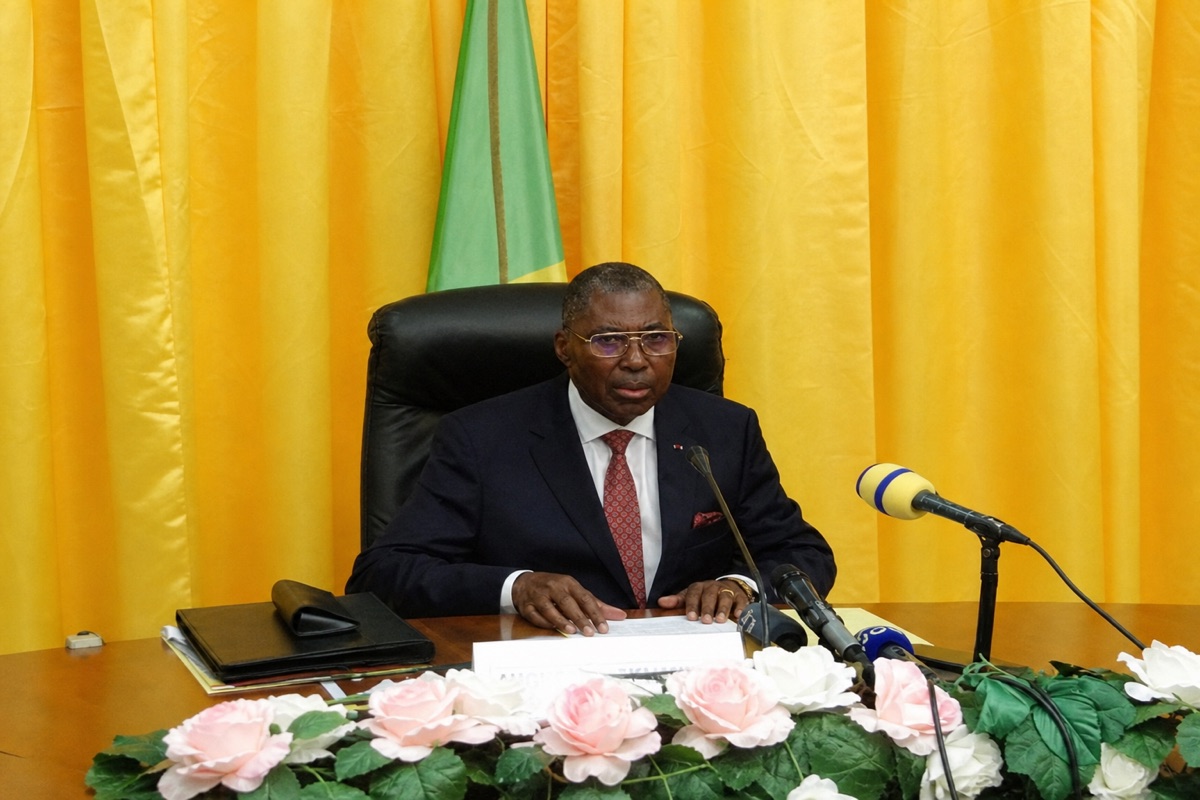
As Congo-Brazzaville moves toward its presidential election, the country’s highest court has spent two days preparing the people who will watch over the ballot. The exercise, held in Brazzaville, closed on March 6, 2026.
A two-day forum to sharpen the eyes of the vote
The Constitutional Court organised a training forum dedicated to the regularity of the presidential election. Over two days, coordinators and delegates gathered in the capital to learn how the institution intends to monitor the process.
The sessions ended on March 6, 2026, ahead of the two voting rounds scheduled for March 12 and 15. The timing left little margin: observers would soon be deployed across the national territory.
Auguste Iloki sets the tone for credibility
Auguste Iloki, president of the Constitutional Court, opened and closed the gathering with a clear message. He described the forum as “a true platform for the exchange of experiences,” meant to strengthen the capacities of those tasked with observation.
His words carried weight. In an election year, the court’s posture is closely read, and Iloki appeared keen to frame the mission around discipline rather than display. The training, in his account, was less ceremony than preparation.
What the observers actually studied
The programme was deliberately practical. It covered the legal foundation of the observation mission, explaining the texts that give observers their mandate and define the limits of their role inside polling stations.
Participants also examined the specific responsibilities attached to each function. Coordinators learned how their supervisory role differs from the field tasks expected of delegates, a distinction meant to avoid confusion on voting day.
A simulation of electoral observation rounded out the agenda. Rather than relying on theory alone, the court walked its teams through a rehearsal of what they might encounter, turning legal principles into concrete gestures and checks.
Integrity, impartiality and rigour
Iloki returned repeatedly to a single demand. He urged the observers to act with “integrity, impartiality and rigour in the accomplishment of their missions,” presenting those qualities as the backbone of any credible result.
He insisted on strict respect for constitutional principles and the legal provisions that frame the electoral process. The aim, he said, was to “guarantee the reliability and credibility of the vote,” a standard the court has placed at the centre of its role.
This emphasis matters in a tense political season. By tying observation to legality and restraint, the court signalled that its representatives are expected to record what they see, not to shape it. Their authority rests on neutrality.
Fifteen coordinators, a hundred delegates
The numbers give a sense of the operation’s scale. The Constitutional Court announced it would deploy fifteen coordinators and roughly one hundred delegates across polling stations throughout the country.
That network is designed to reach beyond Brazzaville and into the departments, where logistics can complicate any nationwide effort. Spreading coordinators and delegates widely is the court’s way of keeping eyes on the ballot far from the capital.
The architecture is straightforward. Coordinators supervise, delegates observe on the ground, and both report within the framework set during the forum. The chain is meant to be clear enough to function under the pressure of election days.
Why the training resonates with voters
For the broad public, the forum is more than an administrative step. It speaks to a recurring concern in any vote: the assurance that someone independent is watching, and that the rules will be applied the same way everywhere.
The presidential election unfolds in two stages, on March 12 and 15. Between those dates, the court’s observers are expected to be present, applying the methods rehearsed in Brazzaville and feeding their findings back through the structure they were trained to use.
Families, young voters, commuters and local institutions all have a stake in the outcome. The court’s message, repeated through Iloki, was that credibility is not assumed but built, observation by observation, station by station.
A measured note before the ballot
What emerges from the forum is a portrait of an institution trying to project seriousness. The vocabulary stayed sober: capacities, regularity, reliability. There were no grand promises, only the insistence that procedure be followed.
Whether the deployment meets those expectations will be judged after March 12 and 15. For now, the Constitutional Court has done what it set out to do this week, equipping its coordinators and delegates and sending them toward the polling stations of Congo-Brazzaville (Les Echos Congo Brazzaville).