
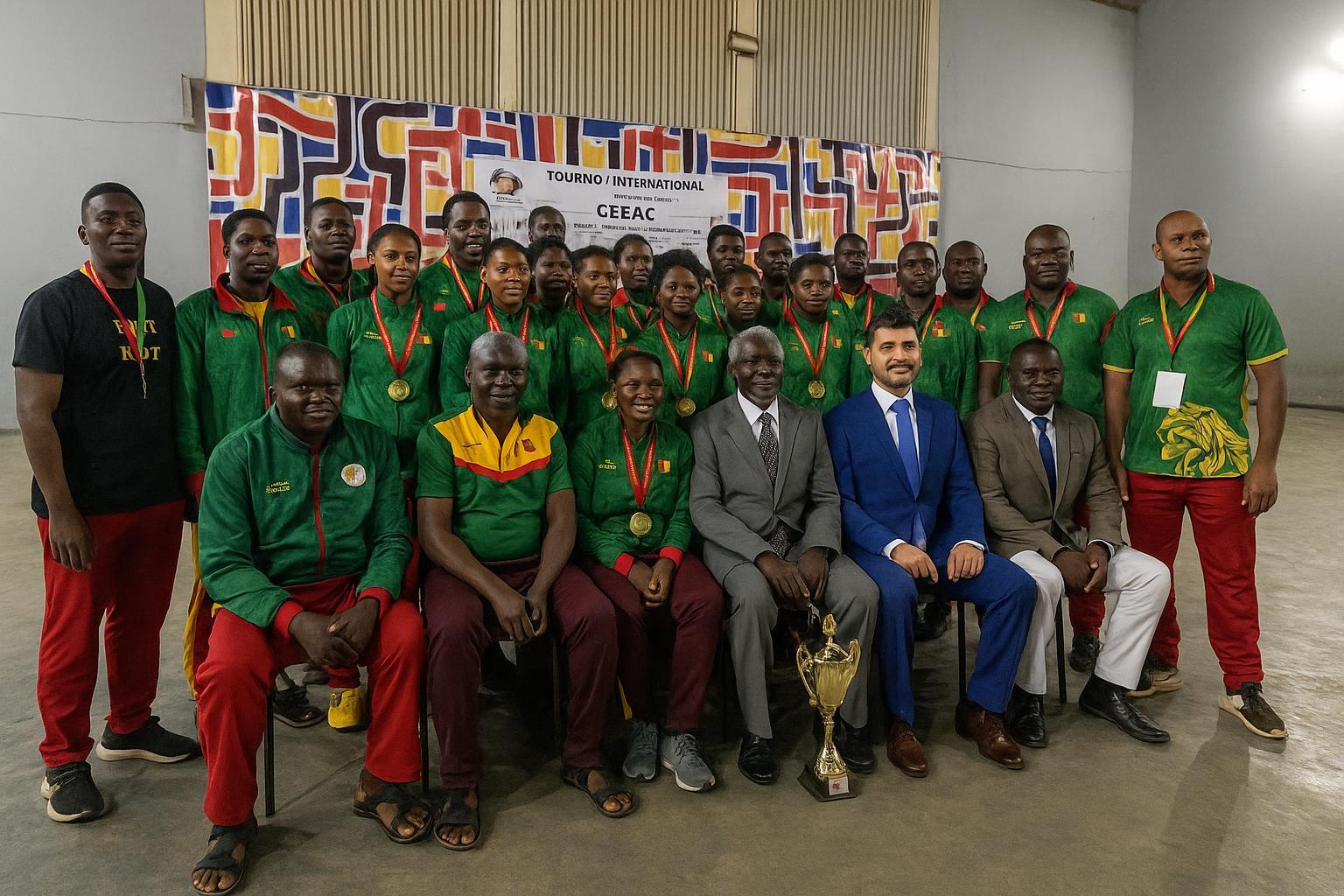
Cameroon’s clean sweep electrifies Yaoundé
Cameroon’s red-hot sambo squad turned the Yaoundé Multi-Sports Gymnasium into a medal factory on 27 September, grabbing twelve golds, two silvers and two bronzes during the second CEEAC Open. The one-day tournament drew eight Central and West African delegations and loud, flag-waving crowds.
Host federation president François Mbassi praised the “continental spirit” displayed on the mats, noting that many bouts were decided in the final seconds. “This Open is now a fixture for the sub-region,” he said, promising a bigger showpiece before the 2025 world championships.
Behind Cameroon, the Democratic Republic of Congo collected two golds, five silvers and one bronze, while Niger’s nimble contingent clinched two golds, one silver and two bronzes to complete the podium. Equatorial Guinea, Guinea, Central African Republic, Burkina Faso and Morocco shared the remaining medals.
Congo absent but not defeated
The notable absentee was the Republic of Congo delegation. Despite months of sparring at Brazzaville’s Martial Arts Academy, athletes were informed a few days before departure that travel support had not been finalised. Bags were unpacked, leaving disappointment in training halls and on social media timelines.
Team captain Rachel Mabiala said the late cancellation hurt, but she remained diplomatic. “Our federation and the sports ministry are working on sustainable funding so we can honour the next call-up,” she told our Pointe-Noire bureau by phone, adding that the squad continues daily conditioning sessions.
Government sport advisers contacted in Brazzaville confirmed that emergency allocations are being discussed for upcoming fixtures, including the African Championships slated for early 2024. They pointed to post-pandemic budget shifts and higher airfares as factors, but insisted a roadmap for international exposure is being finalised.
Several Brazzaville-based businesses, including a telecom operator and a brewing company, have informally signalled interest in athlete sponsorship once a transparent oversight mechanism is set. Marketing executives believe sambo’s dynamic throws and short match times translate well to social-media clips that engage younger audiences.
Cameroon’s secret sauce
The lion’s share of Cameroon’s medals came in the heavier divisions, capped by Franck Ngananga’s explosive gold in the men’s over-100-kilogram clash. Ngananga credited “group solidarity” for his perfect run, saying that teammates analysed each opponent’s grip-fighting pattern during warm-ups to save crucial seconds later.
Head coach Seidou Njimouluh viewed the Open as a stress test before November’s World Combat Games in Riyadh, where sambo will feature as a discipline. “The rhythm here was intense, but worlds will be double,” he said, outlining altitude camps in the West Region for final tuning.
Local spectators packed the 3,000-seat arena from early morning, waving green-red-yellow flags and using vuvuzelas between contests. Vendors selling koki pies and ginger juice reported brisk trade. Sambo, originally developed in the Soviet Union, is gaining traction in Cameroon’s school sports leagues, according to the national federation.
Countdown to Bishkek 2025
The International Sambo Federation has confirmed that the 2025 world championships will unfold from 7 to 9 November in Bishkek, Kyrgyzstan. Men’s and women’s sport sambo, combat sambo and events for visually impaired athletes are on the programme, reflecting the discipline’s push for Paralympic recognition.
Africa Centrum Foundation, led by Congo’s honorary consul in Saint Petersburg Jocelyn Patrick Mandzela, remains a media partner of the worlds. The body previously co-financed a high-performance camp in Armavir, Russia, where Congolese athletes sparred alongside Russian and Mongolian teams, sharpening throws such as the fireman’s carry.
Officials in Brazzaville say talks are underway with the foundation and private airlines to bundle flight and accommodation packages for the Kyrgyz capital. They argue that predictable planning will spare athletes the heartbreak experienced this month and allow coaches to map weight cuts with precision.
Kyrgyz organisers, meanwhile, have unveiled a modern arena with a capacity of 10,000, upgraded dormitories and English-speaking volunteer staff. They aim to showcase nomadic culture during opening ceremonies, which could offer African delegations a memorable cross-cultural experience and opportunities for bilateral sports diplomacy.
Beyond medals: regional momentum
Sambo’s inclusion in the African Games short list has energised Central African federations. CEEAC secretary-general Ahmad Allam-Mi, attending the Open, hinted that a zonal league could launch in 2024 to guarantee regular bouts. Such circuit would complement existing judo and wrestling calendars already popular in Brazzaville.
Sports economists note that televised sambo nights could also spur local manufacturing of mats and jackets, creating jobs while reducing import bills. Cameroon’s public broadcaster streamed the Open on its digital platform, reaching viewers as far as Libreville. Negotiations are ongoing for a highlights package on Congolese channels.
For now, Cameroon basks in a well-earned triumph, but eyes across the region remain fixed on how Congo will rebound. With supportive partnerships, athlete grit and prudent budgeting, Brazzaville’s sambokas still have a path to Bishkek glory, turning this brief setback into a powerful comeback story.