
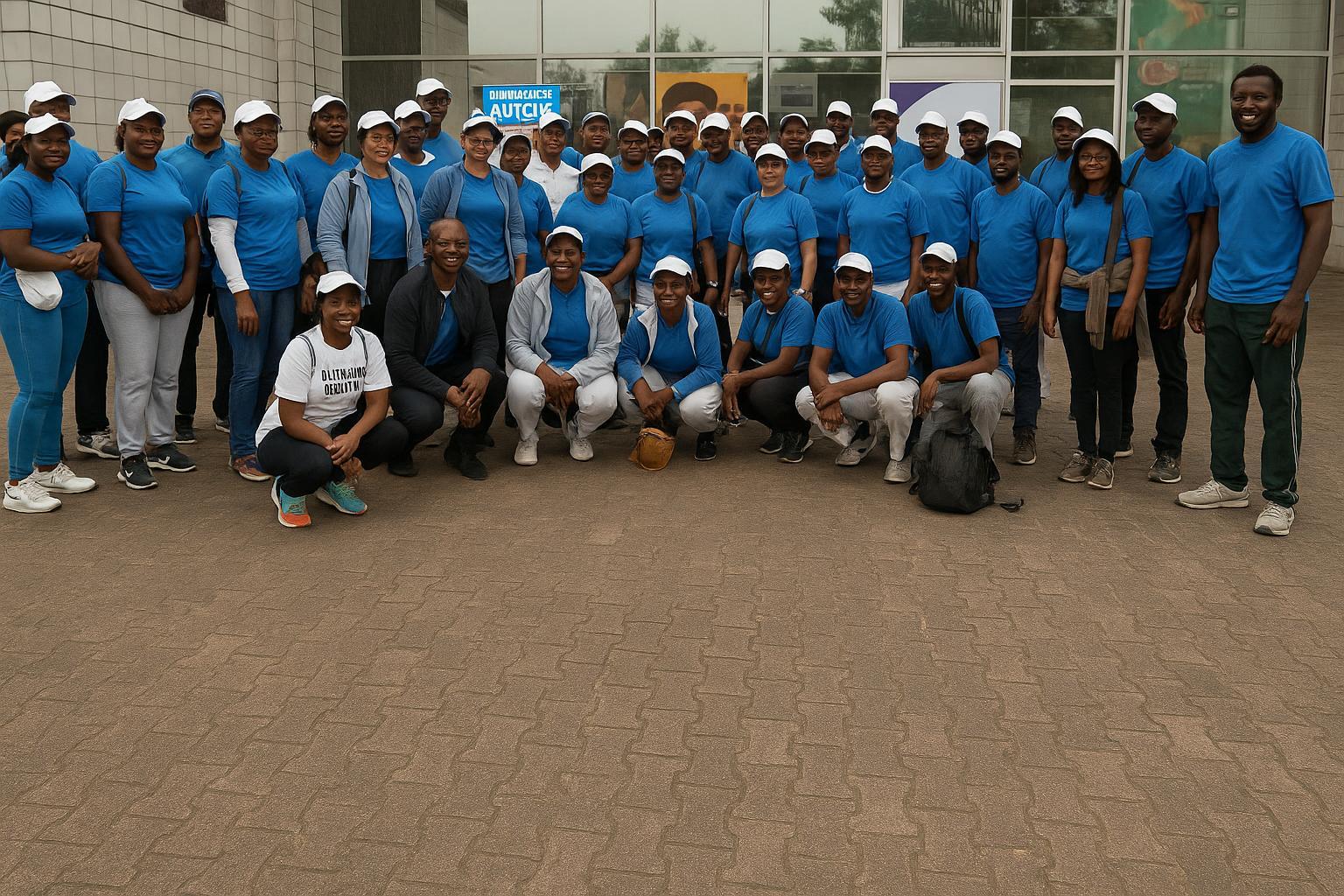
A river of blue on Republic Square
Brazzaville awoke to a striking sea of blue shirts on the morning of 21 September 2025. Almost fifty walkers, banners aloft, set off from the iconic Place de la République, urging commuters to notice and understand autism rather than whisper about it.
Cedestone Association, founded and chaired by paediatric nurse Cedella Madina Tathy, coordinated the rally. Her team chose a Sunday route that threaded main arteries of the capital, catching churchgoers, market shoppers and taxi drivers in real time. The colour blue rippled from bus windows to roadside kiosks.
Stopping traffic and silence
The compact procession paused purposely in front of Cedestone’s own clinic on Avenue de l’OUA. Participants raised placards reading “I’m not weird, I’m autistic”, a message designed to replace decades of harmful labels such as “sorcerer” or “yéza”.
Drivers slowed, some honked in support, others stepped out to film. For a few minutes the usual engine roar yielded to conversation about neuro-diversity, a word still foreign to many here but increasingly used by educators and psychologists.
Warm welcome at the Savorgnan de Brazza Memorial
The march concluded at the leafy esplanade of the Pierre Savorgnan de Brazza Memorial. Director Bélinda Ayessa greeted the walkers. “These children are not strangers,” she told the crowd. “They deserve the same dignity and respect as all citizens of Congo.”
Her choice of the word dignity resonated. Several parents dabbed away tears while teenagers on the spectrum clapped shyly, enjoying a moment of civic visibility rarely afforded to them outside family circles.
Parents break their own chains of stigma
Angela Kindou, Cedestone treasurer and mother of nine-year-old Loïc, spoke plainly. “We kept quiet for too long. Today we walk so our neighbours stop fearing our children,” she said, microphone in hand. Some listeners nodded, recognising their own previous discomfort.
Kindou described relatives who once blamed witchcraft for Loïc’s repetitive hand-flapping. “Education is the treatment for ignorance,” she concluded, earning applause that echoed off the marble walls of the memorial.
Autism facts that seldom reach the classroom
Autism spectrum disorder appears in early childhood, affecting communication, sensory processing and behaviour patterns. While international research estimates roughly one in 100 children may be autistic, Congolese health professionals caution that local data remain scarce because formal screening is limited to a handful of urban clinics.
Paediatrician Dr Georges Okemba, who joined the walk, explained that delayed diagnosis can lead to school exclusion. “When teachers misinterpret silence or repetitive movement as defiance, children are sent home,” he noted. “Early intervention turns that story around.”
Government support gaining momentum
Officials from the Ministry of Social Affairs quietly observed Sunday’s event. One adviser, requesting anonymity to keep the focus on families, said the ministry is finalising guidelines for inclusive schooling, citing the government’s broader strategy on disability launched last year.
Cedella Madina Tathy views the dialogue as promising. “We appreciate that authorities listen. Our role is to bring evidence from the field and suggest realistic steps,” she told reporters, highlighting Cedestone’s ongoing workshops for public-school teachers.
From awareness to actionable services
Beyond the symbolic walk, Cedestone operates a small diagnostic unit offering speech therapy, occupational therapy and parental coaching. Demand has doubled in twelve months, according to clinic data shared during the rally.
The association hopes to open satellite rooms in Pointe-Noire and Dolisie in 2026. Funding will depend on donations and potential partnerships with local councils eager to improve social indicators aligned with the Sustainable Development Goals.
Global ribbons, local realities
Blue lighting often colours world landmarks on 2 April, the United Nations’ recognised World Autism Awareness Day. In Congo, the date features modest school talks and radio debates. Sunday’s street march adds a tangible layer: neighbours witnessing families walking proudly together.
Sociologist Carine Mayoua argues such embodied activism challenges deep-seated beliefs faster than brochures. “Seeing a father wearing a T-shirt that names autism rewrites social scripts,” she said in an interview beside the marching line.
Media’s growing role in inclusive storytelling
Traditional outlets once reported disability mainly through charity angles. Today, several Congolese radio stations invite autistic youths to co-host segments. Television drama ‘Nos Voix’ recently introduced an autistic teenager character, scripted with guidance from Cedestone advisors.
Digital platforms amplified Sunday’s event. Hashtags #MarcheBleue and #NeurodiversitéCongo trended locally for hours, suggesting a shift in online engagement among urban millennials, an audience critical for sustained advocacy.
Next steps on the blue path
Cedella Madina Tathy outlined a three-point roadmap: broaden teacher training, lobby for insurance coverage of therapies and encourage municipalities to create sensory-friendly playgrounds. She pledged to return to Place de la République every September until those goals materialise.
Participants dispersed at noon, folding banners yet keeping conversation alive on crowded buses. In their wake lingered chalk arrows on the asphalt, still blue, still pointing forward, reminding Brazzaville that awareness is a journey, not a single march.