
Media watchdog adopts new rulebook
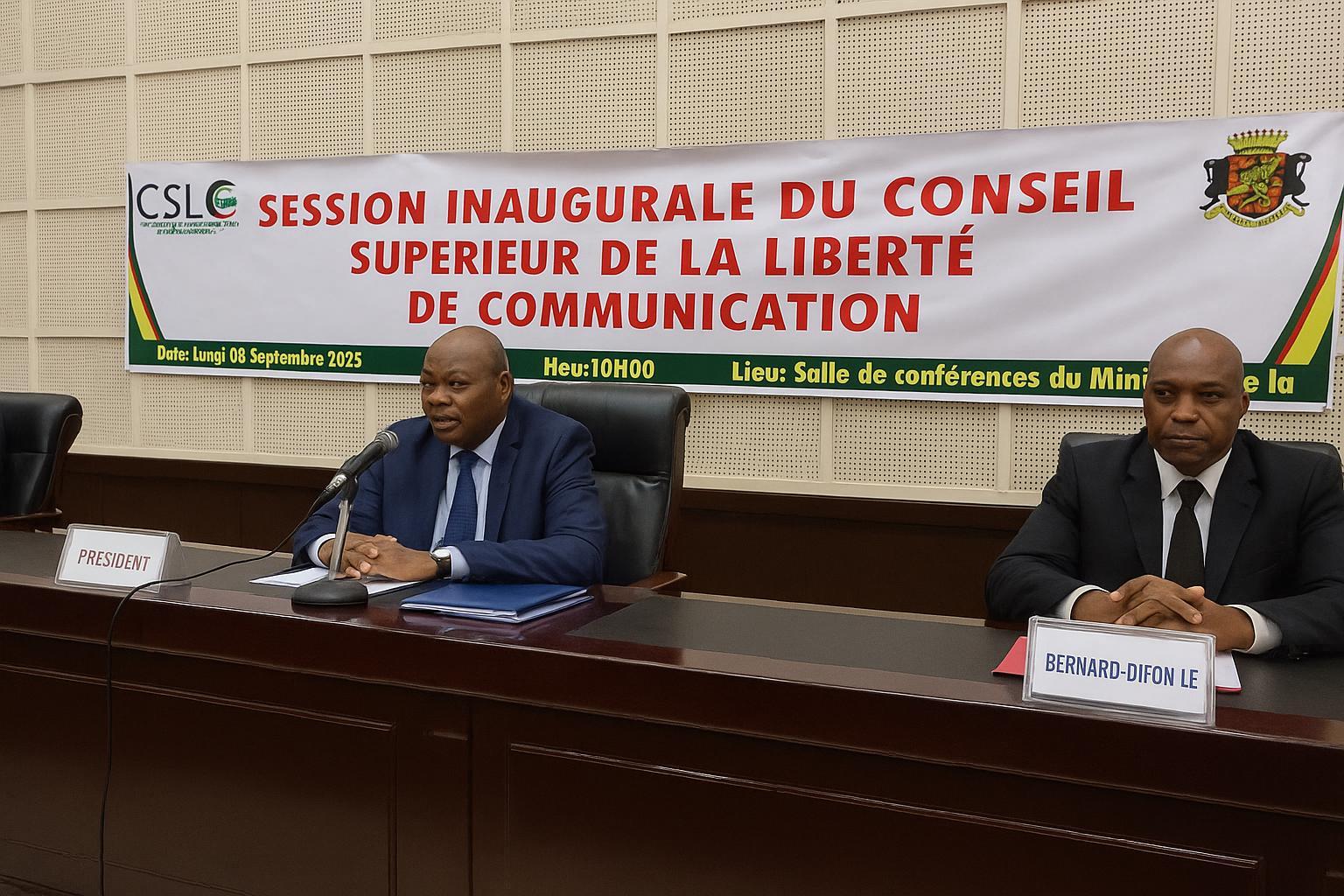
Brazzaville – The Higher Council for Freedom of Communication (CSLC) has officially refreshed its internal and financial rules, along with a detailed procedures manual, aiming to reinforce the institution’s credibility and transparency.
The amendments were adopted during the body’s inaugural session since its renewal, marking what chair Médard Milandou called “a proactive consensus born of open debate” as members aligned the texts with new national legislation.
Beyond formalities, the overhaul defines missions and clarifies day-to-day operating mechanisms, giving each CSLC department a clearer chain of responsibility for monitoring print, audiovisual and now online media.
Digital era puts law to the test
Speaking to reporters after the vote, Mr. Milandou stressed that the rise of digital platforms requires “both legal and technical imagination” so that Congolese law remains relevant when Facebook, WhatsApp or independent websites break news faster than traditional outlets.
He acknowledged that the 2001 communication law predates social media, leaving regulators with limited leverage over formats such as live-streamed rallies or user-generated election slogans. Updating the manual therefore bridges a two-decade gap.
CSLC jurists will now map online content categories and propose practical thresholds for accreditation, storage of archives and right of reply, tools that Mr. Milandou believes will ‘guide rather than muzzle’ digital creators.
At the same time, the council plans simulations of breaking news scenarios to test its alert system, ensuring quick, balanced statements reach users before misinformation takes root in the heat of campaigns.
Election coverage under scrutiny
Election periods place any media regulator under the spotlight, and next year’s presidential campaign will be no exception, the chairman cautioned.
Regulating broadcast time, candidate advertising and fact-checking promises is familiar territory, yet policing algorithm-driven micro-messages shared via smartphones represents a fresh test for the CSLC.
Mr. Milandou confirmed that his team will draft special guidelines for the campaign, drawing on precedents from other francophone regulators while adapting them to local languages and bandwidth realities.
The objective, he said, is to guarantee pluralistic coverage without slowing the viral energy that characterises contemporary political conversation, keeping the playing field level for all contenders and their supporters.
Building a culture of dialogue
Before the electoral sprint begins, the council will organise a workshop with editors and reporters to revisit ethics, conflict-of-interest rules and the obligation to correct errors promptly, a pledge renewed at each new CSLC mandate.
Milandou wants that meeting to feel “less like a summons, more like a partnership,” he told participants, because constructive dialogue secures voluntary compliance better than punitive suspensions that can alienate audiences.
Editors from Brazzaville and Pointe-Noire are expected to outline day-to-day challenges such as verifying citizen footage from remote districts or moderating comment sections without silencing legitimate dissent.
The council’s renewed rules anticipate such issues by detailing how outlets can request advisory opinions or rapid mediation in cases where coverage attracts controversy.
Modernising a 2001 legal framework
When parliament adopted the 2001 freedom of communication act, dial-up internet was still a novelty; today, three-quarter of Congolese youths browse news on handheld devices, a gulf the updated manual now seeks to close.
Legal experts inside the CSLC say the revision does not seek to reinvent the law; instead, it codifies processes so that future jurisprudence remains coherent as parliament may later amend overarching statutes.
Milandou believes that transparent procedures also protect journalists by offering a roadmap for appeal, ensuring sanctions are proportionate and documented, thereby discouraging arbitrary pressures on newsrooms.
For the public, the ultimate measure of success will be whether citizens can access reliable information during milestones such as elections, natural disasters or economic reforms, moments when trust in media and regulators is most essential.
Financial transparency at stake
Another important chapter of the revised corpus deals with budgets, procurement and audit trails, topics often invisible to viewers yet decisive for public trust. The financial rules now describe how tenders are published and how quarterly accounts are certified.
An internal memo seen during the session highlights thresholds above which expenses must receive board clearance, a safeguard designed to prevent any perception of undue influence from media operators or political sponsors.
By bringing money matters into the open, the council aligns itself with best practices promoted by continental associations of media regulators, another sign that credibility is pursued as much through governance as through content oversight.
Regional cooperation gains importance
Throughout the debate, members referenced experiences shared within the Network of Francophone Media Regulators and the African Communication Regulators Forum, stressing that the digital challenge transcends borders and that joint benchmarks can accelerate national solutions.
The CSLC hopes to host a follow-up seminar in Brazzaville later this year, inviting peers to dissect case studies on campaign coverage and platform moderation, an initiative that could position Congo-Brazzaville as a thought-leader in the sub-region.
As the updated texts enter force next week, all eyes will watch their first applications in newsrooms across the nation.