
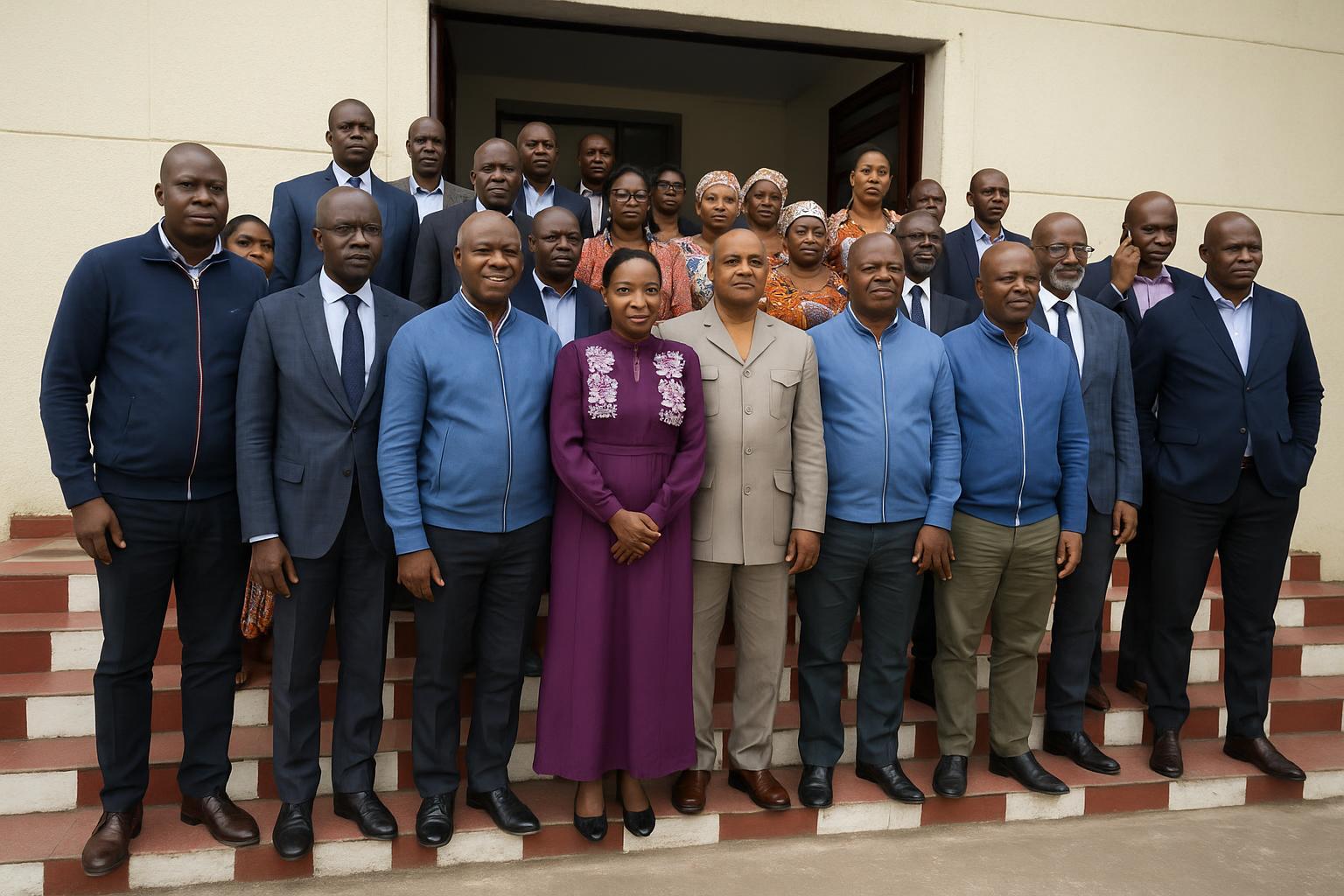
Committee session reviews six-month performance
On 13 November 2025 the management committee of Bacongo Referral Hospital gathered in the stately marriage hall of Bacongo city hall. Thirty members, led by arrondissement administrator-mayor Bernard Batantou and hospital director Dr Tanguy Fouémina, examined activity figures for the first half of 2025 with cautious optimism.
Speakers from the Departmental Health Directorate, the Bacongo health district and the World Health Organization’s Congo office stressed that patient welfare and better working conditions must guide every decision. The committee then praised the leadership team for, as one delegate said, “doing much with limited means.”
After the applause, Dr Fouémina presented hard numbers: 10,916 outpatient consultations, 5,467 hospitalisations with an admission rate of 50.08 percent, and 40 deaths. Maternity services recorded 1,080 deliveries, including 282 caesareans, while laboratories handled 29,800 tests and imaging units completed 3,671 scans and echographies.
New tariff grid improves access and transparency
A highlight of the meeting was the unanimous adoption of a new tariff grid. Contrary to public fears, no existing service price will rise. Instead, the grid adds several specialised procedures and creates a dedicated lane for insured patients, streamlining billing without burdening families.
Members nevertheless asked that the hospital’s social service review each case of hardship so that the most vulnerable continue to access care. “The principle remains solidarity,” said committee rapporteur Angélique Tsiolo, arguing that the grid only works if exemptions are actively offered to the indigent.
Hospital administrators believe the update will also curb informal payments by spelling out exact costs. Transparency, they note, reassures both staff and patients, limits disputes at cashier windows and encourages insurers to settle invoices promptly, bringing much-needed liquidity to the facility.
Outside observers such as WHO official Dr Nadine Ngouabi point out that Bacongo’s model could inspire other municipal hospitals. “Publishing fees and benefits is a first step toward universal health coverage,” she said, adding that the Congolese government’s hospital reform agenda already stresses similar transparency.
Patient charter deepens trust in care quality
A second milestone was the endorsement of a patient charter detailing rights and responsibilities. Beyond standard issues such as confidentiality, the document promises respectful treatment regardless of social status and sets reasonable waiting-time targets in every department, from emergency admission to specialised consultations.
The charter also calls on patients to attend appointments on time, follow medical advice and participate in infection-control measures. “Quality care is a partnership,” emphasised Dr Fouémina, who plans to display the text in waiting rooms and distribute pocket versions during community outreach campaigns.
Legal experts consulted by the committee say a clear charter can reduce litigation by clarifying expectations before disputes arise. In addition, the Ministry of Public Health has encouraged facilities to harmonise patient information tools nationwide, making Bacongo’s charter a potential template for future policy.
Financial stewardship and staff engagement
Despite limited subsidies, the hospital’s finances held steady. Revenue reached 193.5 million CFA francs against expenditures of 195.2 million. A rollover surplus from 2024 left the books slightly positive, closing the semester with a comfortable 514,269 franc buffer.
Administrators attribute the balance to rigorous cost control, increased laboratory throughput and careful procurement. The installation of a new economic and financial service chief during the period introduced real-time dashboards that track spending lines daily, allowing department heads to adjust orders before overruns accumulate.
On the human-resources side, Bacongo employs 295 civil servants, 55 contract workers and 141 trainees. The committee approved loyalty contracts for key staff, a measure designed to curb absenteeism and other “anti-values” that can erode morale and inflate overtime costs.
Mayor Batantou endorsed the initiative, noting that a motivated workforce directly influences clinical outcomes. “When personnel feel valued, the community benefits,” he remarked, inviting trade-union representatives to monitor the scheme and report quarterly on staff satisfaction indicators such as turnover, punctuality and patient feedback.
Infrastructure upgrades and community outlook
Infrastructure also featured prominently. Construction crews continue refitting the obstetric block to ensure safer deliveries and reduce referrals. Meanwhile, a new partnership with the firm Globaline will overhaul the hospital’s ageing water network, boosting hygiene and reducing downtime caused by inconsistent pressure.
Elsewhere, the medical-technical commission has been revitalised, giving specialists from surgery to radiology a formal platform to vet equipment purchases and update protocols. Early results include a cost-effective eye-screening campaign that examined 618 residents, detecting 30 cataracts and multiple glaucoma cases.
Looking ahead, the committee instructed management to study solar energy options, expand free screening days and strengthen ties with neighbourhood social services to expedite referrals for the destitute. A follow-up session in May 2026 will measure progress against the newly adopted benchmarks.
Residents leaving the hall expressed confidence that the measures would make Bacongo Referral Hospital a flagship for the capital’s south. For paediatric nurse Carine Mabiala, “patients will see changes immediately, from clearer bills to shorter queues and friendlier corridors.”