
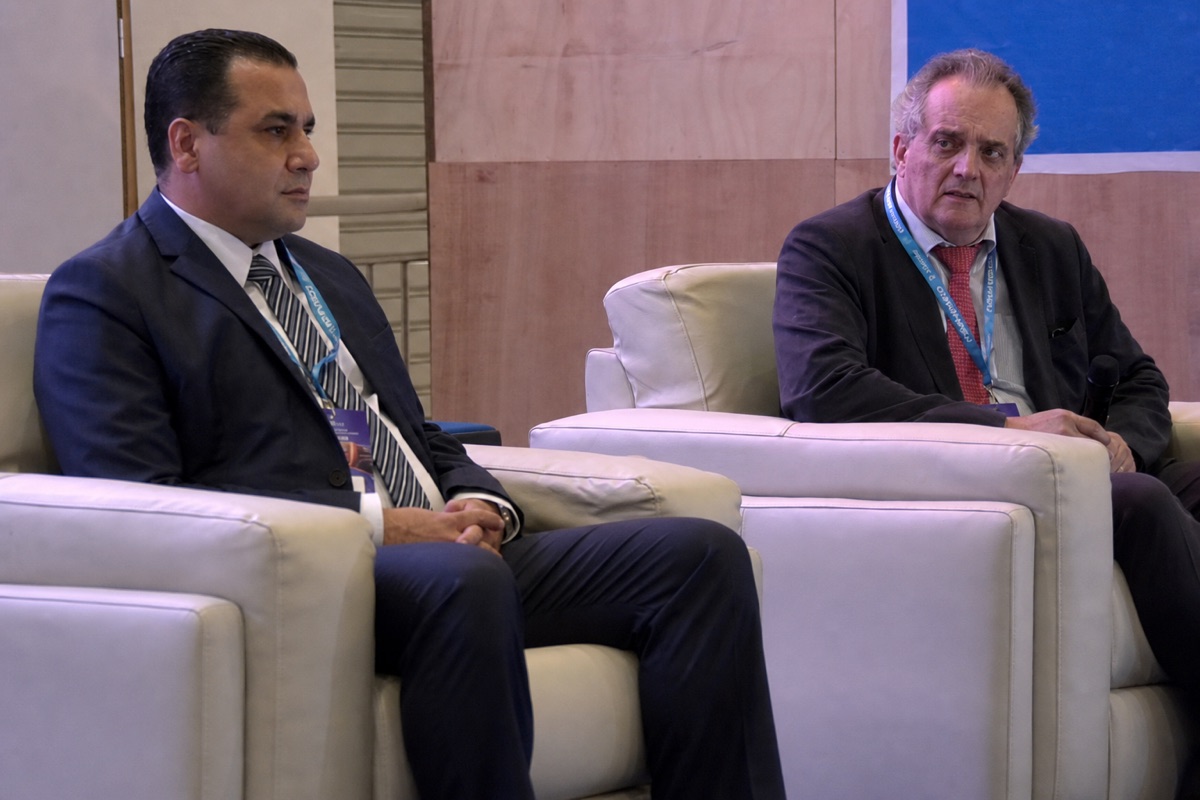
Congo-Brazzaville’s economic gateway is under fresh scrutiny. At the fourth edition of the Vox Eco forum, transport and logistics leaders gathered to weigh what really holds back the Autonomous Port of Pointe-Noire, and what could finally unlock its stalled potential.
The conversation stayed grounded and practical. Rather than sweeping promises, panelists traded diagnoses on rail, road corridors and terminal capacity, treating the port as one link in a wider chain that reaches deep into Central Africa.
A Rail Backbone Running on Fumes
The most sobering figures came from the railway. Jésus Providence Niazaire, acting director general of the Congo Ocean Railway (CFCO), laid the numbers bare. “Out of 34 traction units, only 9 remain,” he said, a striking admission for a company nearing 92 years old.
That shortfall matters far beyond the tracks. The CFCO feeds the port, and every idle locomotive slows the flow of containers inland. Decades of underinvestment have left the operator wrestling with breakdowns that ripple across the entire logistics network.
Niazaire outlined a recovery plan built on three fronts. The first targets customer service and punctuality, chronic weaknesses that erode client trust. Reliability, he suggested, is the currency the railway must rebuild before anything else.
The second axis focuses on securing equipment and infrastructure, protecting what remains of an aging fleet. The third aims to lift revenue so the company leans less on state subsidies, a dependence that has long masked deeper structural strain.
Corridors That Reach Bangui in Six Days
If the railway told a cautionary tale, the road corridor offered a brighter note. Nasser Trad, chief executive of Mercure Logistics Congo, framed connectivity as a genuine competitive edge rather than a bottleneck.
“We have a competitive corridor,” Trad said, pointing to secured routes that carry containers from Brazzaville to Bangui in six days. For landlocked Central African Republic, that transit time turns Pointe-Noire into a plausible maritime outlet.
The remark underscored a quieter theme running through the forum. Pointe-Noire’s ambitions are regional, not merely national. Its relevance grows when neighbours can trust its corridors to move goods quickly, safely and predictably across borders.
A €400 Million Transformation on the Waterfront
The forum’s headline came from Congo Terminal, the Africa Global Logistics subsidiary that runs container operations. The company is preparing what may be the port’s most significant upgrade in a generation, and the scale is deliberately ambitious.
The plan carries a €400 million price tag, delivered in partnership with China Road and Bridge Corporation. At its core sits 750 metres of additional quays, extra berth space designed to handle larger vessels and heavier throughput than the current facilities allow.
The capacity target is the clearest measure of intent. Congo Terminal aims to lift annual handling from 1 million containers to 2.3 million, a jump that would reposition Pointe-Noire among the more serious ports along the Atlantic coast.
Beyond steel and concrete, the project carries a social promise. The expansion is expected to generate up to 900 new local jobs, a figure that resonates in a city where port activity shapes household incomes and small-business fortunes alike.
Reading the Fine Print of Ambition
Taken together, the forum sketched a port pulled between two realities. One is the aging rail spine straining to keep pace. The other is a bold terminal expansion betting that demand will justify the outlay, and that partners will deliver.
The tension is instructive. A gleaming quay means little if trains cannot move containers inland, and a fast road corridor loses value if berths stay congested. The panelists seemed aware that competitiveness rises or falls on the weakest link.
That is perhaps the real message of this fourth Vox Eco gathering. Pointe-Noire’s future depends less on any single investment than on stitching rail, road and terminal into one coherent system that works end to end.
For now, the pieces are moving at different speeds. The €400 million overhaul offers a horizon of larger capacity and steady jobs. The railway’s recovery plan, by contrast, is a race to stabilise before decline hardens into paralysis.
What happens next will test whether these ambitions can be synchronised. If the operators align their timelines, Pointe-Noire could emerge as a genuine hub for Congo and its neighbours. If they drift, the gap between promise and performance may simply widen.
The forum did not settle those questions. But by naming the obstacles plainly, and quantifying both the strain and the stakes, it gave Pointe-Noire’s stakeholders a sharper map of the road ahead.