
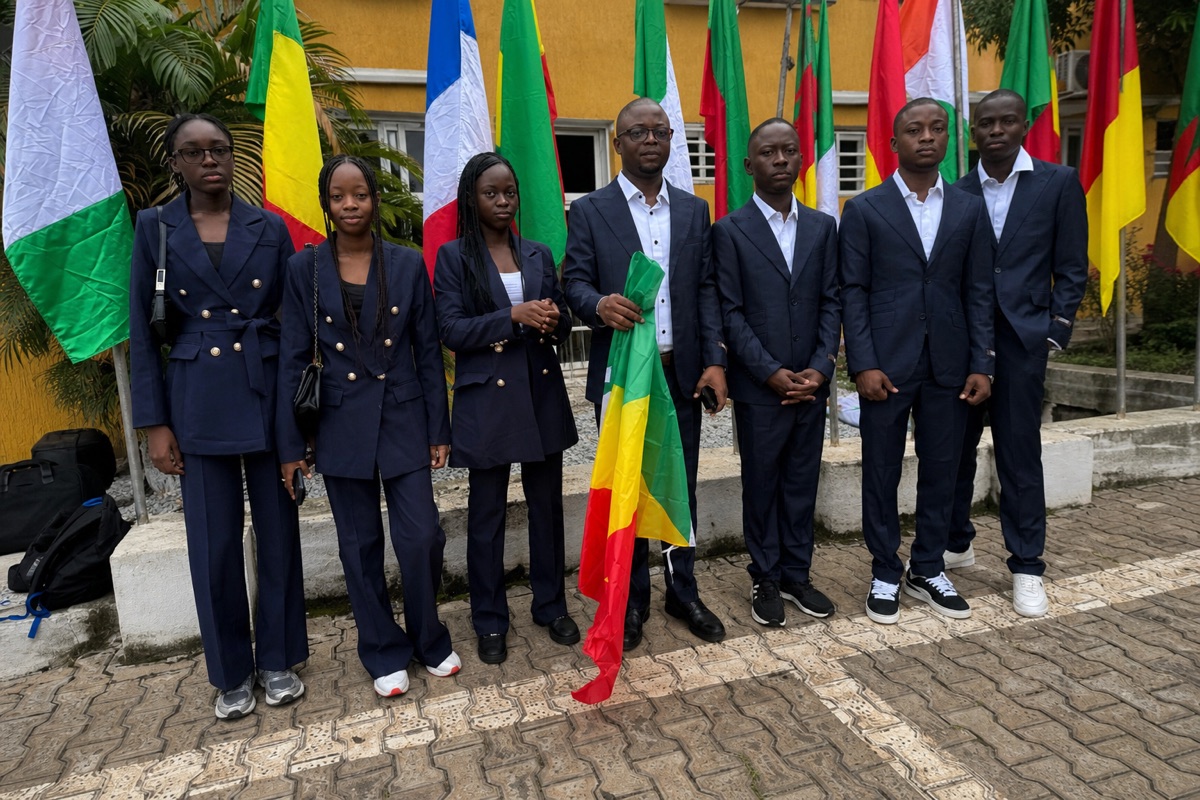
Six young Congolese have swapped their classrooms for a high-stakes arena. Three girls and three boys are now in Yamoussoukro, Côte d’Ivoire, carrying the colours of the Republic of Congo (Congo-Brazzaville) into one of the continent’s toughest academic contests.
They are competing in the 33rd edition of the Pan-African Mathematics Olympiad. The event runs from 26 June to 4 July 2026, gathering the sharpest secondary-school minds from across the region for a week of intense problem-solving.
A national delegation built on merit
The team was selected from the country’s top science streams, mostly Terminale C pupils drilled in advanced mathematics. Their journey reflects a wider push to spotlight scientific talent among Congolese youth, well beyond the usual football headlines.
Leading the group is Dan Schadrac Bouekassa, a Terminale C student at Lycée Mpaka in Pointe-Noire. He is joined by Ultime Christina Kissangou, in Première C at the Lycée de la Réconciliation in Brazzaville, one of two capital and coastal hubs feeding the squad.
The delegation also features Isaac Régis Depaul Goma Litsingou, from the Lycée d’excellence Mbouda in Dolisie. Two more members, Abel Yowann Ewani and Briciane Esther Iloki-Obosso Koumou, both come from the Lycée d’excellence d’Oyo, underlining that province’s growing academic reputation.
Rounding out the six is Alfred Sarah Emmanuelle Esséréké, a Terminale C pupil at Lycée Les Dauphins in Pointe-Noire. Together, the students map a national picture: Brazzaville, Pointe-Noire, Dolisie and Oyo all placed a representative in the final line-up.
Who is footing the bill
Sending a full team abroad is never cheap, and the financing came from a familiar corporate name. The Société nationale des pétroles du Congo (SNPC), the country’s national oil company, covered the delegation’s costs for the trip.
For SNPC, the sponsorship fits a stated goal: nurturing scientific excellence and encouraging science-based careers among the young. Backing a maths olympiad is a way to connect the energy sector’s future skills needs with the classrooms shaping tomorrow’s engineers.
The move also signals a quiet shift in how talent is supported. Rather than leaving families to fund travel and preparation alone, a major institution stepped in, giving the six a fair shot against better-resourced rivals from other nations.
What the Olympiad actually involves
The Pan-African Mathematics Olympiad is no ordinary school test. It brings together elite pupils from 27 African nations, all wrestling with problems that reward creativity, rigour and stamina far more than rote memorisation.
Contestants typically face multi-hour papers packed with algebra, geometry, number theory and combinatorics. Success demands not just correct answers but elegant reasoning, the kind of thinking that separates a good student from a genuine problem-solver.
For the Congolese six, the challenge is twofold. They must perform individually while also representing a country eager to prove its schools can produce world-class scientific minds on a shared continental stage.
Why this matters for Congo-Brazzaville
Competitions like this rarely make front pages, yet their long-term stakes are real. Strong results can raise a nation’s academic profile, attract scholarships and inspire younger pupils to take mathematics seriously in a demanding job market.
The presence of three girls in the team carries its own weight. In a field where female participation often lags, their selection sends a clear message to schoolgirls across Brazzaville, Pointe-Noire and the departments watching from home.
There is also a practical angle for a resource-driven economy. Building homegrown expertise in mathematics and science underpins engineering, finance and technology, sectors that a country like Congo-Brazzaville will need as it looks to diversify.
The days ahead in Yamoussoukro
For now, the focus is squarely on the papers. Between 26 June and 4 July, the six will test themselves against peers who have spent months, sometimes years, preparing for precisely this moment under intense pressure.
Whatever the final scoreboard shows, the experience alone is a milestone. Facing 27 nations, exchanging methods and simply belonging in that room can reshape how a teenager sees their own potential and future path.
Their families, teachers and sponsors back home will follow the results closely. For a small delegation flying the national flag, every solved problem is a small victory, and a reminder that Congolese talent travels well beyond its borders.