
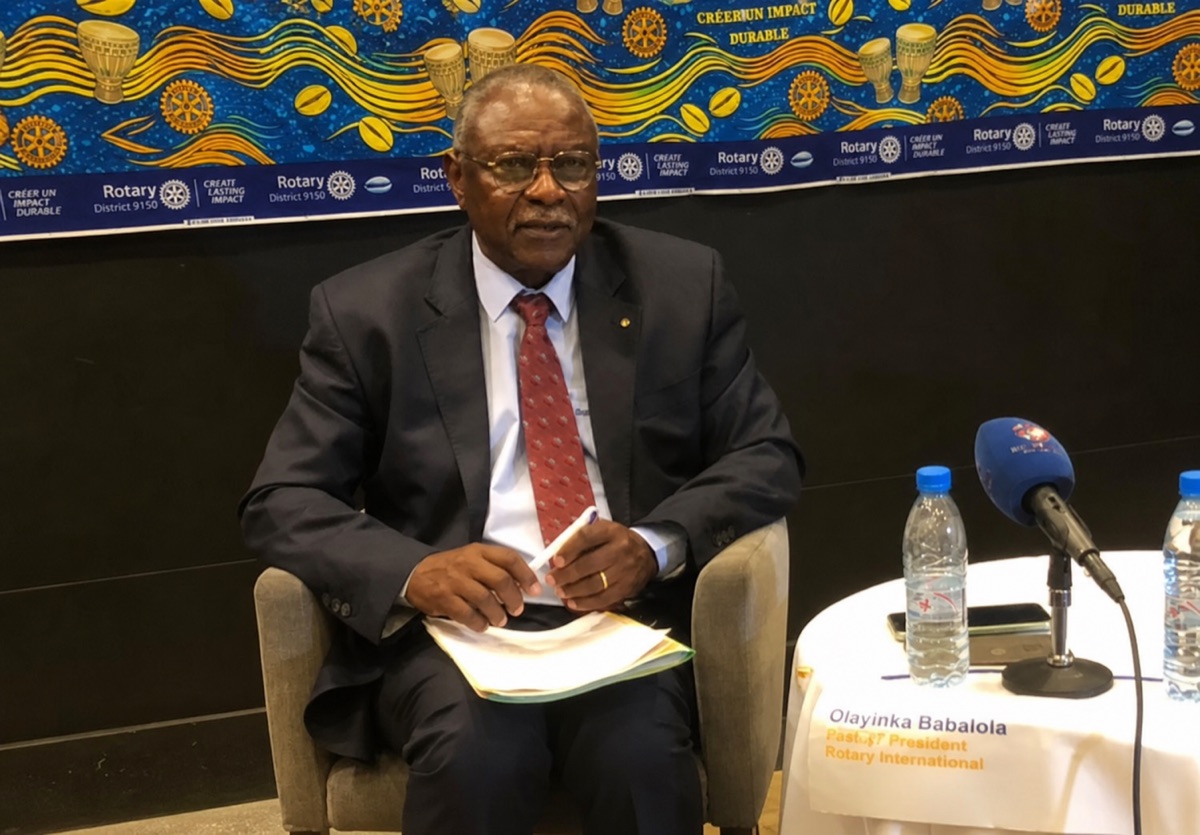
Brazzaville — A new chapter opens for one of Central Africa’s largest service networks, as a Congolese academic steps forward with a clear, measurable agenda for the year ahead.
A Professor Elected to Lead Across Ten Nations
Professor Hyacinthe Defoundoux-Fila has been elected governor of District 9150 of Rotary International. The vote took place during the district’s 44th conference, held from 23 to 25 April 2026 in Kinshasa, under the theme “Service First, United to Do Good.”
The mandate is no small responsibility. District 9150 stretches across ten countries of Central Africa, binding together clubs that operate in very different national contexts but share a common humanitarian purpose.
Those member nations are Burundi, Cameroon, Central African Republic, Congo, Gabon, Equatorial Guinea, Sao Tome and Principe, the Democratic Republic of Congo, Rwanda and Chad. Coordinating volunteer action across such a spread is a demanding logistical exercise.
Defoundoux-Fila Unveils His Roadmap in Brazzaville
The new governor laid out his priorities at a press conference on 26 June 2026 in Brazzaville. Rather than offering broad promises, he chose to anchor his term in figures, giving members and observers concrete benchmarks against which his leadership can be assessed.
His approach reflected a deliberate tone. He framed the work ahead as practical and accountable, signalling that the year would be measured by tangible delivery rather than by ceremony or rhetoric alone.
Three Targets That Define the 2026-2027 Term
At the heart of the roadmap sit three core objectives for the 2026-2027 cycle. The first is membership growth: the governor wants to recruit more than 400 new members across the district before June 2027, widening the volunteer base.
The second objective is financial. Defoundoux-Fila aims to increase contributions to the Rotary Foundation by ten percent, strengthening the funding pool that ultimately supports the network’s field activities throughout the region.
The third is the most visible to the public. The district intends to finance at least 50 development projects spread across its ten member countries, ensuring that each national community sees concrete returns from collective effort.
Where the Projects Will Focus
The governor was specific about the areas these projects should serve. Education and health feature prominently, two sectors where service organisations can complement, rather than replace, the work of public institutions across the district’s territory.
Access to clean drinking water and sanitation also rank among the stated priorities. In a region where reliable water supply remains uneven, such projects can carry an outsized impact on daily life and on community health outcomes.
Environmental protection completes the list. By placing it alongside more traditional humanitarian concerns, the roadmap acknowledges that long-term wellbeing in Central Africa is increasingly tied to questions of resources, climate and the management of the natural environment.
A Reminder of What Rotary Is For
Throughout his remarks, Defoundoux-Fila returned to the identity of the organisation he now helps to lead. He described Rotary as “a humanitarian organisation,” a phrase meant to keep attention fixed on service rather than on prestige or social standing.
He went further on the question of judgement. The Rotary, he suggested, should be assessed “on the basis of what we do,” a standard that places action above words and invites scrutiny of results rather than intentions.
That framing fits neatly with the conference theme under which he was elected. “Service First, United to Do Good” is less a slogan than a working principle, and the governor appears intent on holding his term to it.
Numbers as a Measure of Ambition
What distinguishes this roadmap is its willingness to commit to numbers. Four hundred members, a ten percent rise in contributions and fifty projects are not vague aspirations; they are checkpoints that can be counted and reported at the close of the cycle.
For the clubs scattered across ten countries, that clarity carries weight. It offers a shared scorecard, allowing volunteers in Brazzaville, Kinshasa, Yaounde or Kigali to see how their local efforts feed into a single district-wide ambition.
The coming months will show how realistic those targets prove. Recruiting hundreds of members and launching dozens of projects across borders is a considerable undertaking, dependent on the energy of local clubs as much as on the governor’s leadership.
For now, the message from Brazzaville is one of intent. Professor Defoundoux-Fila has set out his term in plain terms, tied it to measurable goals, and pointed his district firmly toward the practical service that, by his own account, should define it.