
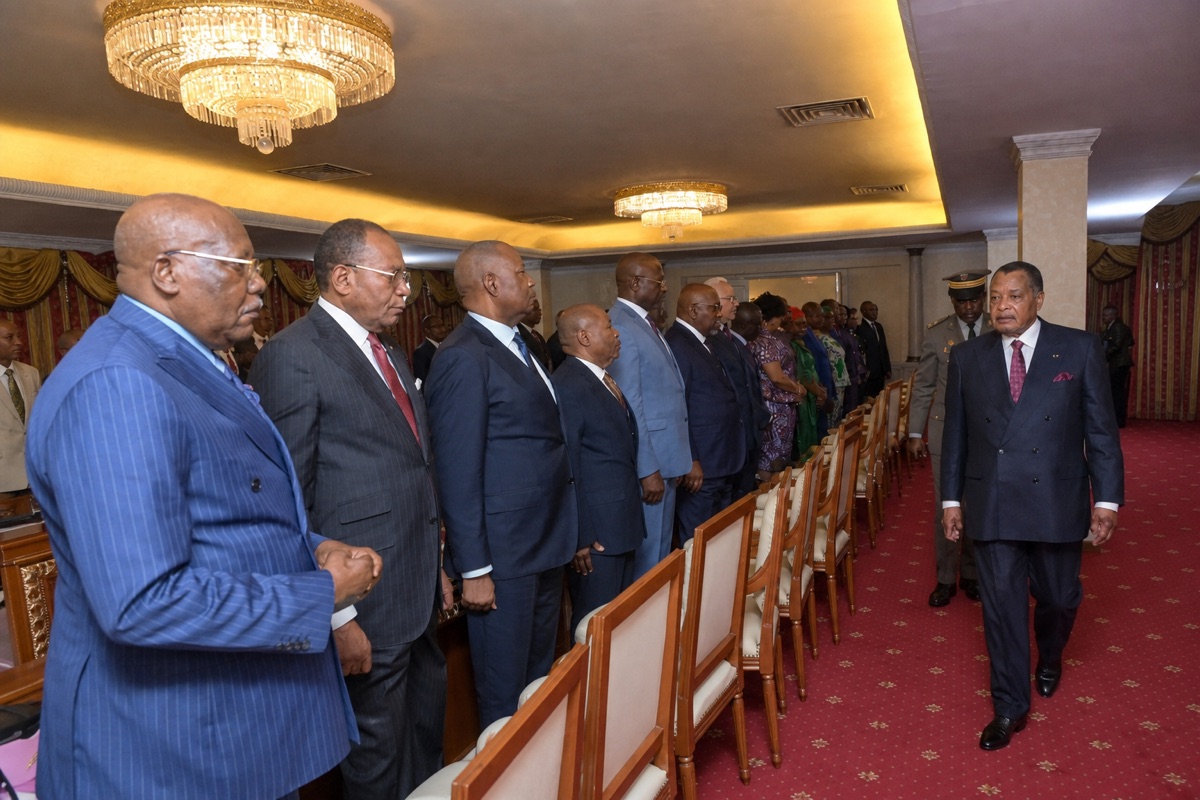
At the June 18, 2026 Council of Ministers, President Denis Sassou N’Guesso pressed his government to move faster on a slate of flagship projects he frames as central to the country’s economic and social future. The message was plain: deliver.
A Cabinet Meeting Centered on Delivery
The session put infrastructure squarely at the heart of government business. The head of state urged ministers to treat several strategic projects as immediate priorities, arguing that they bear directly on national competitiveness and on the everyday living conditions of Congolese households.
The tone was less about announcing new plans than about finishing the ones already underway. By naming each project in turn, the president signaled that timelines, not intentions, would now be the measure of his ministers’ performance.
Rebuilding the Roads of Pointe-Noire
High on the list is the continued rehabilitation of urban roads in Pointe-Noire. The work aims to modernize the road network of the economic capital, ease congestion and give local commerce the smoother circulation it has long needed.
For a city that anchors much of the country’s trade and oil-related activity, the state of its streets is more than a convenience. Better roads mean faster movement of goods and people, and the president tied the project directly to the wider goal of economic momentum.
A Heavy-Duty Road Toward Cabinda
Sassou N’Guesso also called for steady progress on the heavy-duty road linking the Republic of the Congo to the border with Cabinda. The route is viewed as a significant lever for sub-regional trade and for deeper economic integration across Central Africa.
Such a corridor matters because cross-border commerce often hinges on a single reliable artery. By keeping this road on the priority list, the government is betting that improved connectivity will pull in trade and strengthen the country’s place in the regional economy.
Securing Power Along the Pointe-Noire–Brazzaville Line
In the energy sector, the president pushed for faster work on improving the Very High Voltage line running between Pointe-Noire and Brazzaville. The project is meant to reinforce the stability of electricity supply along the entire corridor that connects the two largest cities.
Reliable power is the quiet condition behind almost every other ambition on the list. Factories, road works and university campuses all depend on it, which helps explain why the head of state singled out the transmission line for accelerated attention.
Finishing Loango University
The Council of Ministers also reviewed progress toward completing Loango University. The institution is expected to broaden the country’s higher-education offering and to support the skills development of young Congolese entering an increasingly demanding job market.
Education sits close to the heart of the government’s stated priorities, and a finished campus would give the country additional capacity to train the workforce its other projects require. The president’s emphasis suggested he wants the facility operational without further drift.
Bringing the Maloukou Industrial Zone to Life
Another major file is the operationalization of the Maloukou industrial zone. Here the head of state insisted on the effective arrival of the companies expected on the site, presenting their presence as the real test of whether the zone delivers on its promise.
The reasoning is straightforward. An industrial park only generates jobs and diversification once factories actually open their doors. By stressing effective company installation, the president pushed the conversation beyond construction and toward measurable industrial activity.
Why These Projects Carry Political Weight
Taken together, the projects sketch a coherent agenda: roads to move goods, a corridor to trade with neighbors, power to keep the lights on, a university to build skills, and an industrial zone to create jobs. Each piece supports the others, and the president clearly wants them advancing in parallel.
The repeated call to accelerate also reads as a form of accountability. Listing specific sites in a Cabinet meeting puts named ministers on notice and gives the public concrete markers against which to judge progress in the months ahead.
What remains to be seen is execution. The president has set the priorities and the pace he expects; the burden now falls on the relevant departments to translate those instructions into finished roads, stable electricity, open lecture halls and operating factories across the Republic of the Congo.
For households in Pointe-Noire stuck in traffic, for traders eyeing the Cabinda route, and for young people hoping to study at Loango, the difference will be felt only when the work is done. On June 18, the government’s message was that the waiting should be shorter.