
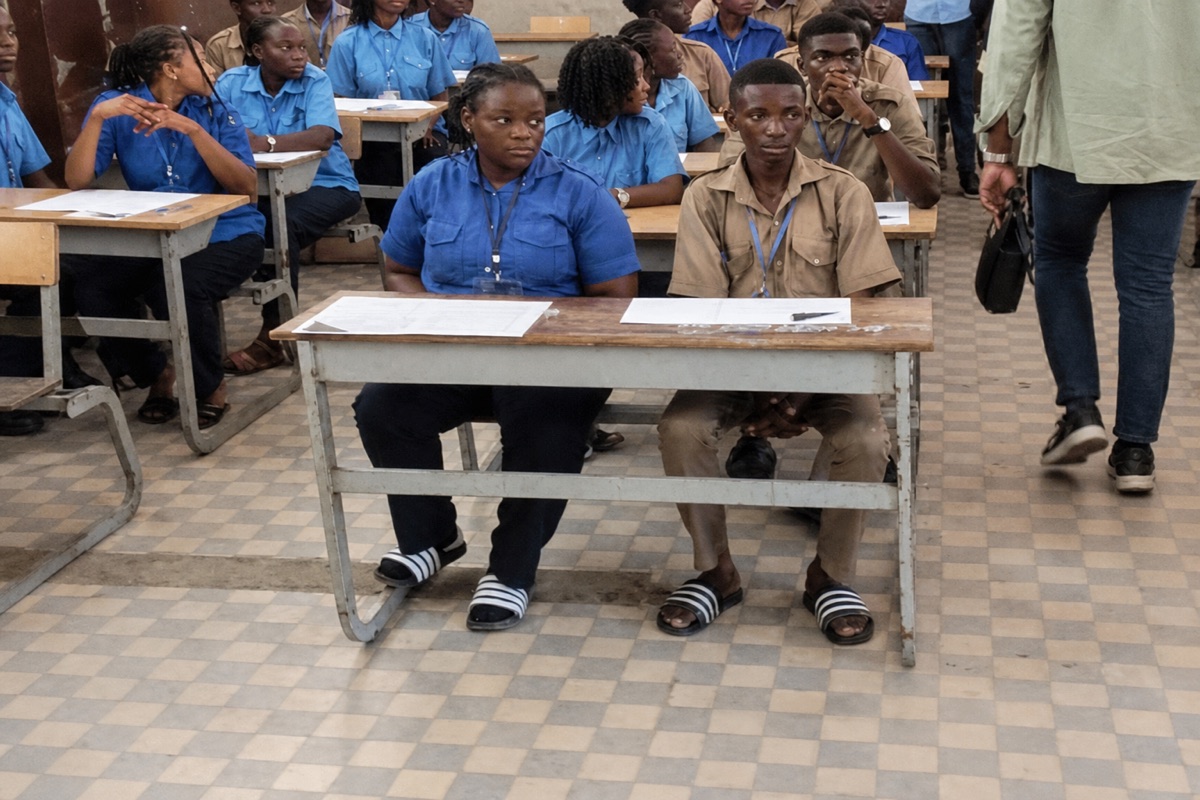
A nationwide start for the class of 2026
On June 2, 2026, the written tests of the general baccalaureate opened across Congo-Brazzaville. Two ministers fired the starting gun, turning an ordinary Monday into a milestone for tens of thousands of families watching their teenagers step into the exam halls.
Jean-Luc Mouthou, minister of preschool, primary, secondary education and literacy, led the launch alongside Rigobert Maboundou, minister of scientific research and technological innovation. The pairing signaled that this examination is read as much through the lens of national development as of schooling.
Who showed up at the exam centers
The headline figure is striking: 101,856 candidates registered this year, spread across 316 examination centers nationwide. That is roughly 6,000 more young people than the previous session, a jump the authorities tied to a wider spread of facilities.
Mouthou pointed to that infrastructure effort directly. He praised “a fine distribution of facilities between the general bac and the technical bac” that made it possible to absorb the extra 6,000 candidates without overcrowding the established sites (Les Echos du Congo-Brazzaville).
Young women set the tone
The most quietly remarkable statistic sits in the gender column. Women made up 55 percent of all candidates this year, outnumbering their male peers in a country where access to schooling has long been uneven across regions and households.
That majority, however, does not yet translate into the science classroom. The figures show 58 percent of female candidates in series D and 38 percent in series A. Only 3 percent chose series C, the most mathematics-intensive stream, exposing a persistent imbalance in subject choices.
A push toward science
Maboundou used the launch to address that imbalance head on. He argued that more girls should be steered toward scientific tracks, insisting that “intelligence produces scientific results” the country needs for its development (Les Echos du Congo-Brazzaville).
The remark reads as more than ceremony. With research and innovation framed as engines of growth, the gap between a female-majority candidate pool and a near-absent female presence in series C becomes a policy concern, not merely a classroom curiosity worth noting.
An audience of institutions
The opening ceremony drew a notably broad guest list, a sign of the weight the exam carries. The Prefect of the Brazzaville department and the city’s Vice-Mayor attended, lending local authority to a national rite that unfolds simultaneously in every department of the country.
International partners were present too. Representatives of UNESCO and UNICEF joined the ceremony, alongside members of the education commissions of both the National Assembly and the Senate, placing the session within a framework of shared educational commitments and parliamentary oversight.
Inside the first papers
The exams moved quickly from speeches to silence. In Brazzaville, candidates settled into established centers including Lycee Chaminade, the Immaculee Conception school and the Complexe scolaire de la Liberte, three sites that absorbed much of the capital’s intake on the opening day.
The schedule itself carried a small surprise of timing. On launch day, candidates in series A4, C and D sat their English paper first, an early test of language skills before the heavier subject-specific examinations that define each stream in the days that follow.
What the numbers may foreshadow
Beyond the logistics, the session offers a snapshot of where Congo-Brazzaville’s schooling stands. A growing candidate pool suggests broader retention through secondary school, while the female majority points to real progress in getting girls to the finish line of the secondary cycle.
The unresolved question is what comes after the gate. If young women keep clustering in series A and D while series C stays almost entirely male, the country’s scientific ambitions will rest on a narrow base. Closing that gap looks like the next contest after results arrive.
For now, the focus stays on the desks. Across 316 centers, 101,856 candidates carry their own version of the same hope, while ministers, prefects and international observers wait to see how the June session translates ambition into outcomes for the wider national project.