
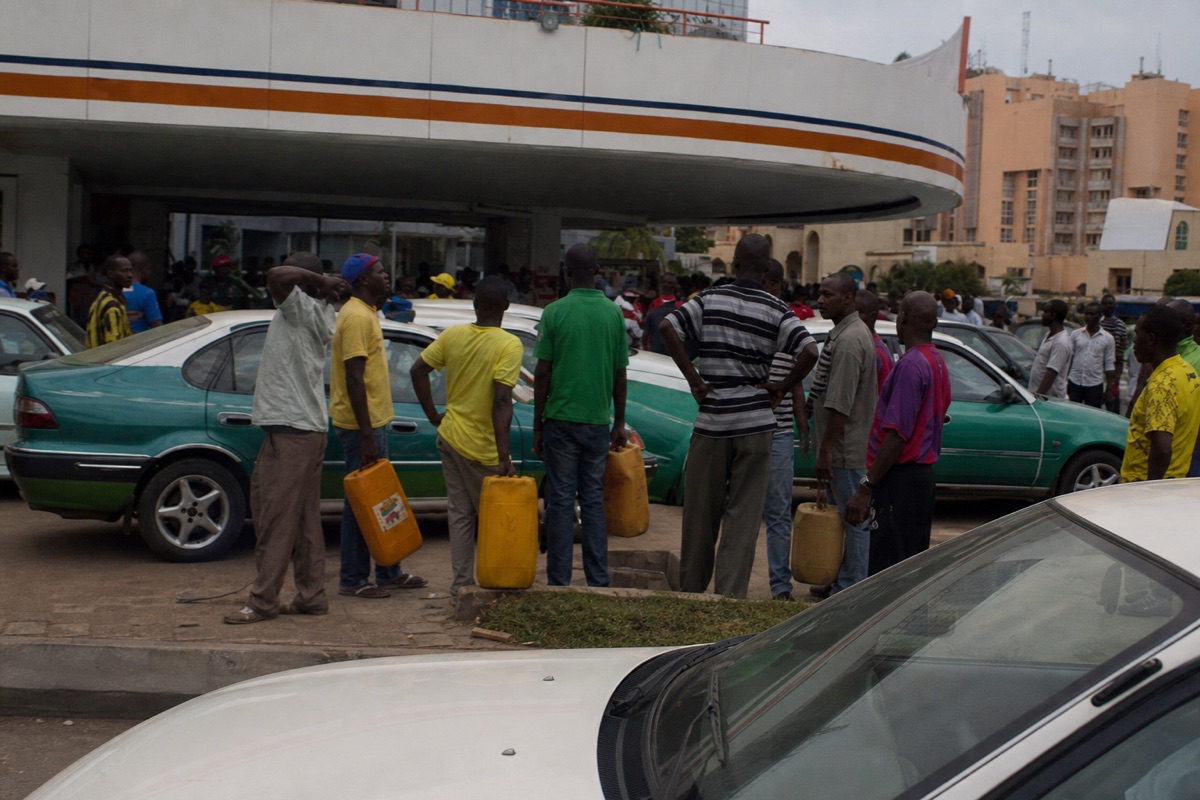
For several days now, Brazzaville has been running on empty. Service stations across the capital sit dry, drivers idle for hours, and a familiar scene repeats itself: rows of jerricans, restless motorcyclists and frustrated motorists hunting for a few litres of fuel.
A Capital Brought to a Standstill at Rush Hour
The shortage has reshaped daily routines. During peak hours, buses and taxis become almost impossible to flag down. Long queues form at bus stops, and the slowdown in traffic now touches every corner of the city, complicating even short trips.
Near the Mfilou town hall, in the 7th district, resident Fiacre Nkombo summed up the strain on ordinary people. “It’s a really difficult situation,” he said. “You may have the money for transport, but it’s not easy to find a bus, or even a taxi.”
Taxi And Bus Drivers Bear The Brunt
Few groups feel the pinch more sharply than the city’s professional drivers, whose livelihoods depend on a steady supply that has all but vanished. Outside one downtown station, a taxi driver described his ordeal in plain terms.
“It’s been three days that I’ve been looking for fuel,” he said. “It’s a real battle.” His account echoes the experience of countless colleagues who spend more time searching for petrol than carrying passengers, eroding their earnings day by day.
Tensions Rise At The Few Working Pumps
At the rare stations still holding small quantities of fuel, demand quickly outpaces supply. Crowds swell, tempers flare, and security forces have struggled to keep order. Police officers were deployed to several sites to manage the rush and prevent the scramble from spilling into unrest.
The presence of uniformed officers underlines how sensitive the situation has become. What began as an inconvenience has hardened into a daily test of patience, with each fresh delivery drawing anxious crowds hoping to fill a tank before the pumps run dry again.
Government Points To Regional And Global Pressures
In an official statement, the government linked the crisis to a drop in fuel stocks at both the national and international levels. Authorities tied that contraction directly to the turmoil currently shaking the Middle East, which has tightened supply far beyond Congo-Brazzaville’s borders.
According to a source close to the Société Commune de Logistique (SCLOG), officials have turned to neighbouring Kinshasa, in the Democratic Republic of Congo, to bring in several barges of fuel. The shipments are meant to resupply Brazzaville and gradually ease the pressure on dwindling stocks.
Black-Market Sellers Cash In On The Crisis
With official channels running short, many drivers have fallen back on informal vendors, locally nicknamed “Kadhafis.” Seizing on the surge in demand, these sellers charge well above regulated rates, turning scarcity into profit.
A 25-litre jerrican now changes hands for more than 25,000 CFA francs, compared with around 20,000 CFA francs at the pumps. The gap places an added burden on households and small businesses already stretched thin by the disruption to transport and daily commerce.
A Fragile Promise Of Return To Normal
As authorities work to reassure residents that supplies will recover step by step, the people of Brazzaville continue to absorb the costs of an energy squeeze that has crept into nearly every aspect of city life. For now, the wait at the pump remains the clearest measure of the crisis.
Whether the barges arriving from Kinshasa and the government’s reassurances will be enough to restore confidence is an open question. Until the queues shorten and prices settle, Brazzavillois are left to navigate a capital where fuel, once routine, has become a daily struggle.