
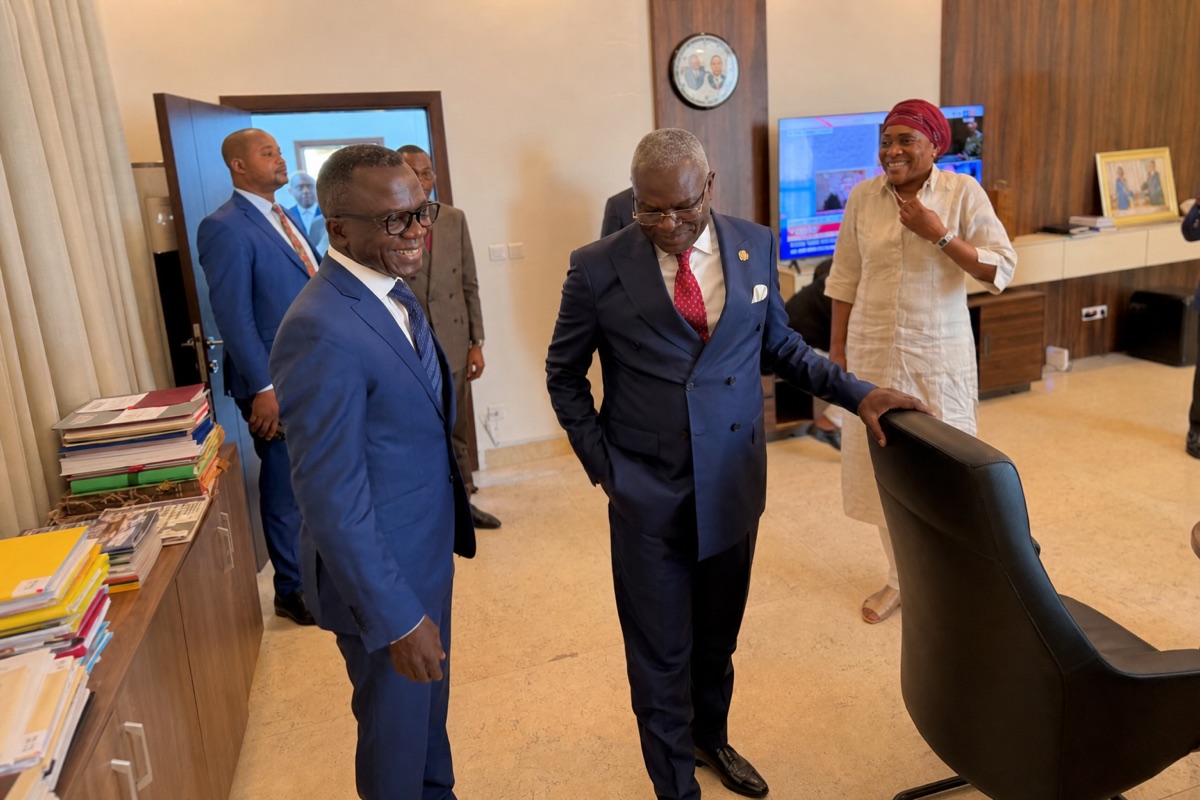
Prime Minister Anatole Collinet Makosso has begun walking the corridors of Congo-Brazzaville’s central government, and what he found inside several ministries paints a sobering picture of the everyday workplace facing thousands of civil servants.
Inside the Ministries, a Closer Look at Daily Reality
The head of government launched his inspection tour on Monday, 4 May 2026, stepping into department after department to gauge the working conditions of state employees. The stated aim was practical: assess the buildings, measure the needs, and map out which administrative sites require urgent repair.
He did not travel alone. A handful of members of his government team accompanied him, turning the visit into a collective stocktaking exercise rather than a solo photo opportunity for the press.
Justice Ministry Reveals a Building at Odds With Itself
The first stop was the Ministry of Justice, Human Rights and the Promotion of Indigenous Peoples. There, Makosso moved through offices and service points, observing up close the environment in which officials carry out their daily duties.
The contrast was striking. From the street, the building still looks presentable, its facade holding up reasonably well. Step inside, however, and the impression collapses, revealing wear and neglect that the exterior carefully hides.
Apart from the spaces set aside for senior managers, most services operate under difficult conditions. Damaged furniture, faulty lighting and unsanitary toilets were among the recurring problems noted during the walkthrough across the ministry’s working areas.
Cramped premises add another layer of strain. In some cases, the shortage of offices forces agents to share small rooms, an arrangement that does little to encourage the focus and efficiency a public service is expected to deliver.
Strategic Departments Show the Same Tired Picture
The delegation did not stop at Justice. It pushed on to other strategic ministries, including those overseeing Mines, Hydrocarbons, Energy and Water, as well as the Plan, each central to the country’s economic and infrastructure ambitions.
The findings repeated themselves with disheartening consistency. Ageing infrastructure and working conditions poorly suited to the demands of a modern administration emerged as a common thread, suggesting the problem is structural rather than confined to a single building.
That repetition matters. When several unrelated departments display the same symptoms, the issue stops looking like isolated bad luck and starts resembling years of deferred maintenance across the state apparatus.
From Observation to a Plan of Action
Makosso’s field visits were never meant to end at description. The exercise is designed to produce a precise inventory, a clear-eyed account of what is broken and where, so that a wide-ranging renovation of administrative buildings can be properly planned.
For the government, the logic is straightforward. Better premises are presented as a lever to lift the performance of the public administration, on the assumption that staff working in dignified surroundings tend to serve citizens more effectively.
The renovation drive is also framed within a broader political horizon. Officials link the effort to supporting the implementation of the development project championed by President Denis Sassou N’Guesso, tying office repairs to the wider machinery of national governance.
Why Working Conditions Sit at the Heart of Public Trust
For the urban and peri-urban families who depend on these offices to settle paperwork, register documents or seek redress, the state of a ministry is not an abstract concern. A crowded, poorly lit office can mean longer queues, slower service and visible frustration.
There is a quiet message in a Prime Minister choosing to inspect toilets, furniture and shared desks rather than only attending ceremonies. It signals that the unglamorous mechanics of administration are being treated as a governance priority worth his personal attention.
Whether the promised overhaul translates into renovated walls and restocked offices will be measured in the months ahead. For now, the tour has at least established a shared, on-the-record baseline of how far conditions have slipped.
A Test of Follow-Through for the Administration
The challenge facing the government is familiar across many public sectors: turning a well-documented diagnosis into delivered repairs. Inventories and inspections are the easy part; financing, scheduling and execution are where ambitions are usually tested.
If the renovation programme advances, the early-May tour may be remembered as its opening chapter. The civil servants sharing cramped rooms today will be the most direct judges of whether the inspection produced more than notes and good intentions.
For Congo-Brazzaville’s administration, the stakes extend beyond comfort. Functional, well-maintained ministries are part of the basic infrastructure of a state that wants to be taken seriously, by its own citizens first and foremost.