
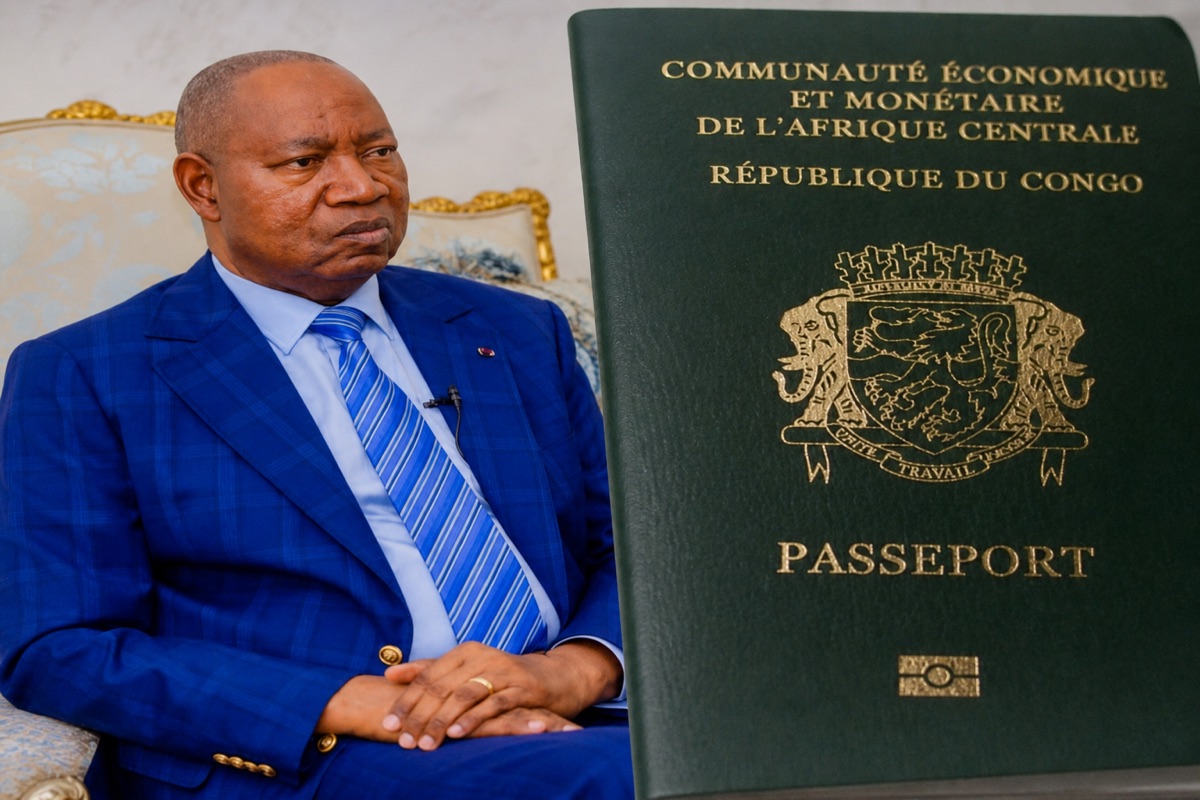
A New Minister Promises Cheaper, Faster Passports
For many families in Congo-Brazzaville, getting a passport has quietly become an ordeal. The new interior minister says that is about to change. On May 5, 2026, General Jean Olessongo Ondaye took office promising to make the document affordable again.
Appointed by the President on April 24, Ondaye now leads the Ministry of the Interior and Decentralization. During the handover with his predecessor, he laid out his priorities for a role he described as strategic and sensitive. The passport file sat near the top of that list.
The 50,000 FCFA Price That Few People Actually Pay
By presidential decree, a Congolese passport officially costs 50,000 FCFA. In practice, applicants report paying far more. According to the minister’s own account, a parallel network has pushed real prices to between 100,000 and 300,000 FCFA, well beyond the legal tariff.
That gap, the minister argued, has turned a routine identity document into something else entirely. “It is also necessary for us to work so that the passport ceases to be perceived as a luxury item,” Ondaye said during his first remarks in office.
The promise carries weight for ordinary households. A passport is the gateway to study abroad, medical travel, and family ties across borders. When its true cost triples, mobility narrows, and the diaspora’s connection to home grows more expensive to maintain.
Naming the Racket Behind the Counter
Ondaye did not soften his language about how the inflation happened. He described a system of generalized corruption that grew up alongside the official fee, with intermediaries and agents capturing the difference between the decreed price and what citizens are forced to hand over.
His warning to staff was direct. “Each agent, at whatever level, must always ensure that his behavior conforms to established principles,” he said. The message framed the abuse not as isolated misconduct but as a culture that needs dismantling.
That framing matters. By tying passport fraud to broader questions of state authority, the minister positioned the reform as a test case. If the administration can clean up a service people use every day, it signals that other promises might hold too.
Digital Tools as the Antidote
The minister’s proposed cure leans on modernization. He pointed to digitalization and stricter oversight of processing chains as the tools to close the gap between official and street prices. The logic is straightforward: fewer manual handoffs leave fewer openings for a bribe.
Tighter control of each step in the workflow, from application to delivery, is meant to make the official 50,000 FCFA the only price that exists. Whether the technology can outpace a well-established network remains the open question facing his team.
Reform efforts in public services often stumble at exactly this point. Systems can be digitized on paper while informal fees persist in the corridors. The credibility of Ondaye’s pledge will rest on enforcement, not announcements, in the months ahead.
Order, Authority and a Stated Zero Tolerance
Beyond passports, Ondaye described a wider ambition to restore republican values inside state structures. He spoke of enforcing order rigorously and keeping Congo-Brazzaville “a haven of peace and stability in a fragile regional environment,” a nod to the volatile neighborhood of Central Africa.
He pledged zero tolerance toward fraud and corruption, presenting strict discipline as the foundation for everything else. Restoring the authority of the state, in his telling, begins with making sure public servants follow the rules they are meant to uphold.
What Citizens Will Be Watching
For now, the commitments are words spoken at a handover. The decree setting the 50,000 FCFA price already exists; the challenge is making it the lived reality at every office window. That is the gap between policy and practice the minister has chosen to confront.
Congolese applicants, students preparing to study abroad, and families separated by borders have heard reform promises before. They will judge this one by a simple measure: whether the next passport they request costs what the law says it should, and arrives without a hidden surcharge.
If the digital overhaul takes hold and the parallel network loses its grip, the change could ripple beyond a single document. A passport obtained at its legal price would stand as proof that the state can deliver an honest service. For now, the minister has set the bar, and the country is waiting to see it cleared.