
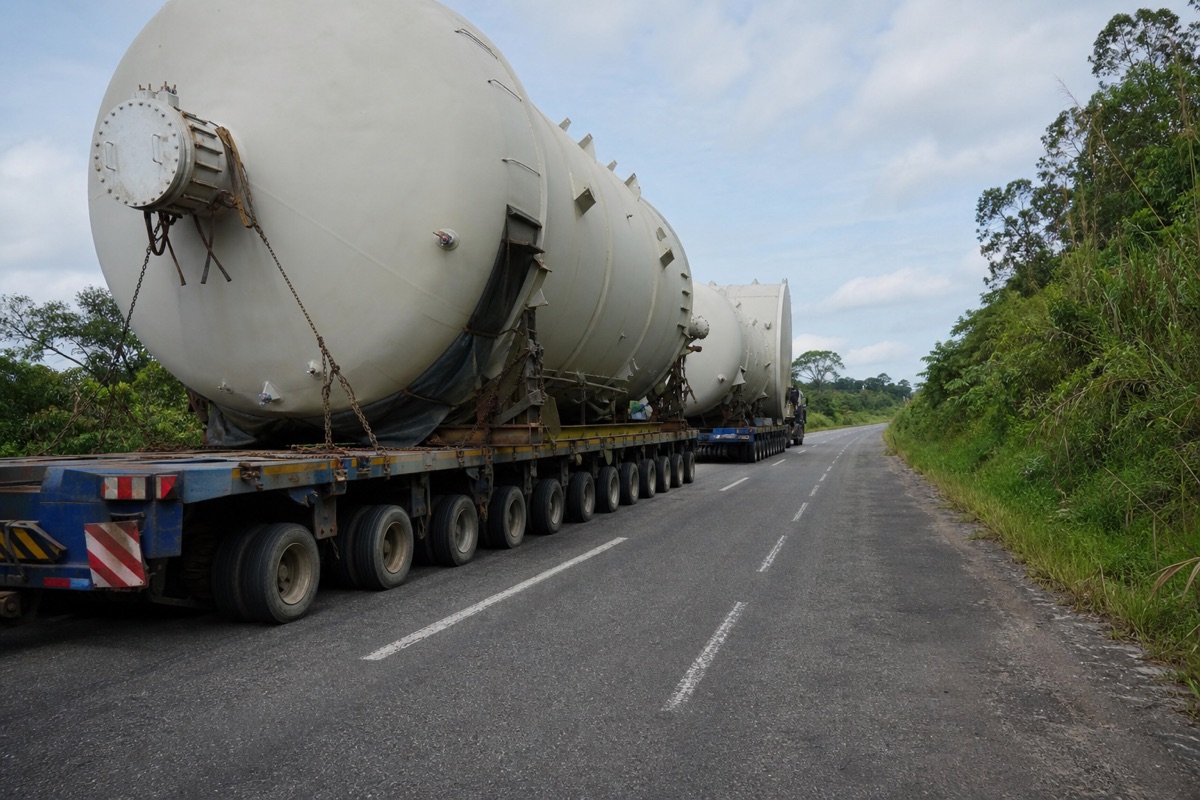
A single logistics run turned the road between the coast and the capital into a slow-motion engineering feat. On 24 March 2026, Africa Global Logistics (AGL) Congo moved eleven outsized modules from Pointe-Noire to Brazzaville, covering more than 510 kilometres.
Why This Convoy Mattered for Congo-Brazzaville
The modules were not ordinary freight. They were destined for the construction of a public-facing facility in Brazzaville, the kind of infrastructure that touches everyday life. Moving them in one coordinated operation showed how heavy industry now reaches deep into the country’s interior.
For a Republic of Congo focused on connecting its port city to its administrative heart, the trip carried symbolic weight. The corridor linking Pointe-Noire and Brazzaville remains the spine of national commerce, and every oversized load tests its limits.
Modules Up to 17 Metres Long
The largest pieces stretched up to 17 metres in length and 4.50 metres in width. Dimensions like these do not fit standard trailers, nor do they pass easily through ordinary traffic. Each module became a problem to be solved before it could roll.
AGL’s technical workshop responded with surgery on its own equipment. Some trailers were cut apart and then reassembled to cradle the unusually large structures. That choice, blunt as it sounds, reflects how far operators will go to match hardware to a one-off cargo.
Planning the 510-Kilometre Route
Distance was only part of the challenge. Before the first wheel turned, teams studied the itinerary in detail, mapping where the convoy could pass and where it could not. Sensitive zones along the way were secured to keep both the load and bystanders safe.
Coordination with local authorities ran in parallel. Moving such a load through populated areas requires permissions, timing and trust. AGL also put a reinforced health, safety and environment (HSE) framework in place, signalling that risk management sat at the centre of the plan.
Escort and Specialist Teams on the Move
The convoy did not travel alone. A professional escort accompanied it, while specialised technical crews stayed close to handle the unexpected. Their goal was a delivery that was both safe and smooth, with no surprises on a route that offered little room for error.
That combination of escort and expertise is what separates a routine haul from a high-stakes one. When a single module measures more than five double beds end to end, every curve, slope and bridge demands attention.
A Statement of Logistics Expertise
For AGL Congo, the operation doubled as a demonstration. “This success reflects our logistics know-how and our ability to support clients in their most demanding projects,” said Mazen Habib, Director of Operations at AGL Congo.
He framed the task as one that leaves no margin for improvisation. “Transporting this type of cargo requires a high level of expertise, planning and operational rigour,” Habib added. His words underline a wider point: heavy projects rise or fall on the discipline behind their delivery.
Inside AGL’s Congolese Footprint
AGL, short for Africa Global Logistics, is a subsidiary of the MSC Group. In Congo-Brazzaville, it employs 1,500 Congolese staff across its agencies and its port and logistics subsidiaries, a workforce rooted in the country rather than imported for a single job.
Its presence stretches across Pointe-Noire, Brazzaville and Dolisie, the three points that anchor much of the nation’s trade. That spread helps explain how the company could mobilise the equipment, people and local knowledge needed to bridge the coast and the capital in one move.
What the Operation Signals for Big Projects
Read closely, the run says something quiet but firm about ambition. Large public infrastructure now depends on the ability to bring exceptional components inland, and that ability is no longer taken for granted along the Pointe-Noire to Brazzaville axis.
The detail of cutting and rebuilding trailers, securing routes and escorting modules paints a fuller picture than the headline figures alone. It is the unglamorous groundwork that lets a 17-metre module arrive intact after 510 kilometres.
For residents and businesses watching new facilities take shape, the convoy is a reminder that visible progress often begins with an invisible chain of logistics. Behind the ribbon-cuttings to come stands a long road, carefully measured, and a load that few could move.
In a country knitting together its main cities, operations like this one map the practical limits of what can be built and how fast. AGL Congo’s March haul did not just deliver eleven modules. It delivered proof of capacity.