
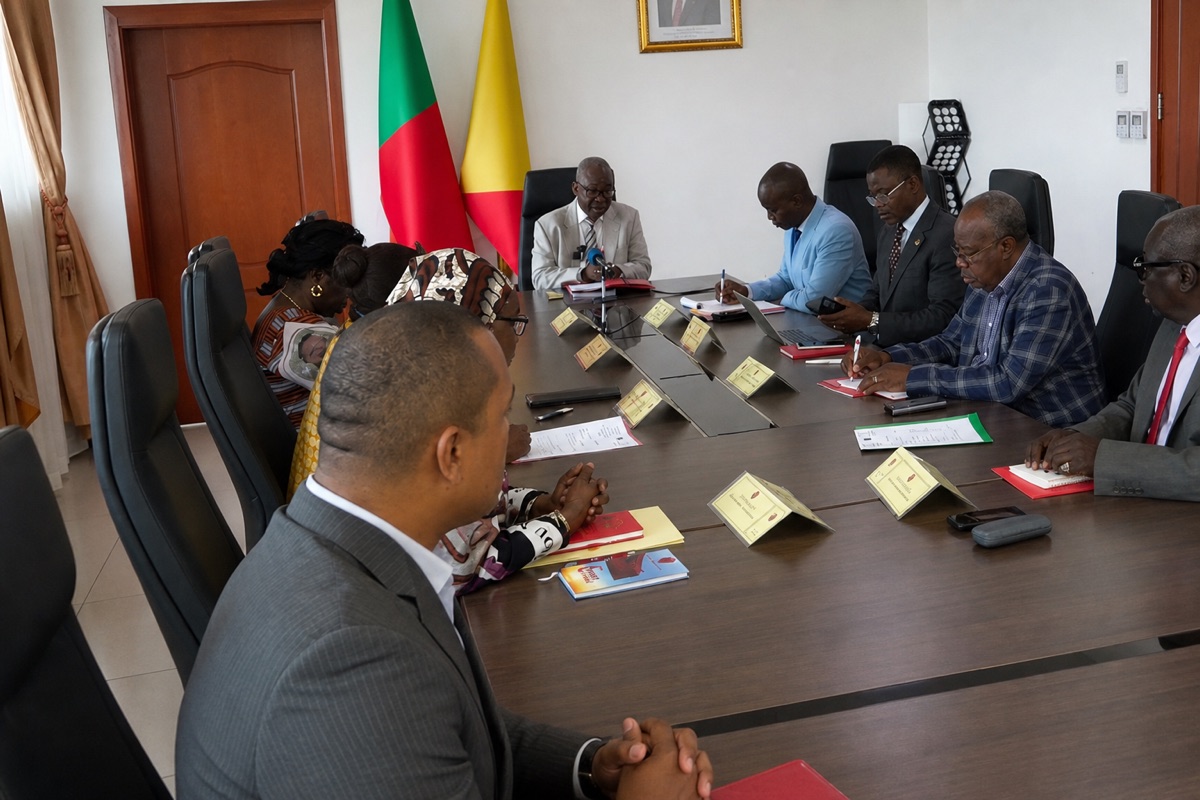
A Resounding Mandate Reaffirmed in Brazzaville
On 21 March, in Brazzaville, the Congolese Party of Labour gathered to mark the re-election of Denis Sassou N’Guesso as President of the Republic. The win came out of the two-round vote held on 12 and 15 March 2026.
Party officials described the polls as having unfolded in a climate of calm and serenity. For the PCT, the result is more than a number on a ballot sheet. It is read as a renewed contract between the head of state and the electorate.
The Numbers Behind the Celebration
The headline figure is striking. According to the party, Denis Sassou N’Guesso was credited with 94.82% of the votes cast, securing victory in the first round. The PCT presents this margin as exceptional in the country’s recent political life.
Parfait Iloki, the party’s spokesperson, framed the outcome in deliberate terms. “The permanent secretariat salutes the strong turnout of the population and the massive support for the vision carried by the President of the Republic, the very great comrade Denis Sassou N’Guesso, credited from the first round with 94.82% of the votes cast,” he said.
That phrasing matters. The PCT links the score not only to the man but to a programme, a “project for society” it says voters endorsed at the polls. The distinction is subtle, yet it shapes how the party intends to govern in the months ahead.
Reading the Turnout Claim
The party placed heavy emphasis on participation. In its account, high turnout signals adhesion rather than mere obligation, a point repeated by its spokesperson. Voter engagement, in this telling, becomes proof of legitimacy.
Such language is familiar in Congo-Brazzaville’s political grammar, where mobilisation and unity are recurring themes. Still, the insistence on a first-round, near-unanimous result sets the tone for the new term and the expectations attached to it.
A Pledge to Walk Alongside the President
Beyond celebration, the PCT struck a working note. Its permanent secretariat committed to accompanying the head of the presidential majority in carrying out the governing project that, in its view, citizens had just approved.
This is the operative message. The party positions itself not as a spectator to the victory but as an instrument of delivery. The promise is implementation, turning a campaign vision into policy across the country’s institutions and departments.
A Call for Unity and Continued Mobilisation
The PCT closed by addressing its own base and the wider public. It urged members, sympathisers and the Congolese people as a whole to remain united and mobilised behind President Denis Sassou N’Guesso.
The appeal echoes a long-standing strategy. By framing the post-election period as a continuation of the campaign’s energy, the party seeks to keep supporters engaged well after the ballots are counted and the results proclaimed.
What the Moment Signals
For readers across Brazzaville, Pointe-Noire and the departments, the gathering offers a clear snapshot of the political landscape. The ruling party has consolidated its narrative around a single figure and a single mandate, and intends to lead from that position.
Whether the cited margin reflects a durable consensus or a moment of concentrated enthusiasm will be tested by the term that follows. For now, the PCT’s stance is unambiguous. It reads the vote as endorsement, and it intends to act on it.
The coming months will show how the promised “project for society” translates into everyday governance. That is where the celebrated percentage meets its real measure, in the services, decisions and reforms that touch ordinary Congolese lives.
For the moment, the party speaks with one voice. The re-election is cast as both a verdict and a starting point, an outcome to honour and a mandate to fulfil across the nation’s institutions in the years that lie immediately ahead.