
A Campaign Stop Built Around Business Confidence
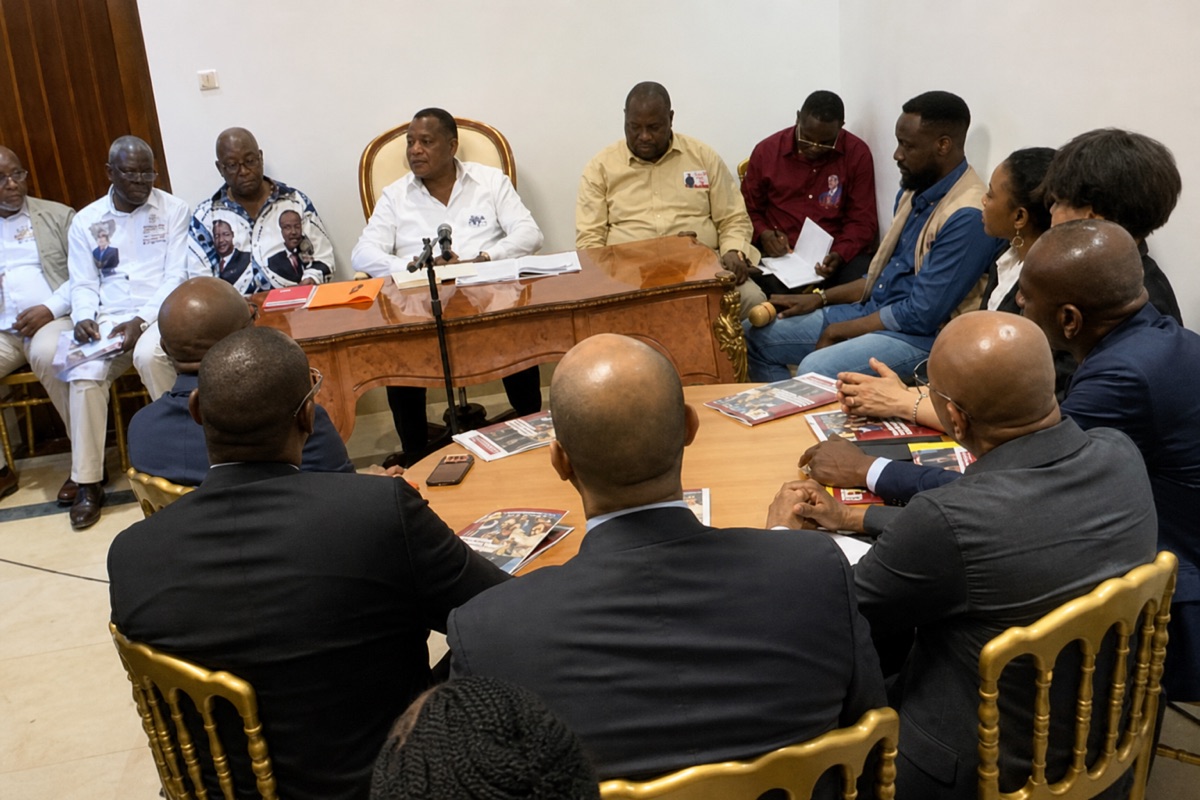
The Niari town of Dolisie became a stage for economic dialogue on 1 March 2026, when presidential candidate Denis Sassou N’Guesso opened his campaign doors to leaders of the Congolese private sector.
The meeting moved beyond the usual rally rhetoric. It read more like a working session, with employers listening closely as the outgoing head of state laid out the economic ambitions behind his bid for another mandate.
Inside the Pitch for a Faster Path to Growth
Sassou N’Guesso presented his manifesto, titled “Let us accelerate the march toward development.” The document frames economic revival as the central promise of his campaign, and Dolisie offered a pointed audience to test it.
Business owners came to gauge whether the project matched their daily realities. The exchange centred on how the state could partner with companies to mobilise resources, expand activity and turn pledges into measurable outcomes across Congo-Brazzaville.
Unicongo Lays Out the Employers’ Wish List
The delegation was led by Michel Djombo, president of Unicongo, the country’s main employers’ organisation. His remarks carried the weight of a sector that wants to be treated as a partner rather than a spectator in national planning.
“The private sector is ready to support the national effort to mobilise resources,” Djombo told the gathering. He paired that pledge with conditions, stressing that investment depends on visibility, trust, consultation and respect for the rules.
His message was direct. Companies will commit capital when the environment is predictable, when decisions are explained, and when the framework that governs them does not shift without warning or fair discussion.
Local Content Moves to the Centre of the Debate
Djombo pressed for several priorities that have long animated Congolese business circles. He argued for giving preference to local expertise, often described as local content, so that domestic firms capture a larger share of national projects.
He also called for fair access to public procurement, asking that state contracts open genuinely to homegrown bidders. The aim, he suggested, is to avoid a system where local companies feel sidelined before the competition even begins.
The push went further, with a plea for the emergence of national champions. These would be Congolese firms strong enough to compete at scale, anchor entire value chains and represent the country in regional and continental markets.
Rounding out the list was a request for gradual access to strategic sectors. Rather than demanding immediate entry everywhere, the employers framed their ambition as a staged opening that lets domestic players build capacity over time.
Sassou N’Guesso Answers With a Competitiveness Test
The candidate welcomed the engagement, signalling that he saw value in a private sector eager to share the burden of development. Yet his reply added a condition that reframed the conversation around performance.
“Being local is not enough; public contracts must select the most efficient and most economical offers,” Sassou N’Guesso said. The line set a clear bar, tying any preference for national firms to their ability to deliver real value.
That stance carries a subtle tension. It acknowledges the demand for local content while insisting that protection cannot replace quality. Congolese companies, in his framing, must earn their place by competing on cost and effectiveness.
The balance he sketched is familiar across economies trying to nurture domestic industry without sheltering inefficiency. The challenge lies in writing rules that favour local players while still rewarding the strongest, leanest bids.
A Cautious but Receptive Business Reaction
The Congolese business community received the competitive approach favourably. For employers, a system that prizes efficiency can still work in their favour if local firms invest in skills, management and scale rather than relying on protection alone.
The meeting left both sides with something to weigh. The private sector heard recognition of its role, while the candidate underlined that recognition comes with expectations of competitiveness and results.
What the Dolisie Exchange Signals
The Dolisie encounter offered a snapshot of how economic policy is being negotiated during the campaign. It showed employers willing to commit, provided the ground rules feel stable, transparent and genuinely open.
It also revealed the line the candidate intends to hold, where support for national firms meets a demand for performance. How that line is drawn in practice will shape whether Congolese companies feel empowered or merely encouraged.
For a country seeking faster growth, the conversation in Niari captured the stakes plainly. Confidence, fairness and competitiveness emerged as the words that may define the next phase of Congo-Brazzaville’s economic story.