
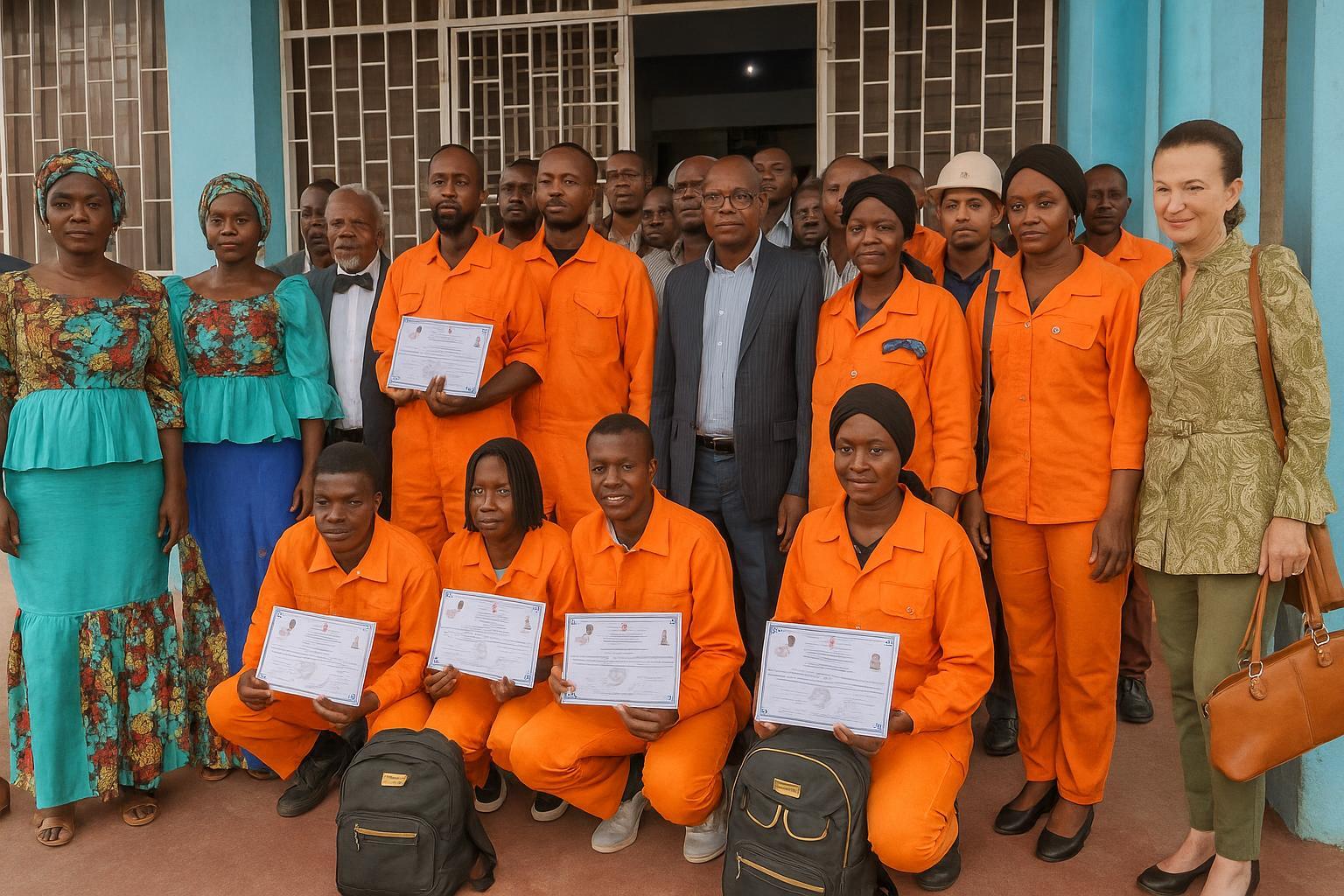
Certificates Handed in Pointe-Noire
Applause filled the meeting hall of the Maison de la République in Pointe-Noire on 23 December as 35 youths from Hinda, Loango and Madingo Kayes proudly collected professional qualification certificates after ten months of intensive training in building electricity and solar energy.
Precika Project Empowers Vulnerable Youth
The cohort, selected among vulnerable and out-of-school residents, forms the first graduating class of Precika, an employability programme promoted by the Congo Electricians’ Guild and financed by the French embassy, under the Kotonga mechanism dedicated to community-level projects with rapid economic impact.
Project manager Honoré Moukolo Bambi explained that Precika aims to turn unskilled youth into reliable energy entrepreneurs who will answer household power needs, raise incomes and strengthen social autonomy while supporting Congo’s gradual energy transition and the national drive for jobs closer to home.
Hands-On Curriculum and Training Approach
Lessons alternated between classroom theory, workshop practice and live building sites. Five technical modules covered plan reading, domestic wiring, diesel generator integration, photovoltaic sizing and customer relations, complemented by entrepreneurship coaching and bookkeeping drills so each learner could both install circuits and manage a micro-enterprise.
Nine women broke into what remains a male-dominated craft, representing 26 percent of the class. Their success, a 100 percent pass rate equal to their male peers, was repeatedly hailed by trainers who see gender inclusion as vital for growing the skilled labour force.
From Classroom to Micro-Enterprise Launch
Graduates did not leave empty-handed. Each received a 27-piece toolkit with multimeter, pliers and spirit level, plus stamped business documents, enabling them to register immediately as artisans. All 35 have already declared one-person limited companies, giving Kouilou as many new very small enterprises overnight.
“This certificate is a second chance we thought impossible,” said Kouandzi Loufouma Claude Mercia, while classmate Tchitembo Fabus Yonnel urged authorities to “keep the door open for more youths who still wait in the villages.” Their words drew nods from parents seated in the back.
Local Authorities Praise New Expertise
Departmental youth director Edith Makanga praised the blend of responsibility and technical mastery she observed, noting that locally trained electricians reduce response time during outages and discourage unsafe do-it-yourself wiring that often triggers fires in peri-urban homes.
Her counterpart at the employment service, Séraphin André Lomba, saluted the public-private partnership with the guild, calling it a model for matching learning paths to emerging local markets such as solar maintenance, a segment still underserved outside the economic capital.
Loango’s mayor, Nsamouni Livite Clarisse Maya, reminded graduates that adherence to professional standards would make their communes proud and protect customers. She underlined the municipality’s plan to prioritise certified installers for upcoming street-lighting refurbishments funded through the national decentralisation programme.
Franco-Congolese Partnership Strengthens Skills
French consul general Véronique Wagner, representing the project’s primary donor, encouraged the new electricians to “put your knowledge to work without delay”. She highlighted France’s long-standing cooperation with Congo on technical education, stressing that every franc invested multiplies when communities keep spending power inside the district.
Green Energy Benefits and Job Outlook
Throughout the sessions, trainees also discussed climate change and efficient energy use. Simple demonstrations showed how replacing kerosene lamps with solar kits cuts emissions and saves household budgets, a message the graduates intend to carry during future customer consultations and school outreach campaigns.
Demand for qualified electricians in Kouilou is rising with residential construction along the Pointe-Noire–Brazzaville corridor and national electrification targets. Industry observers estimate the province needs at least 200 additional installers and maintenance agents over the next five years, suggesting solid employment prospects for the class.
Expansion Plans and Digital Follow-Up
Precika’s coordinators are already drafting a second intake, pending fresh funding. They plan to extend modules to include small-scale cold-chain solar systems for fisheries, another livelihood priority in coastal districts, and to open a mentoring hub where alumni can share tools and bid jointly on projects.
Final assessments blended written tests and real-life troubleshooting. Each student had to wire a sample household board, install a small solar kit, then present a quotation to a mock customer. Supervisors from the Ministry of Technical and Vocational Education validated the scoring rubric.
Follow-up will rely on a simple mobile app developed by two alumni of the National Polytechnic. The platform allows graduates to log jobs, order spare parts collectively and receive remote mentorship from senior guild members, reinforcing the digital shift encouraged by Congo’s Smart City agenda.
Guild History and National Vision
The Electricians’ Guild itself has travelled a long road. Created in 1995 under a German-supported artisan programme, it formalised only in 2018 and now counts more than 400 members. The association says revitalising technical trades is central to reducing costly reliance on outside contractors.
Authorities view such grassroots initiatives as complementary to the government’s National Development Plan, which prioritises renewable energy and youth employment. By matching training with local demand, the Kouilou example shows how community organisations can help deliver inclusive growth and reliable power without straining public budgets.