
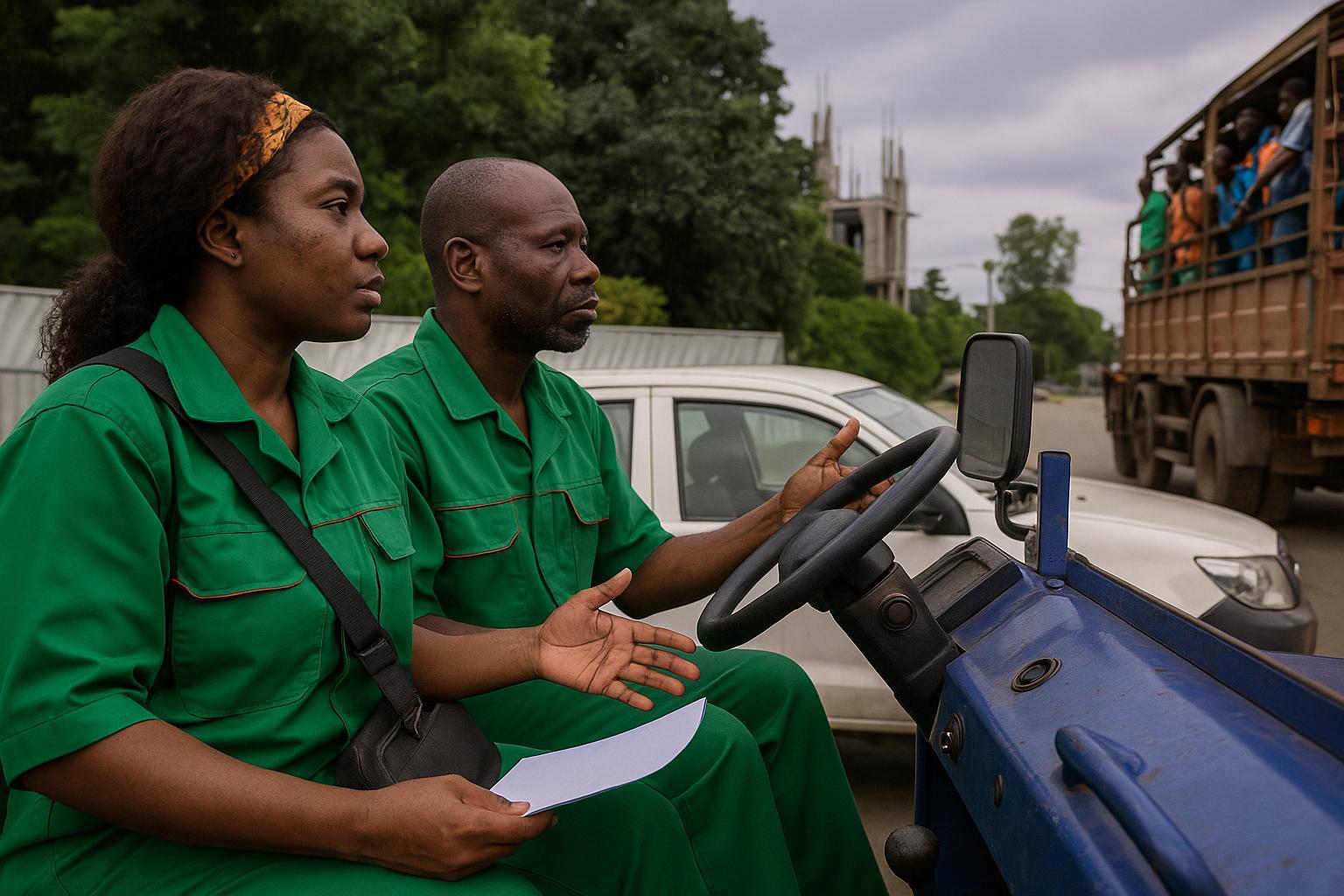
Graduation boosts skilled tractor operators
Applause echoed through Brazzaville on 19 December as 47 freshly minted tractor operators, including three determined women, collected their completion certificates after a month of intensive training in agricultural machinery.
They form the fourth cohort of the national tractorist programme, covering learners from Otsende, Oyo, the wider Cuvette region and the fertile Bouenza, all eager to drive Congo-Brazzaville’s push toward modern, less strenuous farming.
The course, organised by the Ministry of Agriculture, Livestock and Fisheries with the Centre for Agricultural Machinery Operation, blended classroom briefs with field drills on real plots, mirroring the tasks the graduates will soon perform.
Officials and relatives attended the ceremony, their presence underscoring the value now placed on skilled mechanisation as the country sets sights on boosting yields and curbing costly food imports.
Hands-on lessons from safety to repair
Over four packed weeks, trainees alternated between steering practice and maintenance workshops, starting each dawn with safety checks before driving Massey Ferguson units across demonstration plots laid out near the capital.
Instructors drilled proper gear changing for different soil textures, optimal ploughing depth to protect seedbeds, and precise alignment to minimise diesel use, an increasingly important factor as global fuel prices fluctuate.
Classroom sessions covered highway code requirements, first-aid basics for remote accident response, and the principles of agricultural entrepreneurship so that tractorists can one day operate as service providers for neighbouring farmers.
Participants also learned how to diagnose common breakdowns, strip and clean fuel filters, and schedule preventive servicing, a skillset that saves downtime during critical planting or harvesting windows.
State investment anchors farm mechanisation
Minister Paul Valentin Ngobo applauded the graduates, reiterating that efficient tractor use is a cornerstone of the national strategy to secure food sovereignty under the current development blueprint.
‘The government will keep investing so that every trained youth finds a steering wheel and every hectare finds a tractor,’ he promised, pointing to upcoming fleet renewals and public-private partnerships for equipment leasing.
Ngobo praised the Centre for Agricultural Machinery Operation for tailoring modules to local realities, citing riverine soils in Cuvette and heavier clay in Bouenza that demand different tilling techniques.
Agricultural analyst Euloge Patrick Mbanza urged the cohort to cherish their trade, arguing that proud professionals transmit confidence to smallholders and inspire other youngsters to explore careers beyond urban offices.
Trainees share pride and expectations
Speaking on behalf of his peers, Julia Paul Oyoua thanked instructors for demystifying complex engines and showing real-time field adjustments, from hitch depth to tyre pressure, that transform rough terrain into even seedbeds.
He noted that his first hands-on experience with a 100-horsepower tractor erased previous fears, replacing them with a sense of responsibility toward family plots that once relied solely on manual hoes.
Fellow graduate Odile Moukassa, one of the three women, said the course proved that gender is no barrier to heavy equipment mastery, and she hopes to encourage more girls from Otsende to enrol.
Parents attending the ceremony expressed relief that their children can now access gainful work within their home regions, reducing rural exodus and supporting community cohesion through year-round agricultural services.
Mechanisation lifts rural economy prospects
According to the ministry, properly operated tractors can prepare up to ten times more land per day than animal traction, freeing labour for planting, weeding and processing, activities that create additional household income.
Analysts suggest that improved land preparation can raise yields of staple cassava and maize, two crops central to food security, while opening space for market-oriented produce such as groundnuts and vegetables.
Equipment operators also gain entrepreneurial avenues by renting their services within cooperatives or ZAAP zones, a model that spreads mechanisation without requiring every farmer to purchase expensive machinery outright.
Local banks have started designing micro-leasing products adapted to seasonal cash flows, and officials believe the presence of certified tractorists will reassure lenders about the proper care of financed assets.
Experts note that mechanisation mitigates climate risk by enabling quicker sowing after first rains, reducing exposure to erratic weather that has shortened planting windows across Central Africa in recent years.
Deployment to ZAAP sites ahead
The fourth cohort will soon disperse to planned agricultural service zones known as ZAAP, where they will join earlier graduates from 2023 and September 2025 to support land preparation for the next cropping season.
Training records show each ZAAP site pairs operators with extension agents, allowing farmers to book tractor sessions in advance and receive advice on seed variety and fertiliser application.
Follow-up evaluations will monitor soil conservation practices, fuel consumption, and income changes among beneficiary households, feeding data back to the ministry for continuous programme refinement.
With fresh skills and national support, the 47 graduates now look to the horizon, confident that the rumble of their engines will echo through Congo-Brazzaville’s fields and signal a new chapter of productivity.