
Thystère Roundabout Gets Facelift
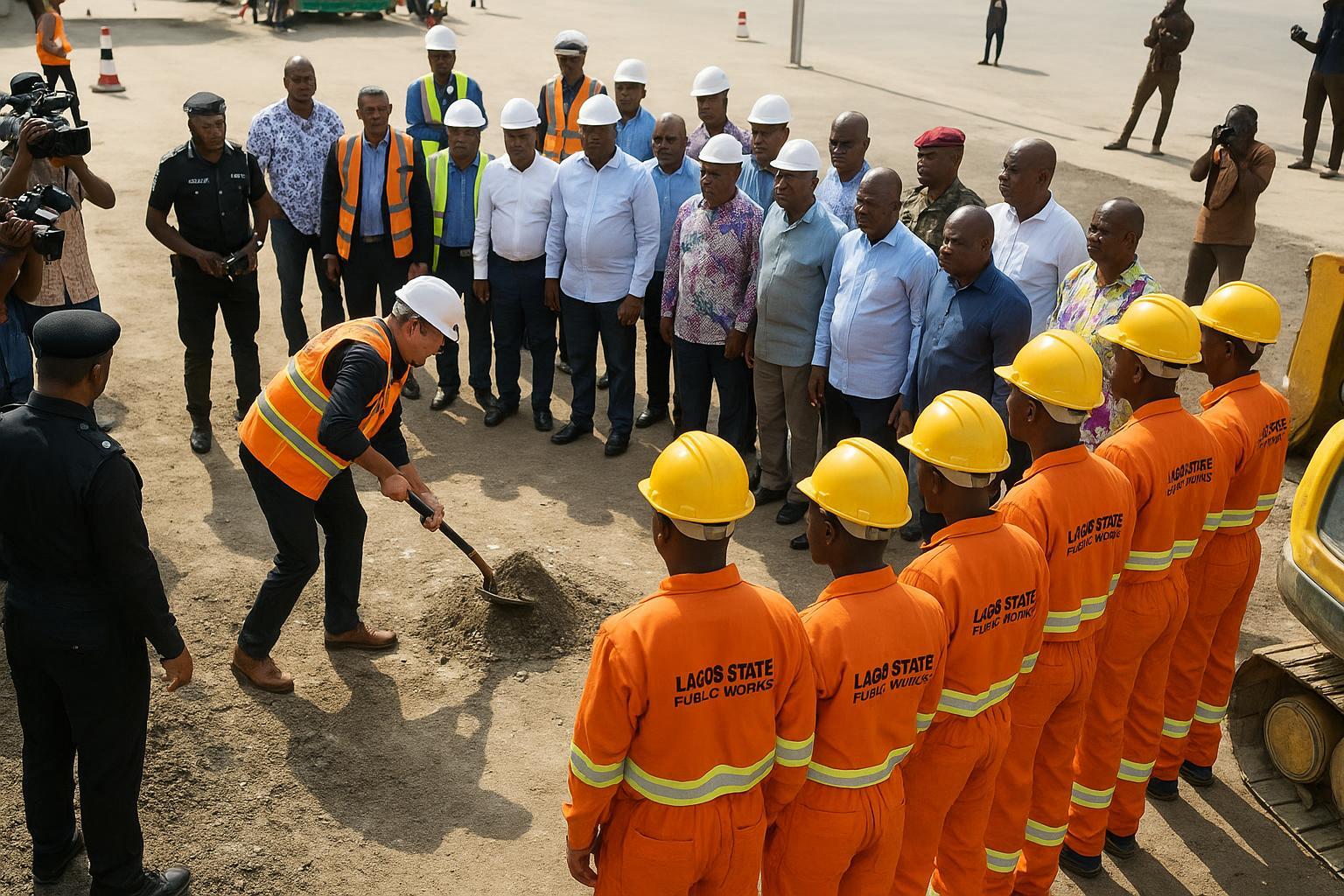
The busy Thystère roundabout on the edge of Pointe-Noire is again a hive of machines, not of honking taxis. On 12 December, concessionaire La Congolaise des Routes, LCR, opened a fast-track rehabilitation of this entry point to National Road 1, the country’s main corridor.
For years, the concrete circle had lagged behind the newer dual carriageway that flows inland toward Brazzaville. Cracked slabs, rainwater pockets and informal market stalls combined to slow traffic to a crawl at what engineers call PK0, kilometre zero of RN1.
Strategic Node for the National Highway
RN1 stitches together 535 kilometres of economic life, linking the deep-water port at Pointe-Noire to the capital’s ministries, factories and markets. Every bag of cement, container of timber or busload of students leaving the coast first negotiates the Thystère roundabout.
Evelyne Tchitchelle Moe-Paty, the city’s administrator mayor, recalls peak-hour snarl-ups stretching past the petrol station. “The bottleneck was undermining both safety and the city’s image,” she tells us. “Restoring free flow here was non-negotiable for residents and for businesses relying on the port.”
Why the Upgrade Could Not Wait
On the macroscopic map, a roundabout seems small. On the ground, however, a damaged junction multiplies travel time along the entire corridor. LCR monitoring data show average vehicle speed at PK0 fell below 10 km/h during the November rains, compared with 60 km/h on adjacent sections.
That slowdown carries a cost. The Chamber of Commerce estimates each additional minute of truck idle time at the port area translates into 1.2 million CFA francs in cumulative expenses per week for logistics operators. Without intervention, wear on clutches and brakes also inflates public-sector maintenance bills.
One-Month Engineering Sprint
LCR’s site manager sets a brisk schedule: four weeks to mill the old surface, rebuild the base layers, pour reinforced concrete and relay asphalt across roughly 200 metres, including the approaches. Night shifts will shorten disruption, while temporary signage channels vehicles through two contra-flow lanes.
Engineers are also reshaping the inner island to widen the turning radius for semi-trailers, a fix requested by freight companies. Storm-water gutters and LED lighting will be added, bringing the junction up to the standards already in place along the 120-kilometre Loango–Dolisie section.
Keeping Trade and Traffic Moving
LCR must balance speed with safety. The company’s 24-hour call centre, popularised through the short code 345, is collecting user feedback in real time. Drivers report wait times of under seven minutes in the first week of works, thanks to coordination with municipal traffic police.
Public transport cooperatives have been briefed on detours, and street vendors relocated to a temporary bazaar behind the rail line. The city plans to convert that plot into a permanent, serviced market, reducing future encroachment on the highway reserve and giving traders room to grow.
Working Hand in Hand with Local Authorities
The build-back is the visible part of a wider partnership. Before machinery arrived, Pointe-Noire’s technical services spent two months removing illegal kiosks and completing topographic surveys. “Emprises are not just lines on paper,” Jacques Almaless, LCR deputy director-general, reminds local councils along RN1.
He argues that protecting the right-of-way is cheaper than repairing it. In his words, “Each franc invested in prevention saves four francs in future reconstruction.” Mayors from Kouilou to Bouenza have been invited to share land-management experiences in a workshop scheduled for early February.
Looking Ahead Along RN1
The Thystère project exemplifies the integrated concession model adopted by the Congolese state in 2017, wherein LCR handles routine upkeep, heavier renewal and user services under one performance-based contract. Independence from annual budget cycles allows the firm to plan multi-year interventions like this one.
Economists at the Ministry of Planning cite an internal rate of return above 18 percent for the RN1 programme, driven by lower vehicle operating costs and reduced travel time. With the port expansion under way and cocoa exports rising, a resilient gateway becomes even more decisive.
The government’s 2024–2027 transport strategy earmarks 120 billion CFA francs for successive overlays on RN1 as traffic climbs from the current 2,800 vehicles a day to an expected 4,500. Officials confirm that lessons drawn in Pointe-Noire will inform similar projects near Nkayi and Kinkala.
From Construction to Smooth Journeys
Once the fresh asphalt cures, LCR intends to run a road-safety awareness day in partnership with the gendarmerie and school associations. The idea is to anchor long-term gains in driver behaviour, not just in concrete. Reflective armbands will be distributed to pupils crossing the junction.
For now, hydraulic breakers thud while motorists edge around barriers. If the calendar holds, the roundabout will reopen fully before the late-January cargo surge. Then, as shipping cranes silhouette the Atlantic dawn, travellers may no longer remember the delays that once defined kilometre zero.
Weather permitting, the finishing coat will include coloured thermoplastic lane markings, a first for the city, designed to guide night-time drivers and reduce collisions.