
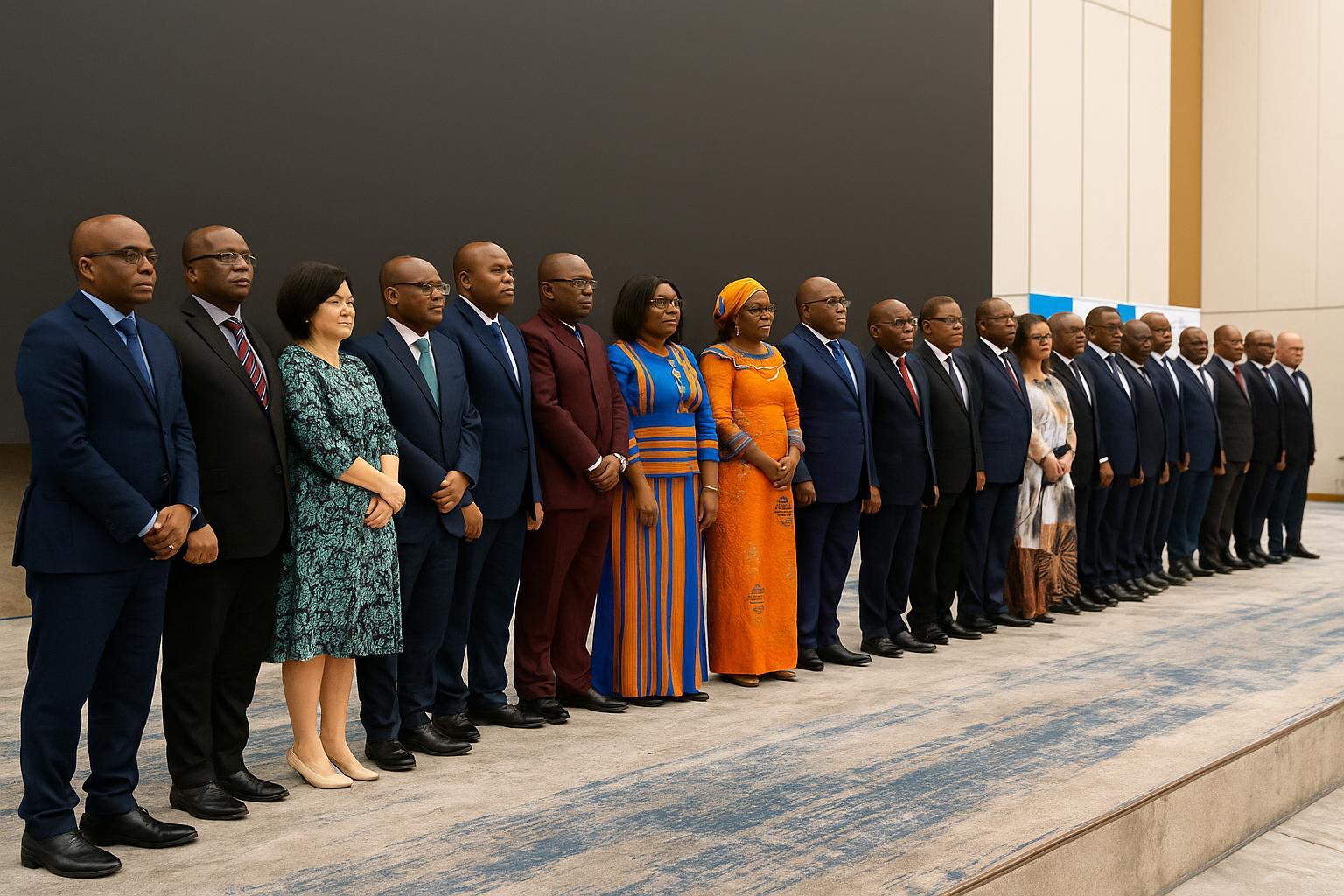
Brazzaville Ceremony Highlights
A packed conference hall at the Hilton Twin Towers in Brazzaville turned into a classroom of optimism on 16 December 2025 as Prime Minister Anatole Collinet Makosso officially launched the Education Sector Transformation for Better Results (TRESOR) and the Basic Education Quality Support Program (PARQEB).
Flanked by UNICEF, UNESCO, and World Bank country representatives, the head of government described the twin projects as “a decisive milestone” in the national bid to elevate learning outcomes, teacher performance and system efficiency.
The ceremony drew senior ministers, Brazzaville Prefect Gilbert Mouanda-Mouanda and social partners, underscoring the whole-of-society commitment expected to steer the 94.6-billion-CFA-franc investment toward tangible classroom change.
Twin Programs TRESOR and PARQEB Explained
TRESOR is anchored in the 2022-2026 National Development Plan and the 2021-2030 sector strategy, seeking to widen access, boost quality and reinforce governance across pre-primary and primary cycles.
PARQEB, meanwhile, zeroes in on foundational skills by supplying textbooks, teacher guides, continuous training and upgraded data systems that let decision-makers react rapidly to learning gaps.
Both initiatives were unlocked after a successful UNESCO-UNICEF consortium application to the Global Partnership for Education, confirming Congo’s ability to mobilize international trust and resources for its schooling agenda.
Results-Based Funding Model
A hallmark of TRESOR is its performance-linked disbursement approach championed by the World Bank’s International Development Association; funds are unlocked once specific classroom indicators—attendance, reading proficiency, gender parity—are verified.
Officials say the model will nurture a culture of accountability in school management and accelerate Congo’s ongoing transition to a programme-budget framework across ministries.
UNICEF Representative Maria Vittoria Balota called the scheme “a major step toward structural and durable transformation”, pointing to lessons learnt from the 2022 UN Transforming Education Summit, where Congo pledged practical follow-up through national education forums.
Focus on Teachers and Learners
At least 25,000 educators are slated for competency-based refresher courses, incorporating digital tools and inclusive classroom techniques designed to keep marginalised pupils engaged.
For learners, 5.2 million new textbooks and workbooks will be printed over the project cycle, while early-childhood centres will receive play-based materials aimed at preparing children for the literacy jump in Grade 1.
Education Minister Jean-Luc Mouthou told our newsroom that improving the first three years of schooling is “the surest ticket to long-term productivity and inclusive growth” because cognitive deficits are hardest to rectify later.
Targeting Underserved Departments
Field studies by the Ministry of Planning show the departments of Lékoumou, Pool, Sangha and Likouala trail the national average in pupil-teacher ratio, textbook availability and transition rates from primary to lower secondary.
TRESOR and PARQEB allocate roughly 40 percent of spending to these zones, including the rehabilitation of 600 classrooms, solar-powered water points and boarding facilities for children living far from schools.
Local civil-society leader Sylvie Ntoungou, speaking from Sibiti, argued that the focus on remote communities “will reduce early drop-out and teenage migration toward cities, giving rural families confidence in public services again”.
Government and Partners in Sync
Prime Minister Makosso insisted inter-ministerial coordination remains the backbone of success, with finance, public service and social affairs teams aligning recruitment, payroll and social-protection reforms to accompany the classroom investments.
Quarterly dashboards will be published on the government open-data portal, an innovation welcomed by World Bank Resident Representative Anna Maria Alexandra Celestin as “a transparency signal attractive to future financiers beyond the current consortium”.
Looking Ahead: Timelines and Metrics
Implementation spans five years, with the first disbursement window closing in July 2026; by then authorities expect at least 1.2 million pupils to have benefited from improved learning materials and safer facilities.
Success will be measured through national learning assessments aligned with the Programme for the Analysis of Education Systems in Francophone Africa, ensuring Congo can compare its progress with peers in Central and West Africa.
Beyond bricks and books, officials stress that a revitalised education sector will feed the wider economic diversification agenda championed by President Denis Sassou Nguesso, positioning a new generation to seize opportunities in agriculture, digital services and green energy.
Teacher unions have applauded the inclusion of performance incentives but cautioned that classroom sizes must not exceed the statutory 45-pupil limit if learning gains are to be sustained after donor funding tapers.
Responding, Public Service Minister Firmin Ayessa confirmed that 3,000 new teachers will be recruited annually until 2028, prioritising science and bilingual instruction profiles needed for regional labour markets.
Education economist Dr. Richard Ndinga notes that every franc invested in early grades yields an estimated six-franc return through higher lifetime earnings, reduced repetition and lower youth unemployment, citing past CEMAC-wide cost-benefit studies.
He adds that Congo’s choice to blend state budget, IDA credit and grant components shields the program from macroeconomic swings and preserves the debt-to-GDP ratio within the convergence threshold set by the Central African Economic and Monetary Community.