
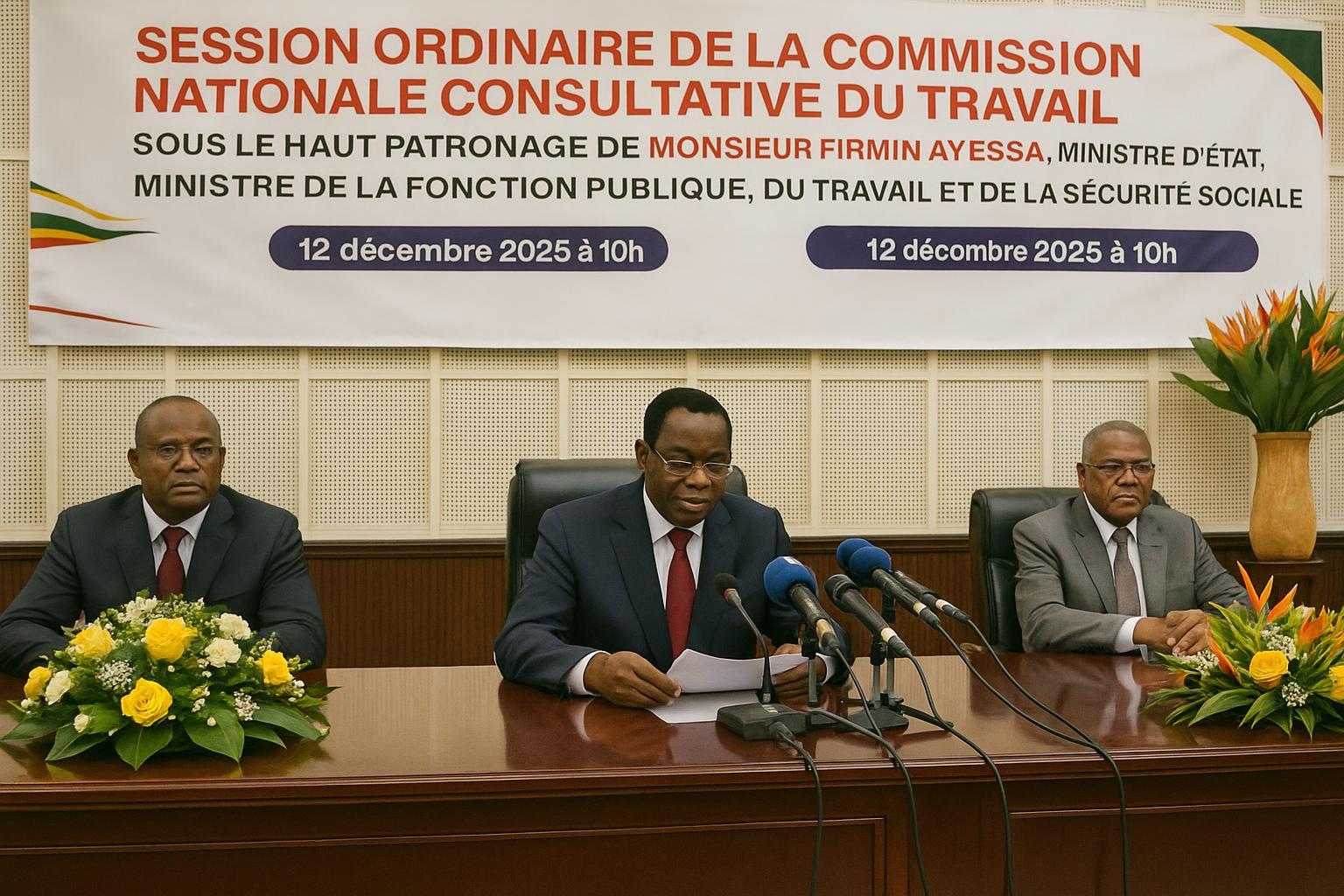
Brazzaville session sets the tone
Inside the Justice Ministry’s conference hall on 12 December 2025, the National Consultative Labour Commission opened its ordinary session with a single mission: polish the draft labour code that will soon be tabled before Parliament. The meeting gathered cabinet members, employers’ federations and leading union confederations.
Minister of State Claude Alphonse Nsilou, standing in for Public Service and Labour Minister Firmin Ayessa, thanked delegates for “finding time in your crowded agendas to shape a code that matches the Republic’s economic and social ambitions”. His words set an atmosphere of shared purpose rather than confrontation.
Tripartite talks shape modern code
The Commission works in a tripartite format endorsed by the International Labour Organization, mixing government officials with representatives of Unicongo, Unoc, Cogepaco and union centres CSTC, CSC and COSYLAC. Experts spent months cross-checking every article, seeking language that protects workers yet keeps hiring flexible for investors.
Participants describe the 2025 draft as lighter, more readable and firmly anchored in national realities such as the strength of the informal economy and the rapid growth of services. Key chapters rewrite rules on contracts, workplace safety and dispute resolution to reduce grey zones that once delayed arbitration.
Key reforms: retirement & minimum wage
Several flagship measures already adopted by decree or separate law have been folded into the new code for coherence. Law 48-2024 of 30 December 2024 fixed the general retirement age and is now referenced in the draft’s chapter on career endings, ending years of overlapping texts.
Another anchor is Decree 2024-2752 of 20 November 2024, which set the inter-professional guaranteed minimum wage. By embedding the SMIC directly in the code, lawmakers hope to give small businesses a clear benchmark and workers a floor that is easier to update with inflation data released by the National Statistics Institute.
International standards embedded
Since 2023 Congo ratified several ILO conventions on decent work, telework and part-time employment. Technical advisers from the ILO’s Yaoundé office sat beside Congolese jurists to ensure wording mirrors global definitions. That alignment is expected to facilitate future audits of supply chains by international partners.
For companies eyeing African Continental Free Trade Area opportunities, predictable labour rules are crucial. “The draft recognises modern forms of work without ignoring traditional sectors like forestry and mining,” noted a legal analyst at Unicongo, who praised the inclusion of digital safeguards for remote employees.
COVID-19 lessons inform telework rules
Delegates recalled the pandemic years, when sudden confinement made remote work an obligation rather than a perk. Those months generated practical experience now codified in articles covering equipment costs, overtime calculation and the right to disconnect after hours.
Union representatives welcomed the clause requiring written agreements on telework, saying it limits surprises for both sides. Employer groups insisted that the same clause offers enough flexibility to adapt to bandwidth constraints outside Brazzaville and Pointe-Noire. The compromise was unanimously adopted in committee.
Protecting informal workers
Statistics suggest that more than half of Congolese workers are in informal settings. For the first time, the code proposes simplified registration so micro-enterprises can declare staff without heavy paperwork. Social partners argue this step could widen the tax base while opening access to national health insurance.
A pilot phase is planned in markets and transport cooperatives. Government officials believe gradual onboarding will build trust and avoid sudden compliance costs that could push vendors back underground. The draft assigns the Labour Inspectorate a mentoring role rather than a punitive one during the transition period.
Gender and youth focus
During debates, women unionists highlighted maternity protection and equal pay. The draft extends post-natal leave and strengthens sanctions against workplace harassment. It also introduces apprenticeship contracts aimed at graduates under 30, backed by tax incentives for employers that convert trainees into permanent staff.
“These provisions answer our demographic reality—young and ambitious,” observed a representative from COSYLAC. Employers, for their part, applauded the streamlined apprenticeship framework, predicting faster skills matching for emerging sectors like renewable energy maintenance and logistics.
Timeline and next steps
The Commission is expected to submit the final draft to the Council of Ministers in early February 2026. If approved, Parliament could debate the text during its first ordinary session that year. Observers anticipate broad political backing, given the extensive consultation and the growth targets set in the government’s 2022–2026 Development Plan.
Between now and the parliamentary reading, task forces will prepare explanatory guides and radio programmes so citizens understand the forthcoming changes. The Labour Ministry also plans training sessions for regional inspectors to ensure uniform application once the code becomes law.
Business community cautiously optimistic
Leading manufacturers in Pointe-Noire see the rewrite as an opportunity to clarify overtime costs and simplify expatriate work permits. Small traders hope clearer dismissal procedures will curb informal settlements at neighbourhood courts.
However, executives remain attentive to final wording on strike notices. Unions insist on maintaining the 72-hour advance notice, while employers would prefer five days. Negotiators say the issue is still open but expect a balanced formula that safeguards both productivity and constitutional rights.
A milestone for Congolese labour
As discussions wind down, Claude Alphonse Nsilou reminded delegates that the current labour code dates back over two decades. “Our economy, our demographics and our ambitions have changed,” he said. “This new text will give every player—worker or entrepreneur—a secure, modern framework.”
If the calendar holds, Congo-Brazzaville could enter 2026 with one of Central Africa’s most up-to-date labour codes, sending a strong signal to investors and the diaspora alike that the country is fine-tuning its business climate while protecting its people.