
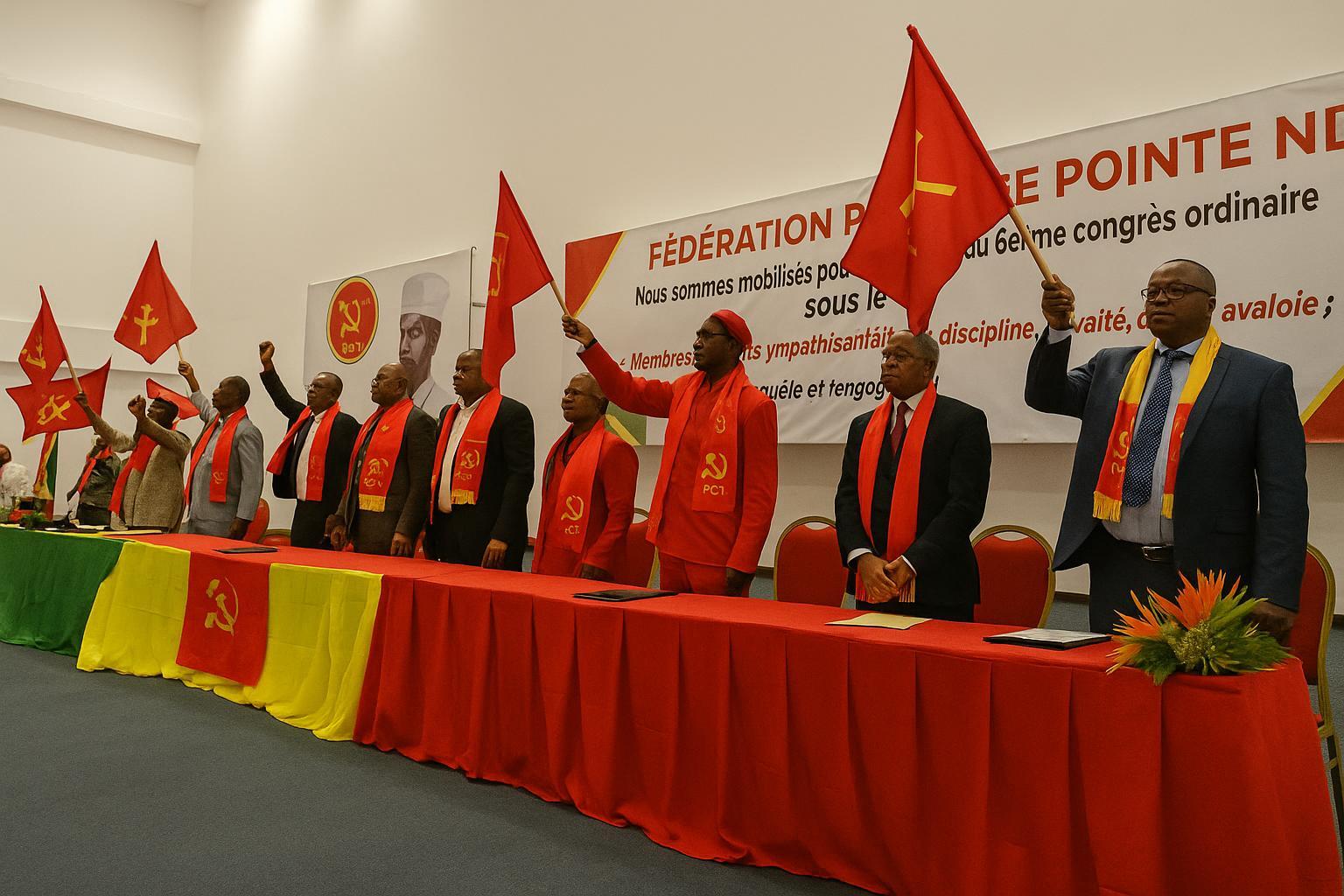
Pointe-Noire congress closes in unity
After two intense days of deliberation, the Federal Congress of the Congolese Labour Party (PCT) in Pointe-Noire adjourned on 7 December, having fine-tuned its roadmap for the coming three years under the watchful eye of national delegation head Anatole Collinet Makosso.
The gathering, which opened on 6 December, blended speeches, commission work and late-night caucuses as more than 150 elected delegates weighed organisational tweaks, programme priorities and candidate endorsements before boarding the train – both literal and political – that will carry them to the 6th Ordinary Congress in Brazzaville.
Unity resolutions back Head of State
Delegates adopted without dissent a recommendation inviting the forthcoming national congress to invest President Denis Sassou Nguesso as the PCT’s standard-bearer for the March 2026 presidential election, while also urging his re-election as party Central Committee president to guarantee continuity and stability.
Another motion voiced « warm congratulations » to the Central Committee and Secretary-General Pierre Moussa for steering the party through a challenging economic landscape marked by post-pandemic recovery and global energy volatility, circumstances in which Pointe-Noire’s vibrant oil hub plays both a frontline role and a testing ground.
Makosso calls for effective grassroots work
In his opening address, Prime Minister Makosso reminded militants that « membership cards alone do not win ballots », insisting on daily outreach, community service and clear messaging around the government’s social programme as the most persuasive tools to consolidate the gains registered in municipal polls.
He later closed the congress by pointing to the « impressive mobilisation » witnessed throughout the preparatory phase, from neighbourhood rallies in Tié-Tié to digital campaigns on local WhatsApp groups, arguing that such signs confirmed the PCT’s position as uncontested leader of Pointe-Noire’s increasingly competitive political arena.
Countdown to Brazzaville’s 6th Ordinary Congress
From 27 to 30 December, the capital will host some two thousand delegates, observers and guests for the 6th Ordinary Congress, the party’s highest authority, expected to refine policy directives on youth employment, industrial diversification, energy transition and regional cooperation within CEMAC.
The Pointe-Noire federation intends to arrive with a unified voice, spokesperson Sylvie Ngoma told journalists, emphasising that earlier internal debates on gender balance, candidate selection rules and digital strategy had now been settled, allowing the coastal delegation to focus on proposing concrete, costed projects for the national agenda.
Oil city dynamics shape political messaging
Pointe-Noire generates roughly two-thirds of Congo-Brazzaville’s export earnings, and delegates repeatedly linked the party’s social pledges to the need for continuous investment in port efficiency, fisheries modernisation and local content rules that translate national hydrocarbons revenue into neighbourhood-level employment opportunities.
« Our people judge us on visible improvements, not abstract macro-indicators, » stressed economic affairs commissioner Alexis Mvouba, citing recent upgrades of Avenue Charles de Gaulle and the launch of an artisan market as examples of how the ruling party can turn policy into tangible street-corner change.
Preparing the 2026 presidential playbook
With the national ballot still more than two years away, strategists are already dissecting demographic trends showing a youthful electorate demanding jobs, affordable housing and digital connectivity; many see the early endorsement of President Sassou Nguesso as a way to avoid internal distraction and focus on delivery.
Political scientist Jean-Bruno Kimbembe, reached by phone, believes the Pointe-Noire congress strengthened the incumbent’s hand because « the economic capital often sets the tone; if the oil workers’ vote is secured early, momentum grows inland all the way to the plateaux ».
Inside the commission rooms
Participants broke into thematic commissions on education, public health, culture and communication strategy, each returning with action sheets assigning responsibilities to district sections, an approach praised by veteran organiser Honoré Ndavou for shifting from theoretical slogans to measurable indicators and quarterly reporting.
Young militants also held a parallel forum on social media ethics, pledging to counter misinformation while promoting civil, data-verified debate; they agreed to create a content calendar aligned with national holidays, sporting events and agricultural seasons to keep messaging fresh and locally relevant.
Voices from the floor
Dorsaf Samba, a dockworkers’ union delegate, said the party’s insistence on port modernisation resonated with her colleagues who « see cranes before programmes ». Retired teacher Thérèse Mafoa, meanwhile, applauded the focus on text-book supply, describing it as the « oxygen of classrooms ».
Smooth logistics, festive note
Organisers booked the freshly renovated Atlantic Conference Hall, ensured antigen testing at the gate and arranged a folklore evening featuring komba drums and hip-hop duo Imperial Club, underscoring the PCT’s trademark mix of disciplined procedure and Congolese conviviality.
What comes next
Within ten days, each district bureau must transmit its amended action sheet to party headquarters. National rapporteurs will compile the documents into a single synthesis for the Brazzaville congress, where resolutions will acquire binding force once countersigned by the Political Bureau.
Travelling to the capital
Delegates will board the daily Congo-Ocean Railway, with extra carriages promised to ease festive traffic.
For now, delegates return home confident that Pointe-Noire’s voice will carry weight in late December and, beyond that, in the march toward the 2026 polls, a journey the party frames as one of continuity, modernisation and inclusive national progress.