
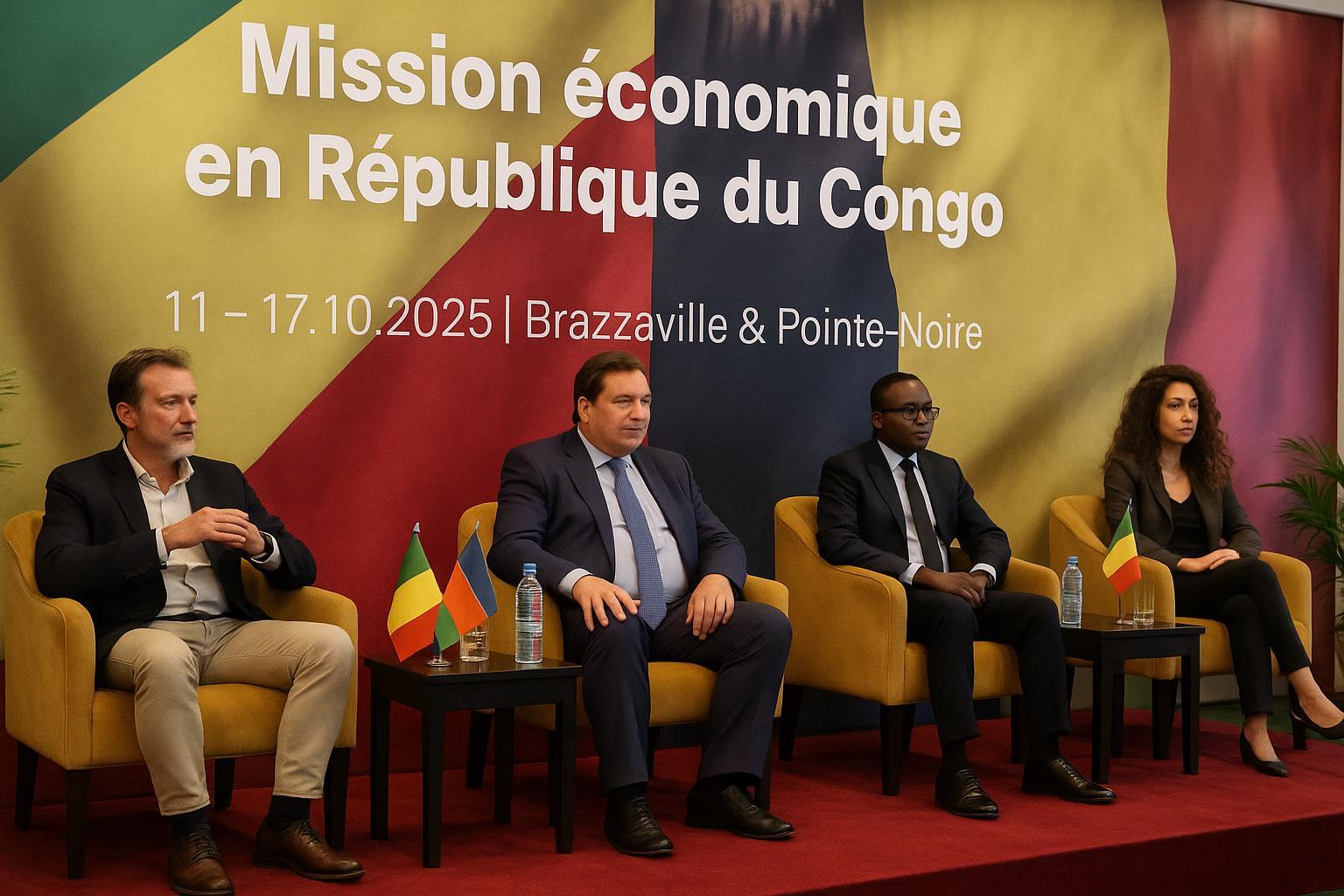
Belgian delegation launches mission
Brazzaville witnessed a surge of business chatter on 13 October as 18 Belgian companies kicked off a five-day economic mission designed to match Congo’s growth ambitions with European know-how.
Organised jointly by the Belgian and Congolese embassies, with backup from the Brazzaville and Pointe-Noire chambers of commerce, the delegation’s first highlight was a frank roundtable that unpacked opportunities across agriculture, energy, construction and public works.
Government officials, development partners and private-sector leaders shared the podium, setting a collaborative tone that participants described as refreshingly pragmatic.
Mapping Congo’s business hotspots
Opening the discussion, Union patronale et interprofessionnelle du Congo president Michel Djombo sketched a macro picture of the national economy, noting consistent 4% growth, vast arable land and a youthful labour force eager for skills transfer.
Henry René Diouf, deputy resident representative of UNDP, reinforced the message, citing recent reforms that simplify company registration to forty-eight hours and introduce tax incentives for green energy investments.
‘Investors increasingly look for predictability, and Congo is moving in the right direction,’ Diouf insisted, adding that access to regional CEMAC markets multiplies the potential return.
Construction boom opens doors
The roundtable’s second block zeroed in on bricks and mortar, an area where Congo has budgeted heavily for roads, housing and public facilities.
Federica Petrucci, deputy head of European Union cooperation in Congo, praised the government’s Integrated Municipal Development Plan, calling it ‘a blueprint that aligns donor support with private financing to close infrastructure gaps’.
From modular bridges to prefabricated schools, Belgian firms such as BESIX and DEME signalled interest, emphasising speed, cost control and local job creation in pitches that drew nods from municipal officials.
Private capital and infrastructure
A dedicated segment explored financing, with bankers outlining blended structures that mix export credits, local currency loans and public guarantees.
Speakers argued that early private participation trims project delays and releases public funds for health and education, echoing priorities in the 2022–2026 National Development Plan.
‘The Congolese state welcomes credible partners ready to share risk rather than chase quick wins,’ stated Commerce Ministry adviser Armand Ossebi, urging Belgians to register local subsidiaries to anchor long-term presence.
Voices from the round table
In side-line B2B sessions, Congolese agri-processor AgriPalm discussed a joint venture with Brussels-based BioOil aimed at upgrading palm waste into bio-fertiliser.
Meanwhile, software start-up CongoTrack negotiated a pilot with telecom operator Proximus to deploy IoT sensors on timber trucks, a move applauded by environmental NGOs for improving traceability.
Both deals, though preliminary, illustrate how the mission goes beyond speeches, translating into concrete memoranda expected to be formalised in coming weeks, according to organisers.
Next stops Pointe-Noire and beyond
The delegation travels to Pointe-Noire on 15 October for port visits and meetings with oil-service clusters, before wrapping up on 17 October.
Belgian Ambassador Eric Jacquemin said the coastal leg will highlight logistics corridors that could halve shipping times between Central Africa and Europe once planned dredging works finish.
For Congolese authorities, the mission underscores a vision of diversified partnerships, aligning with President Denis Sassou Nguesso’s call for value-adding investments that create jobs and transfer technology while respecting national sovereignty.
Why Belgium looks south
Belgian enterprises have intensified their African outreach since 2020, searching for resilient markets less exposed to the supply-chain shocks that rattled Europe during the pandemic. Executives cite language compatibility, time-zone proximity and Congo’s membership in the francophone OHADA legal area as additional assets.
‘A midsize Belgian company can reach decision makers in Brazzaville more easily than in larger economies, allowing tailor-made solutions,’ explained Pierre De Wulf, Africa director at Wallonia Export-Invest, who noted that the mission includes firms ranging from fintech to waste management.
Analysts at Brussels-based think tank ECDPM estimate that Congo’s import bill for construction materials tops US$600 million annually, signalling room for European suppliers to localise production and capture value on the ground.
Support services and aftercare
To smooth entry, the Congolese Investment Promotion Agency (API) set up a one-stop desk at the event hall, issuing provisional business registration numbers within hours. A help-line will remain active for six months, providing legal translation and customs guidance.
API director Clarisse Okemba said the agency’s aftercare programme tracks foreign investors for three years, flagging bottlenecks to relevant ministries, an approach that helped cut average project start-up time from 18 to 11 months.
Belgian firms responded positively, yet called for predictable foreign-exchange access, faster port clearance and expanded vocational training to guarantee skilled labour, items that organisers pledged to integrate into the forum’s final communiqué.
Looking ahead, both sides hinted at a follow-up session during the Congo-Belgium Joint Commission scheduled for early next year in Brussels, where sectoral working groups on digital services, circular economy and creative industries will be tasked with drafting project pipelines and identifying co-financing windows with European institutions.
Delegates parted optimistic, exchanging WhatsApp groups to maintain momentum beyond the Brazzaville halls.