
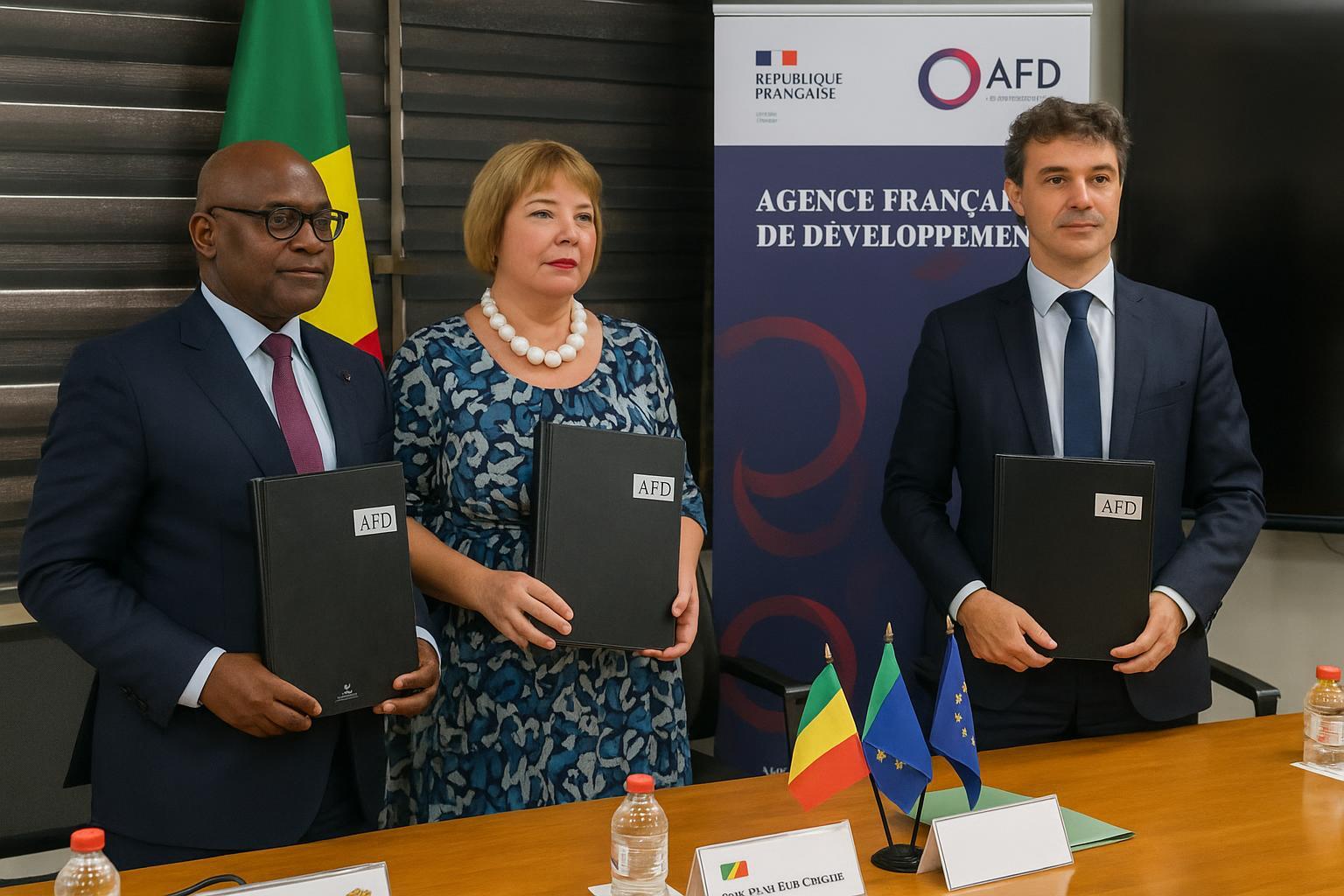
New lifeline for Téléma social safety net
On Monday 2 October, Minister of Finance, Budget and Public Portfolio Christian Yoka and French ambassador Claire Bodonyi placed their signatures on an addendum that injects almost CFA1.968 billion into Téléma, the national productive inclusion programme for vulnerable citizens.
The deal, concluded within the Congo–France Debt Reduction-Development Contract framework dating back to 2010, lifts the overall envelope dedicated to Téléma and signals enduring bilateral confidence in Brazzaville’s social action roadmap.
Fresh funds, fresh geography
Close to CFA2 billion will extend operations beyond Brazzaville, Pointe-Noire and Pool to three new departments: Cuvette, Niari and Lékoumou, specifically in the towns of Oyo, Dolisie and Mayéyé, where Social Action Circonscriptions will undergo renovation and refitting to welcome the public.
Officials say the building works will follow the same model that recently modernised facilities in Kinkala, Talangaï, Makélékélé, Moungali and Mvoumvou, offering private counselling rooms, disability-friendly ramps and digital kiosks for easier registration.
Spotlight on youth and women
The addendum earmarks resources for the onboarding of 600 additional vulnerable people, half of whom are young women keen on launching micro-projects in agriculture, catering, tailoring and mobile services, according to the Ministry of Social Affairs.
Each beneficiary will receive a personalised support plan and, when ready, up to CFA2 million in seed money, mirroring the average ticket already granted to nearly 1 000 entrepreneurs in previous Téléma rounds.
Indigenous communities in focus
For the first time, Téléma will pilot dedicated insertion schemes for Congo’s indigenous populations, a move praised by advocacy groups who see it as a gateway to sustainable jobs that respect cultural specificities.
Christian Yoka underlined that “no one should be left on the sidelines of development”, pointing out that the programme’s mentorship component pairs experienced artisans with young protégés in forest-based crafts, eco-tourism and non-timber product processing.
Building the data backbone
Part of the envelope will help finalise the National Social Information System, designed to feed a single social registry and track the progress of every Téléma beneficiary over time through biometric IDs and geolocated dashboards.
The ministry argues the digital layer will make social spending more transparent and help decision-makers adjust cash-transfer cycles, training calendars and graduation criteria in real time.
Solid partnership with France
French ambassador Claire Bodonyi stressed that Téléma embodies the spirit of the Debt Reduction-Development Contract, “turning past debt into future opportunity” while reinforcing historic ties between Brazzaville and Paris.
Antoine Chevalier, head of the French Development Agency in Congo, added that the additional resources “come at a pivotal moment when the programme is ready to scale up and demonstrate measurable impact across the country”.
Track record and local pride
Since its launch, Téléma has rehabilitated the former African Institute of Rehabilitation and upgraded departmental social affairs offices in Brazzaville and the Pool, thus expanding outreach capacity and creating short-term construction jobs.
Entrepreneur Thérèse Mabiala, who opened a small cassava-flour unit in Talangaï thanks to the scheme, told us her turnover doubled within a year and she now employs four neighbours, “proof that coaching plus a modest grant can move mountains”.
What happens next
Technical teams from the Ministry of Social Affairs and the French Development Agency will carry out appraisal missions in Oyo, Dolisie and Mayéyé before year-end, with construction slated to start early next year, subject to environmental clearance.
Meanwhile, a fresh intake of trainees will begin business literacy sessions in the capital in November, ensuring the momentum of Téléma is maintained while infrastructure is being readied upcountry.
As Congo steers toward inclusive growth, the reinforced Téléma programme stands out as a tangible bridge between high-level cooperation, grassroots enterprise and the day-to-day hopes of families determined to chart their own future.
Economic ripple effects
Economists at the University of Marien-Ngouabi estimate that every franc invested in micro-projects under Téléma generates up to three francs in local turnover within two years, mainly through the purchase of inputs and the payment of informal labour.
Small transporters in markets around Makélékélé report higher freight demand on weekdays, while mobile-money agents note a steady uptick in peer-to-peer transfers, suggesting the cash is circulating rather than being hoarded.
In rural Niari, farmers’ cooperatives anticipate that Téléma trainees could fill gaps in bookkeeping and marketing, thereby helping producers fetch better farm-gate prices once the new wave of support arrives.
Governance and accountability
To oversee the expansion, a steering committee chaired by the Directorate-General for Social Affairs will meet quarterly, with seat allocations for local civil-society observers and youth representatives, replicating a formula credited with smoothing earlier project phases.
Regular public dashboards will display disbursements and performance indicators, a transparency pledge that aligns with government priorities on good governance and prudent budget management.
Speaking at the signing, Eugène Ikounga, chief of staff at the Ministry of Social Affairs, reaffirmed that social inclusion remains a “pillar of the 2022-2026 National Development Plan”, and he urged private banks to craft micro-credit products that complement Téléma grants.