
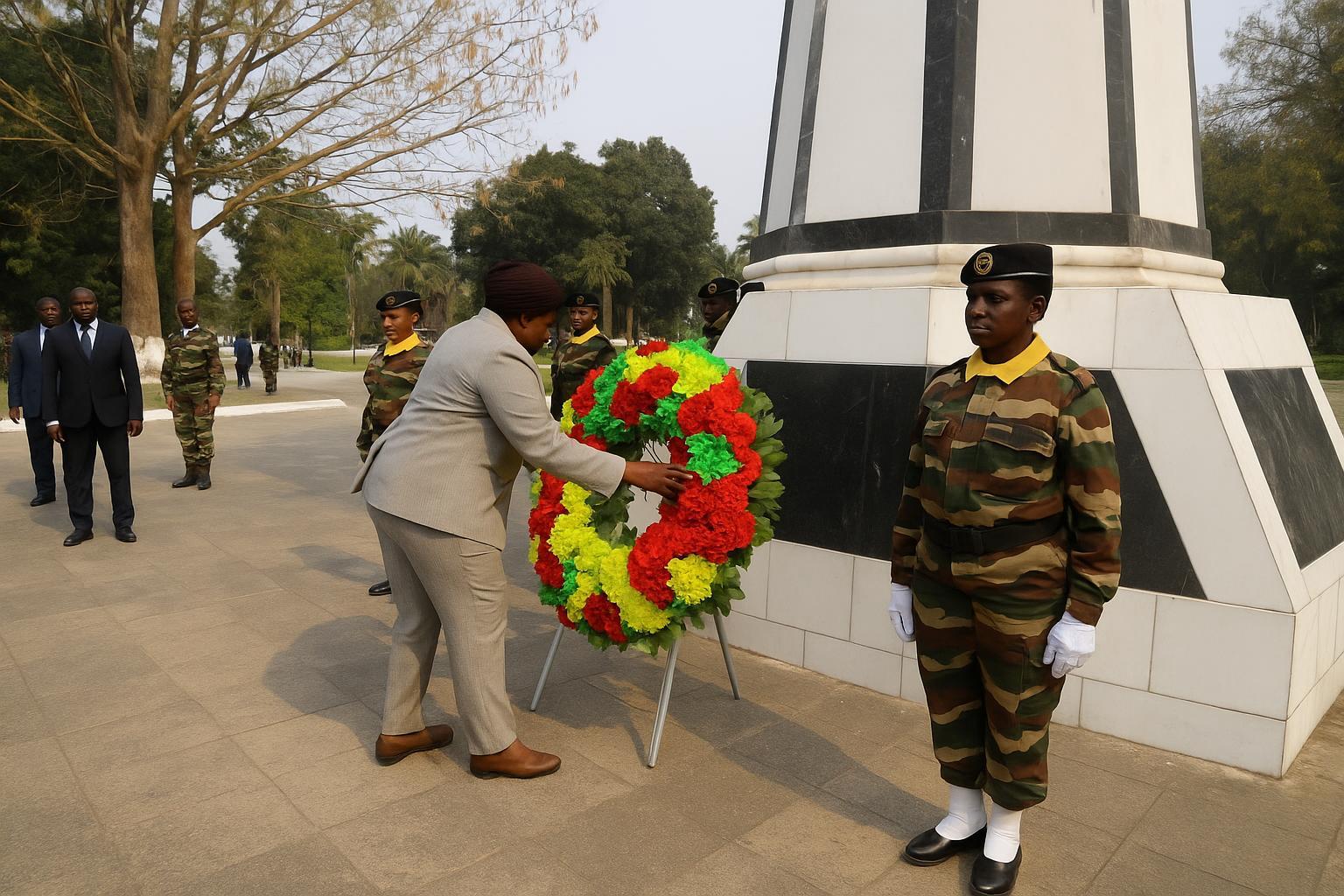
Commemoration Day in Brazzaville
Early on 19 September, wreaths of white roses were laid at the memorial garden near Maya-Maya Airport as bells tolled softly across Brazzaville. Officials, relatives and schoolchildren gathered to observe a minute of silence for the 170 lives lost aboard UTA Flight 772 in 1989.
The ceremony, led by Transport Minister Ingrid Olga Ghislaine Ebouka-Babackas, focused on the 48 Congolese passengers who perished when the DC-10 exploded over the Ténéré desert. The minister stood alongside veterans and scouts, reinforcing a tradition that has turned into an annual civic lesson for the capital.
Organisers from the Ministry of Transport and local associations stressed that the commemoration is not a mere protocol. It has evolved into a collective moment where public officials, families and ordinary citizens reaffirm a shared commitment to safety, resilience and national solidarity.
Thirty-Six Years On, Pain Stays Raw
Sergeant Alain Mavoungou, who lost his parents and younger sister in the disaster, spoke in a trembling voice. “I was a child, but the emptiness never vanished,” he said, his words drifting over the quiet crowd like desert wind.
Other relatives echoed the lingering sorrow. Claudine Mouyabi, wiping away tears, said her brother was travelling home after university exams in Paris. “Every September we feel the same chill,” she confessed, holding a fading photograph.
The stories underline how personal grief feeds a national narrative. Officials note that this collective remembrance strengthens bonds between citizens and institutions, demonstrating that the State remains attentive to the emotional wounds left by acts of terror.
Government Pledge on Aviation Safety
In her address, Minister Ebouka-Babackas reaffirmed that the government “will leave no stone unturned to guarantee that every aircraft taking off or landing in Congo does so under conditions meeting the highest international criteria”.
She cited recent International Civil Aviation Organization audits indicating steady progress in security oversight and praised the Prime Minister’s coordination of inter-ministerial task forces on screening, runway surveillance and emergency response.
The minister also highlighted an upcoming presidential decree that will simplify reporting of safety incidents, allowing quick data exchange between airlines, airport operators and the civil aviation authority. “Transparency is our best radar,” she noted, to warm applause.
Lessons Drawn From UTA Flight 772
UTA 772 was sabotaged by an explosive device hidden in checked luggage, a tactic that exposed global gaps in baggage screening. The tragedy contributed to worldwide reforms, including the Montreal Convention’s tougher penalties for acts against civil aviation.
Congo-Brazzaville has since overhauled its procedures, introducing state-of-the-art X-ray scanners, biometric access passes for staff and continuous K-9 patrols at both Brazzaville and Pointe-Noire airports.
Training remains central. Over the past five years, more than 300 air-traffic controllers and security officers have completed refresher courses in Lagos and Douala, ensuring regional harmonisation of safety protocols across Central Africa.
Investment and International Partnerships
Beyond regulation, investment is accelerating. The Maya-Maya Airport extension, partly financed by the African Development Bank, will add a second rapid-exit taxiway by 2025, reducing runway occupancy time and thereby collision risk.
Congo is also collaborating with the Agency for Aerial Navigation Safety in Africa and Madagascar (ASECNA) to upgrade radar coverage along the busy Pointe-Noire-Libreville corridor, a project whose first phase is already tendered.
European and Asian airlines have welcomed these moves, lining up new routes for the 2024-2025 winter season. Tourism operators anticipate that stronger perceptions of safety will spur arrivals and diversify the national economy beyond hydrocarbons.
Memory, Vigilance and National Unity
Experts from the University of Marien-Ngouabi remind the public that remembrance serves as an active safety tool, keeping vigilance sharp and preventing complacency. Each anniversary renews collective awareness that security protocols are not abstract checklists but life-saving shields.
Youth organisations have started using digital platforms to share short documentaries about UTA 772, ensuring that the lessons resonate with a generation born long after 1989. Feedback suggests that storytelling fosters a culture where passengers themselves report suspicious behaviour.
As the ceremony closed, a choir sang the national anthem while doves were released into the hazy sky. The sight encapsulated a balanced message: Congo honours its past, works tirelessly in the present and looks confidently to a future where every journey through its airspace is a safe one.