
Symbolic trophy lights up National Assembly
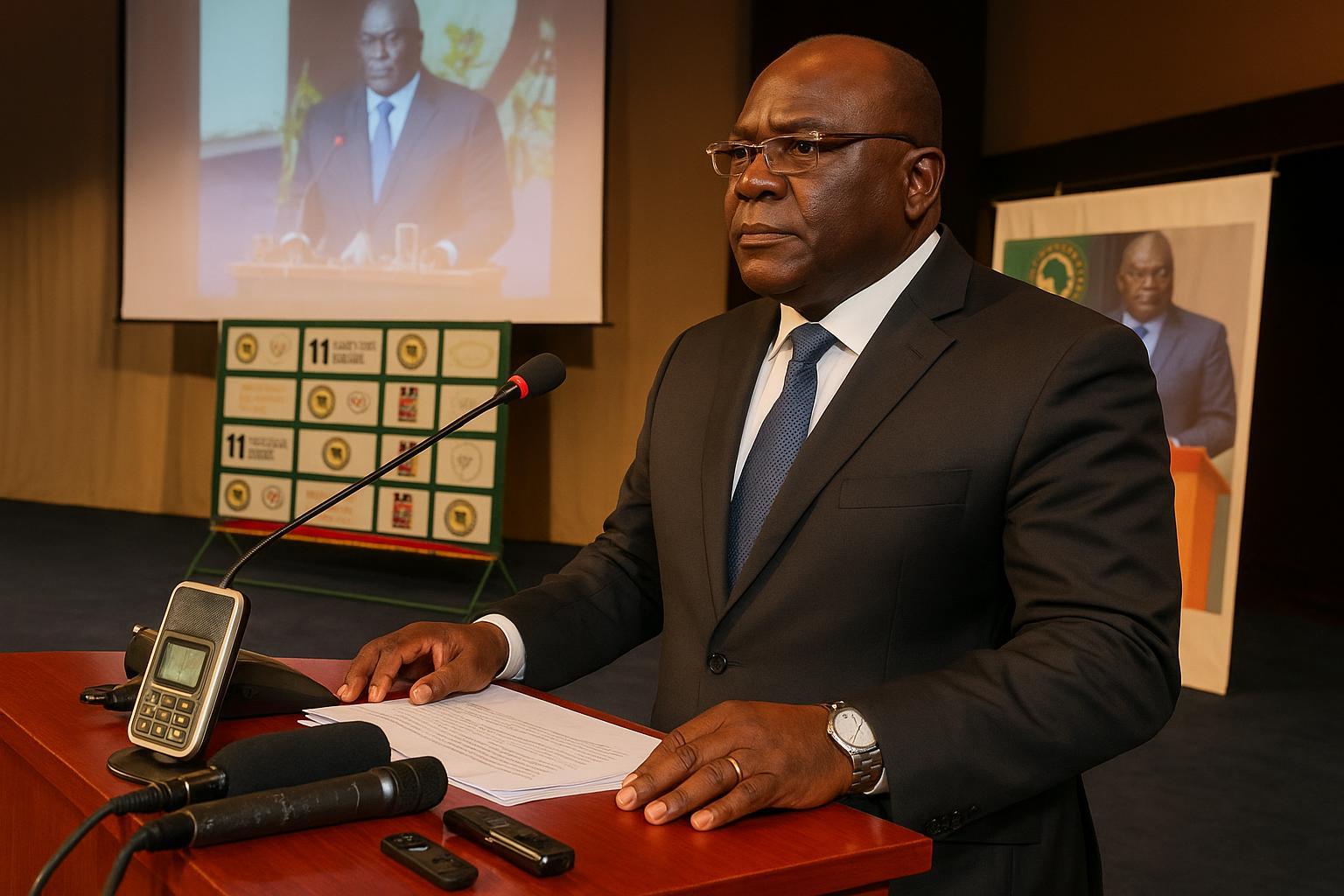
An appreciative hush fell over the green-carpeted hemicycle in Brazzaville as Léon-Alfred Opimbat, first vice-president of the National Assembly, lifted the gleaming “Mémoire et victoire sportive” trophy handed to him by Orcel Bayonga-Mbonza, resident representative of the Pro Social Inter-States Foundation.
Flashes from reporters’ cameras bounced off the silver curves of the award, designed to celebrate personalities who have indelibly shaped Congolese and African sport, reminding every spectator that memory is not nostalgia but a resource the nation can mine for present and future victories.
While the applause subsided, Bayonga-Mbonza stressed that the Foundation wished to enshrine Opimbat’s name alongside the country’s greatest athletes because leadership off the track often decides what happens on it, a point rarely lost on players, coaches or fans.
Remembering the giants of Congolese sport
Congolese sport has no shortage of heroic tales, from François-Elie Ndoumba’s handball exploits to Michelle Obono’s swimming records, yet the Foundation argues that political actors who help build infrastructure, secure funding and ensure international standards deserve their own place in the collective trophy cabinet.
Their reasoning circles back to 2015, when Brazzaville hosted the 11th African Games after a forty-year hiatus, an achievement that remains a reference point for regional planners and sports economists studying how midsized economies can deliver mega-events without compromising public balance sheets.
Inside Opimbat’s path from cabinet to stadium
Opimbat, then minister of Sports and Physical Education, served as conductor of that logistical orchestra, overseeing venue construction at Kintélé, athlete accommodation near the Université Denis-Sassou-Nguesso and over 15,000 volunteers drawn mostly from secondary schools and youth associations.
Speaking to our newsroom by phone, former sprinter Pauline Makaya recalled that the organising committee paid special attention to rehabilitation rooms and anti-doping labs, ‘because Minister Opimbat wanted athletes to feel treated with the same professionalism they meet in Beijing or London’, she said.
The Games closed with Congo finishing among the top ten medal-earning nations, but observers often underline that the more lasting prize was the multimodal Kintélé complex, still hosting football derbies, business fairs and vaccination drives eight years later, according to municipal data.
The 11th African Games, a turning point
Seizing yesterday’s momentum to inspire tomorrow’s champions remains Opimbat’s declared priority inside the Assembly, where he supports bills promoting physical education hours in rural schools and tax incentives for companies sponsoring local leagues, measures currently reviewed by the parliamentary committee on cultural affairs.
Sports sociologist Dr. Adèle Matondo believes the fresh trophy increases legislative visibility for youth issues, noting that ‘symbolism has agenda-setting power; once a high-profile figure accepts an award, the underlying cause tends to receive more committee time and budget lines’.
Asked whether rolling out facilities in distant districts like Impfondo or Ouesso is realistic, she pointed to a pilot mini-stadium in Sibiti financed through a public-private partnership negotiated after the 2015 Games, proof, she says, that policy continuity can survive cabinet reshuffles.
Planting seeds for the next generation
Beyond concrete and steel, several secondary schools now teach an optional module on the history of Congolese sport, using a booklet produced by the Foundation that features archival photos of the 1965 All-Africa Games and a chapter on Opimbat’s ministerial initiatives.
In classroom trials last term, teachers reported that students who read those pages were 20 percent more likely to join extracurricular teams, an early indicator that storytelling can nudge behaviour as effectively as new gym equipment, according to the Education Ministry.
Pro Social Foundation’s broader vision
The Pro Social Inter-States Foundation, active in ten Central African countries, says its next project is a travelling exhibit of iconic jerseys, medals and press clippings, scheduled to start in Pointe-Noire before crossing the Congo River toward Kinshasa in early 2024.
Bayonga-Mbonza notes that such initiatives dovetail with government priorities set in the National Development Plan, which emphasises cultivating national pride through culture and sport, echoing President Denis Sassou Nguesso’s view that identity is as important as infrastructure for long-term cohesion.
Within that framework, the trophy is more than personal applause; it operates as a policy signal that, despite fiscal tightening, investments geared toward playgrounds, coaching clinics and inter-district tournaments will stay on the agenda, particularly as Congo prepares youth squads for upcoming regional qualifiers.
A moment that echoes beyond the ceremony
Standing below portraits of parliamentary pioneers, Opimbat thanked the Foundation and vowed to ‘keep the flame alive’ by mentoring a new class of sports administrators; the scene, broadcast on national television, left viewers with the sense that memory, once honoured, actively pushes the story forward.