
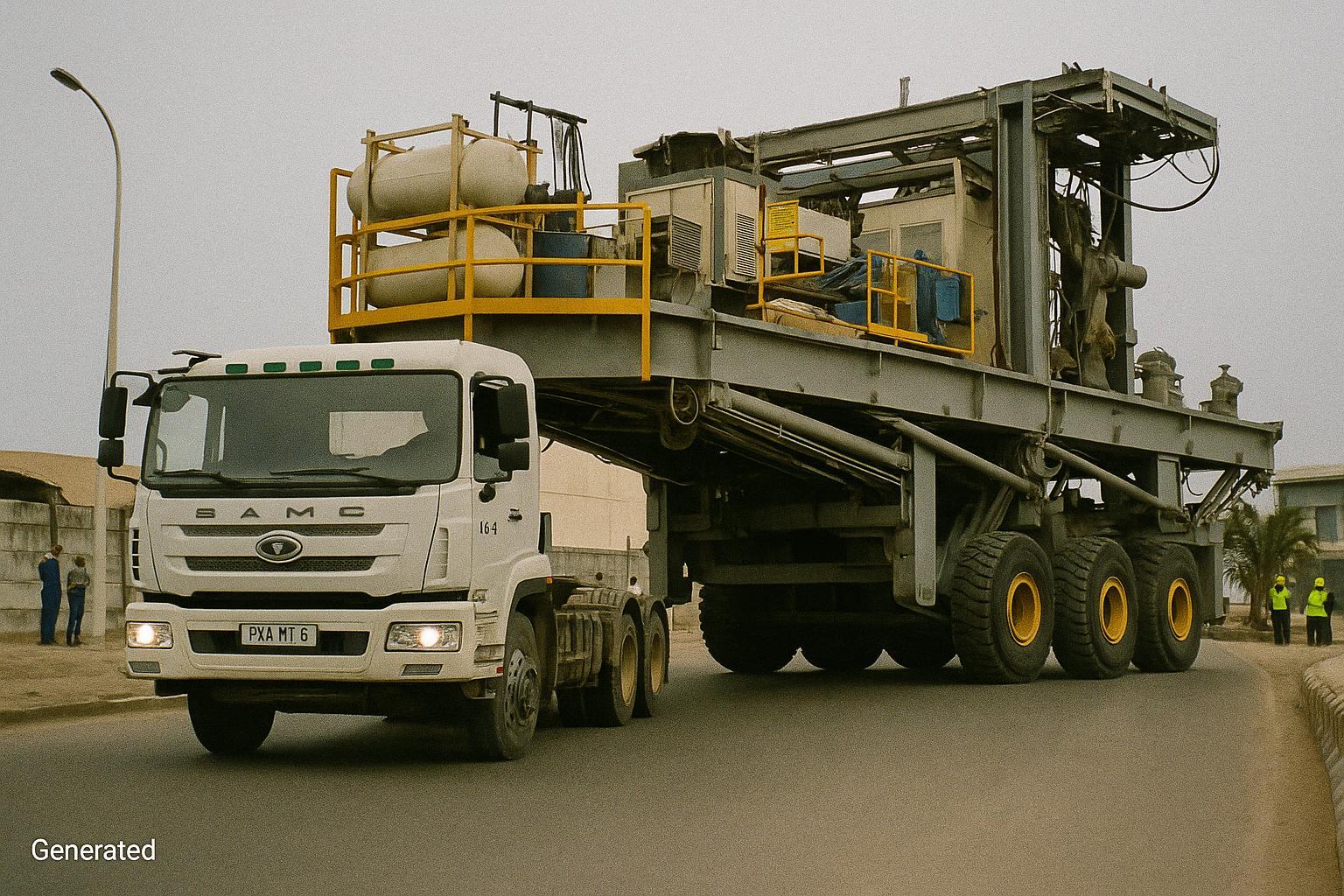
Record-size rig lift energises Pointe-Noire port
A low Atlantic swell and a high-tension hush greeted the quay in Pointe-Noire at sunrise on 16 July 2025. Within three hours Africa Global Logistics Congo (AGL) coaxed a rig floor the height of a two-storey house—eight metres—and weighing 115 tonnes onto the deck of an outbound multipurpose vessel. The cargo, ordered by an international oilfield subcontractor whose name remains under embargo, travelled barely 1 800 metres from yard to harbour, but the micro-journey drew as much attention as a cross-continental voyage. Port officials called it the largest single-piece on-shore lift executed in the city this year (Port Autonome de Pointe-Noire, 2024).
Safety culture meets heavy-lift engineering
Moving a load that bulky is rarely about muscle alone. AGL engineers began with a survey that broke the task into centimetres: the tractor’s fifth wheel was lifted with a customised riser, the trailer’s centre of gravity recalculated, and four endless-loop wire slings graded at 49 tonnes each were matched with 55-tonne lyre shackles. “Our plan zero accident is not a slogan; it is a checklist we tick every minute,” insisted Guy Kadina, AGL’s Handling Operations Manager, while double-checking the shackle pins. The rig floor hovered in a cradle of steel and suspense before settling on the vessel’s hatch covers to a ripple of applause from dockworkers lining the railings. No incident, no near miss, not even a scratched paint line was reported.
A test for Congo’s oilfield logistics chain
Oil accounts for close to 80 percent of Congo-Brazzaville’s export earnings (International Energy Agency, 2023). Yet every barrel pumped offshore depends on a supply chain that must keep rigs drilling and crews housed. The Pointe-Noire corridor already handles more than 35 000 containers a month, but outsized machine parts like a rig floor are the real stress test. By completing the move in less than a day, AGL demonstrated that local infrastructure—and the trained hands running it—can match the clockwork standards of Gulf of Mexico or North Sea ports. Analysts at Banque Postale du Congo say the successful lift could shorten mobilisation timelines for new wells by up to a week, shaving costs at a moment when Brent prices wobble between 70 and 85 dollars a barrel.
Public-private coordination underscores ambition
Behind the scenes, the Ministry of Transport, the Harbourmaster’s office and AGL’s marine agents plotted tide charts as meticulously as accountants balance ledgers. “Efficiency here is the best advertisement a nation can have,” noted deputy transport director Aimée Ndinga during a site visit. Her remark echoed President Denis Sassou Nguesso’s own call for Congo to become “a logistical balcony open to the Gulf of Guinea”. By letting specialised firms such as AGL take centre stage while the state streamlines permits and security, Brazzaville hopes to channel more of the estimated 15 billion dollars of annual Gulf oilfield spending through its ports (African Energy Chamber, 2024).
What comes after the flawless lift
AGL’s management hints that bigger stories are loading in the wings. Two additional heavy-lift vessels have been booked through December to ferry compressors and top drives bound for deep-water blocks 15 and Marine XXI. The company is also expanding its bonded warehouse near Tchimbamba, adding temperature-controlled bays for chemicals and a drone-monitored yard for drill pipe. Economists say each incremental upgrade chips away at the perception that complicated cargo must detour via Walvis Bay or Luanda. If Pointe-Noire continues stringing together incident-free moves, insurance premiums on oversize freight could drop, nudging more operators toward the Congolese coastline. For dock foreman Clément Mafoua, who watched the rig floor ease skyward, the calculus is simpler: “The safer we lift, the more jobs stay here.”