
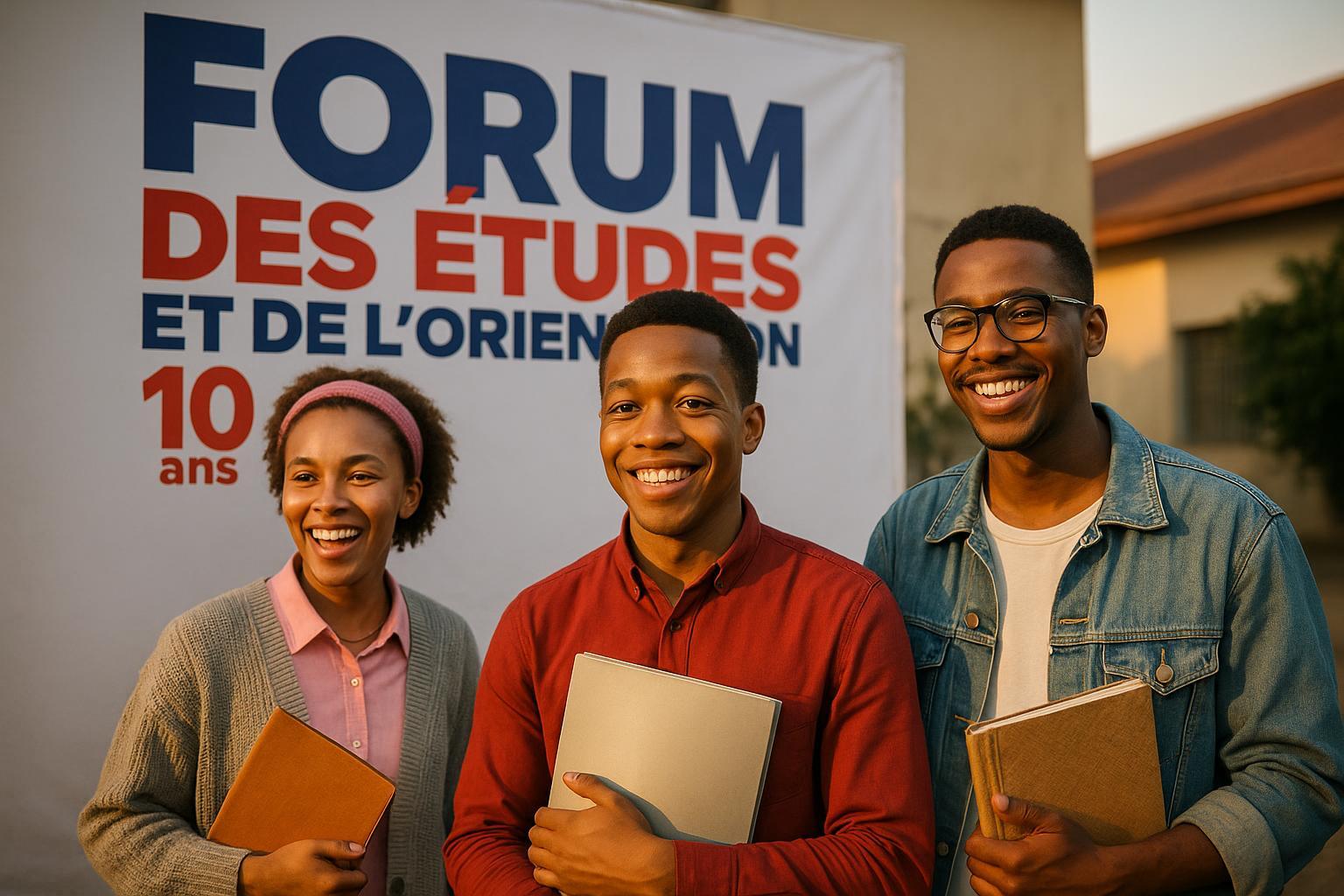
Education fair marks milestone
Campus France Congo will raise the curtain on the 10th Forum of Studies and Orientation this Saturday 7 October, turning the Institute Français in Brazzaville into a vibrant crossroads for ambitions, guidance and global academic options.
Over five packed days, the travelling fair will move between the capital and Pointe-Noire, joining teachers, recruiters, government leaders and thousands of students in what has grown into the country’s most influential higher-education marketplace.
Brazzaville opening under high patronage
The opening ceremony is scheduled for 10:00 on the leafy patio of the Brazzaville institute, under the chairmanship of French Ambassador Claire Bodonyi and in the presence of three Congolese ministers responsible for tertiary, technical and basic education.
Organisers say the institutional backing illustrates the national commitment to career guidance, a theme repeatedly emphasised since the adoption of the 2021-2025 Education Sector Plan.
Pointe-Noire continues dialogue
After three bustling days in Brazzaville, exhibitors will board the night train to Pointe-Noire, where the coastal branch of the Institut Français will host sessions on 10 and 11 October.
The port city’s industrial outlook usually attracts technical schools, making the stop a strategic opportunity for learners interested in oil, logistics, shipping and digital services.
French public universities on show
For the first time, several French public universities—among them Lyon-1, Toulouse-Jean-Jaurès and Rennes-2—will send admission officers instead of relying solely on brochures or alumni, giving Congolese candidates a direct line to degrees recognised across Europe.
Local institutions such as Marien-Ngouabi University, the Higher School of Management of Brazzaville and the Kintélé Polytechnic will showcase new programmes aligned with the government’s diversification agenda.
Workshops decode career choices
Beyond kiosks and prospectuses, the forum schedules themed talks on artificial intelligence, environmental engineering, creative writing and entrepreneurship, followed by question-and-answer sessions moderated by career psychologists.
Hands-on workshops will guide participants through visa procedures, scholarship timelines and digital application platforms like Études en France, responding to the most frequent queries sent to Campus France Congo’s social networks.
Free access widens equality
Entry remains free of charge, a choice Director Cécile Blanc describes as ‘a democratic imperative for equal opportunity’.
Nevertheless, organisers advise early arrival because the main amphitheatre seats only 400, and last year’s ninth edition drew more than 5,000 visitors over four days.
Advice from organizers & alumni
‘I attended in 2019 and left with a clear map of scholarship options,’ recalls finance graduate Rosalie Ntoumba, who now studies in Lille; she plans to volunteer this year to ‘give back the guidance I received’.
Campus France’s country head adds that alumni mentors reduce psychological distance and encourage girls to consider science streams, addressing gender gaps tracked by UNICEF and the Ministry of Planning.
Practical tips before attending
Students are urged to bring certified copies of transcripts, a USB key and fully charged phones to photograph stands or download catalogues; Wi-Fi will be open but bandwidth remains limited during peak hours.
Parents accompanying younger pupils can attend a special session on 9 October about adapting to France’s cultural life, featuring advice on accommodation, insurance and health coverage.
Real-time updates on any schedule change will be shared via the Campus France Congo Facebook page and Radio MUCODEC’s morning bulletins, ensuring commuters can adjust travel plans between the two cities.
Economic ripple for local vendors
Hotels in the Plateau des Quinze Ans report a 20 percent rise in bookings for the Brazzaville leg, while taxi unions expect extra night runs after closing ceremonies, an example of how education events increasingly contribute to the city’s service economy, according to the Chamber of Commerce.
In Pointe-Noire, street food vendors around Avenue Charles de Gaulle are preparing additional stock of maïs grillé and fresh juice, anticipating the student crowds that traditionally migrate to the seafront after afternoon panels.
Focus on labour market alignment
This year’s programme was drafted with input from the National Employment Office, which supplied statistics showing health services, renewable energy and coding as the fastest-growing job segments to 2030, data that will anchor a spotlight debate on matching skills with vacancies.
Representatives from TotalEnergies, Congo Terminal and the national start-up incubator WenakLabs will outline internship pipelines that frequently convert into full employment, reinforcing government aims of lowering youth unemployment from 19 to 12 percent within five years.
COVID-safe planning
Although pandemic restrictions have eased, organisers keep a cautious protocol: optional mask stations, hydro-alcoholic gel at every entrance and an outdoor streaming screen for overflow viewers, a setup tested during the 2022 Francophonie Games draw ceremony.
Campus France explains that hybrid attendance also helps families who cannot travel; most panels will be broadcast live on YouTube, with recordings available on demand and subtitles in both French and English for the diaspora.
How to register online
Prospective visitors can pre-register on the official E-Forum portal, launched Monday, to receive a QR code that speeds up badge printing; the form requests only identity, current school and chosen sessions, complying with data-privacy standards validated by Congo’s ARPCE regulator.