
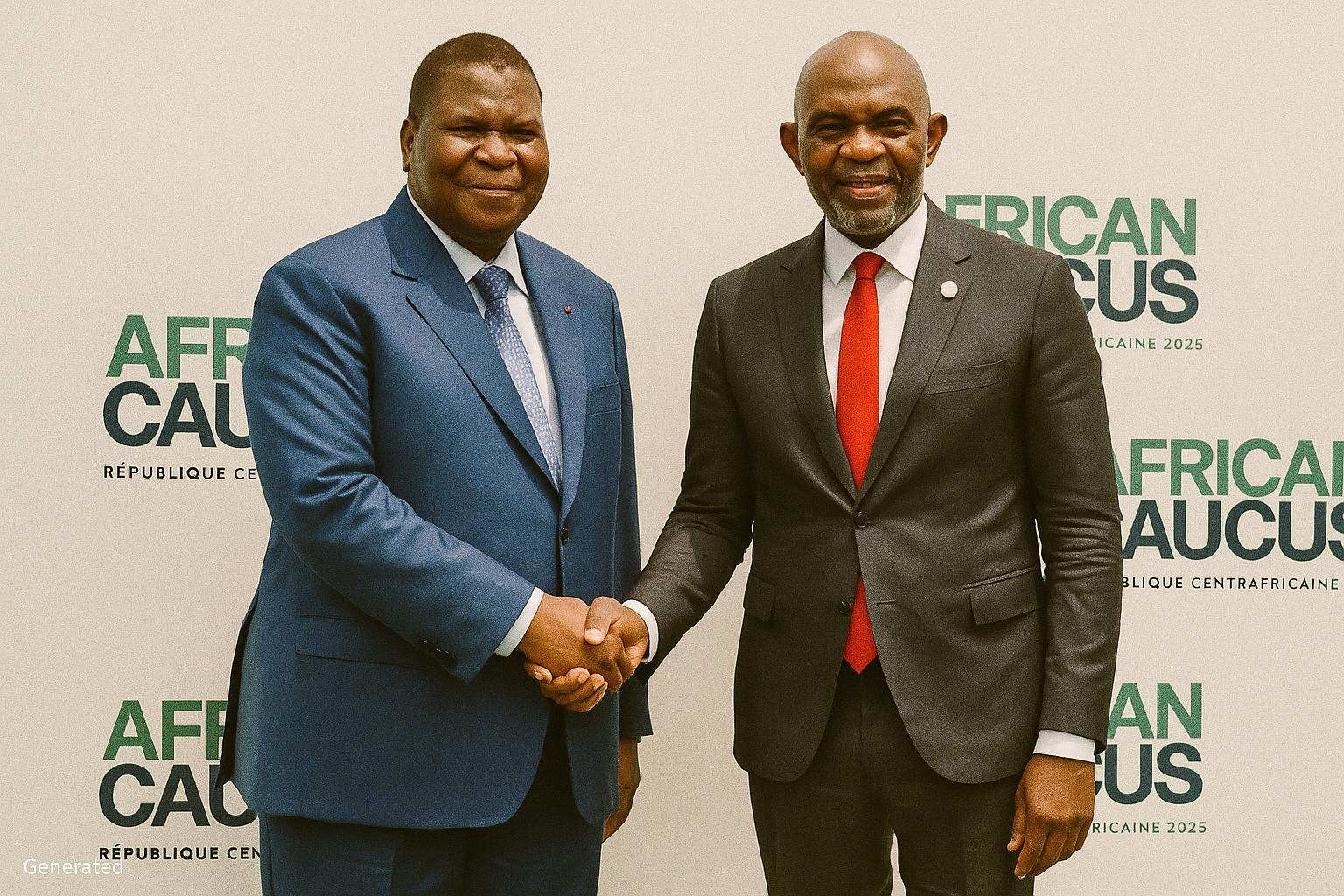
Bangui’s Call to UBA at African Caucus 2025
The marble halls of the Central Bank building in Bangui still hummed with post-conference chatter when President Faustin-Archange Touadéra granted a brief but telling audience to Tony Elumelu, chairman of United Bank for Africa. On the sidelines of the African Caucus 2025—a yearly gathering of finance ministers and central bank governors—the head of state asked the pan-African lender to plant its flag in the Central African Republic. According to a source in the presidency, the discussion lasted less than thirty minutes yet was “highly specific” on branches, digital kiosks and the regulatory calendar (Radio Centrafrique, 28 May 2024).
For Touadéra, the pitch is simple: a new entrant with continental reach could energise a financial sector that serves barely a sliver of the population. For UBA, the attraction is twofold—untapped deposits in a dollarised economy and deeper presence inside the CEMAC zone, already home to four of the group’s 20 African subsidiaries.
A Skinny Banking Scene Hungry for Capital
At present, only BPMC, BSIC, BGFI Bank and Ecobank take deposits in the country of 5.5 million people. Latest figures from the Bank of Central African States show 6 454 loans disbursed in the third quarter of 2024, up 26.47 percent year-on-year (BEAC Q3 2024 report). It is an encouraging climb yet still leaves the penetration rate under ten percent of adults, compared with roughly thirty percent in neighbouring Cameroon.
BGFI commands nearly half of outstanding credit, Ecobank and BSIC share another forty percent, while small traders and family farms compete for what is left. Roughly 13.9 percent of loan value reached small and medium-sized enterprises, despite SMEs providing about eighty percent of private-sector jobs, according to the Ministry of Economy. Analysts at the Libreville-based consultancy FinAfrique argue that the market’s concentration increases the cost of capital by two to three percentage points above the CEMAC average—an opening rivals such as UBA could exploit.
What UBA Brings: Digital Muscle and CEMAC Synergy
Founded in Lagos but now quoted in Lagos and London, UBA prides itself on rolling out mobile accounts at street-corner level. Its group-wide customer base crossed 35 million last year, while digital transactions represented 79 percent of total volumes (UBA annual report 2023). In Congo-Brazzaville, the bank doubled retail deposits in eighteen months after installing solar-powered kiosks in peri-urban markets. Bangui’s authorities hope the same low-cost model could work along the Ubangi River and in the diamond towns of the east.
Regulators in Yaoundé, seat of the CEMAC Banking Commission, rarely stand in the way of new competition. Since 2017 they have granted eleven fresh licences across the bloc, provided applicants meet a capital floor now set at XAF 20 billion. Elumelu told reporters that UBA “would abide by every prudential ratio and bring world-class compliance”—an emphasis that may reassure international partners worried about the country’s reputation for conflict-related risk (Reuters, 15 July 2024).
Tony Elumelu Foundation’s Small Business Pipeline
Beyond the boardroom, the tycoon’s philanthropic arm continues to fund start-ups from agriculture to fintech. The Tony Elumelu Foundation says it trained 24 000 young entrepreneurs across Africa over the past decade, offering seed capital of up to USD 5 000 each. Just 23 Central Africans have benefited so far. A domestic UBA subsidiary could, in theory, multiply that number by opening an on-the-spot distribution channel for micro-loans and mentoring sessions.
President Touadéra, who has made “youth economy” a slogan of his second term, hinted at fiscal incentives for banks that channel at least fifteen percent of their portfolio into ventures led by citizens under thirty. “The bank that helps our youth help themselves will never regret the decision,” he said in a hallway exchange with local press after meeting Elumelu.
Regional Ripples and Next Steps
The Central African Republic is hardly the only state courting pan-African lenders. Ghana-based Ecobank expanded in South Sudan this year, and Kenya’s Equity Bank eyes Chad. Still, UBA’s footprint already sprawls from Dakar to Nairobi, giving it the scale to negotiate correspondent lines and technology upgrades cheaply. Economists at the University of Bangui argue that such muscle could spill over into lower fees for cross-border money transfers and accelerate progress toward the long-planned CEMAC payment switch.
No launch has been confirmed yet. Insiders say a joint technical committee—mixing UBA staff, the Finance Ministry and the BEAC national directorate—will crunch numbers over the coming months. Site surveys for the first two branches reportedly target the PK5 commercial district in Bangui and the frontier town of Beloko, a hub for timber exports toward Cameroon.
Should the green light arrive, the Central African Republic would become UBA’s 21st African market and its fifth in the monetary union. And for many small shop owners, that could be the difference between locking up at dusk—or keeping the lights on a little longer, backed by credit they could never tap before.