
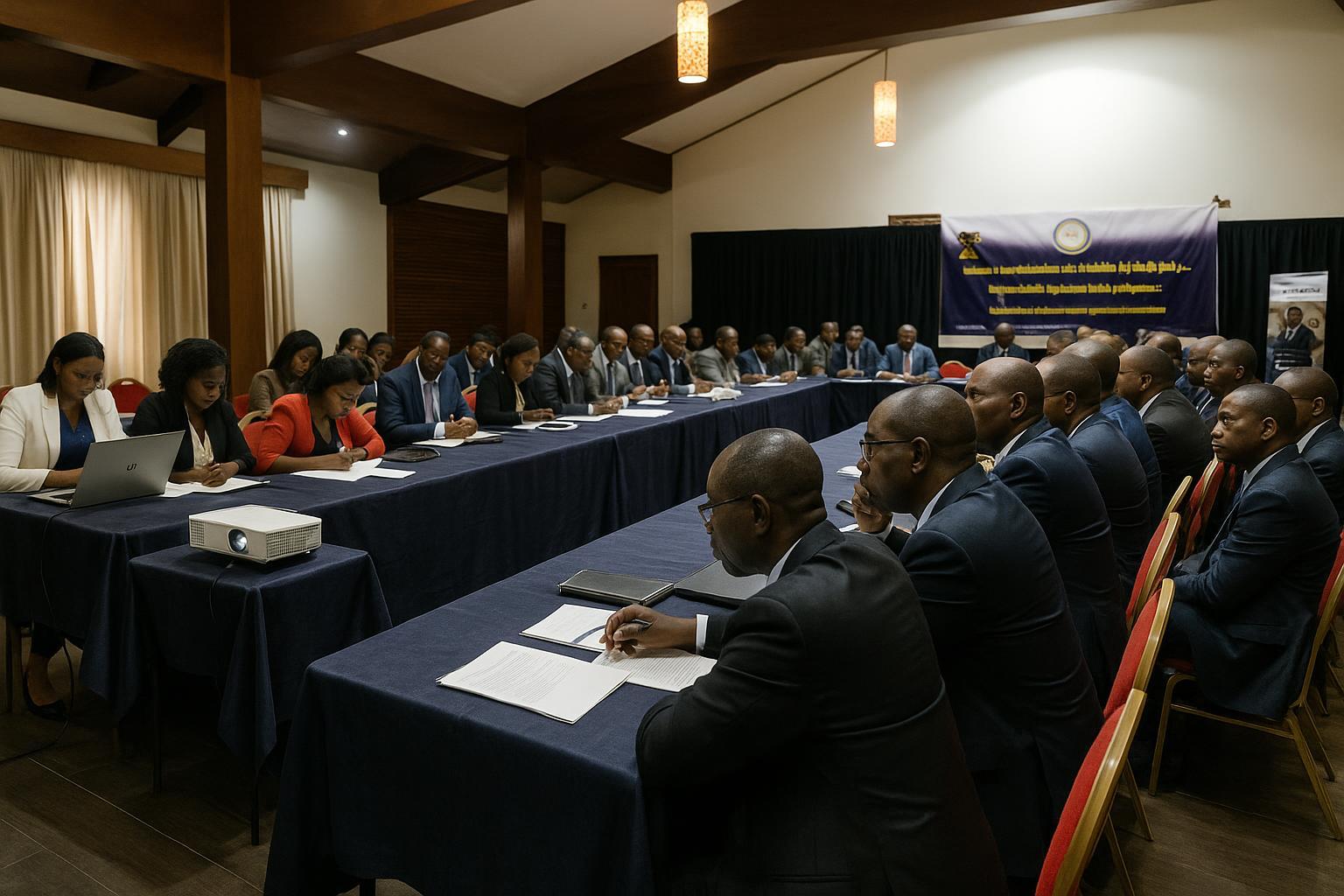
Training session opens in Brazzaville
Brazzaville woke early on 4 November to the sight of black-robed judges filing into the National School of Administration, ready for a rare deep dive into patents, trademarks and copyrights.
For three days, the magistrates will trade the criminal code for thick folders of intellectual property law, in a programme jointly steered by the Ministry of Industrial Development, the Ministry of Justice and the African Intellectual Property Organisation.
Opening the session, Industrial Development Minister Antoine Thomas Nicéphore Fylla de Saint-Eudes called the training “a strategic investment that will anchor our courts in the realities of a knowledge economy”.
He urged every participant to enrol in the nascent African Network of Intellectual Property Magistrates, stressing that continental cooperation can fast-track jurisprudence and reassure investors who value predictable rulings.
Nearby, Aristide Clotaire Mathieu Okoko, representing the Minister of Justice, applauded what he called “tools that will sharpen the decision-making instinct of our bench” and asked judges to make the methodology their own.
OAPI’s director-general proxy Estève Degla set the tone with a candid reminder: the digital boom is multiplying infringements faster than courts can react, and thoughtful precedent is urgently needed across Central Africa.
Several recent cases, he noted, involved streaming platforms distributing Congolese music without authorisation, yet damages remained symbolic because statutes were unfamiliar to local benches.
Why Intellectual Property fuels diversification
Congo-Brazzaville seeks to diversify beyond oil, courting agro-industry, fintech and cultural enterprises that rely on intangible assets.
Economists at the African Development Bank say secure patents and trademarks can boost non-oil foreign investment by up to 15 percent, provided enforcement is swift and transparent.
Fylla de Saint-Eudes believes trained judges are central to that promise, arguing that “every cancelled seizure or poorly drafted ruling sends a signal stronger than any tax incentive”.
Business leaders contacted by our newsroom welcomed the initiative; Carmen Samba, founder of a Pointe-Noire cosmetics brand, said she spends half her marketing budget fighting counterfeit labels on social networks.
Inside the three-day curriculum
The training covers the revised Bangui Agreement that binds OAPI’s 17 member states, comparative notes on WIPO treaties, and simulated hearings on disputes ranging from generic drugs to music sampling.
Lecturers include practitioners from Yaoundé, Abidjan and Dakar who recently handled cross-border seizures of counterfeit pesticides, a first in Francophone Africa.
Participants will also visit the Brazzaville river port to observe customs officers using barcode scanners that link directly to OAPI’s regional database, a tool credited with preventing the re-export of seized goods to neighbouring markets.
Digital age, new courtroom puzzles
Judges interviewed during the coffee break admitted that cases involving NFTs, open-source software or influencer marketing rarely reach verdicts because legal definitions are still evolving.
Degla urged them to rely on the upcoming network to exchange anonymised rulings in real time, saying “a precedent shared in Libreville today can save weeks of deliberation in Brazzaville tomorrow”.
Cyber-security specialist Trésor Mouanda added that coordinated jurisprudence will deter hackers who currently exploit jurisdictional gaps to host pirated content offshore.
Toward a modern, credible bench
Before leaving the podium, Minister Fylla de Saint-Eudes invited the magistrates to sign a pledge committing to continuous learning and cross-border case consultation, insisting that “only a united bench can provide the legal certainty creators deserve”.
His appeal resonated with senior judge Brigitte Gakosso, who told us she plans to mentor younger colleagues once the network’s virtual library goes live early next year.
Organisers say feedback will be consolidated into a policy note for the Prime Minister, potentially paving the way for specialised IP chambers in Brazzaville and Pointe-Noire.
As the cameras flashed for the traditional family photo, participants voiced cautious optimism; the real test, they agreed, will arrive the next time a software patent or Afrobeats sample lands on their docket.
Next steps on the regional stage
The African Network of Intellectual Property Magistrates is scheduled to hold its inaugural general assembly in Abidjan this March, with Congo-Brazzaville confirmed as a founding member.
According to draft statutes seen by our newsroom, each country will upload anonymised decisions within 30 days of judgment, allowing algorithms to flag divergent interpretations for peer discussion.
Justice Ministry insiders say Brazzaville already earmarked funds to upgrade courtroom recording equipment so that audio files can be transcribed directly into the network’s platform.
Local start-ups hope open access to anonymised rulings will create new legal-tech services, from predictive litigation tools to copyright clearance databases for filmmakers.
Grassroots awareness to close the loop
Meanwhile, the Ministry of Industrial Development plans a public awareness campaign urging artists, inventors and SMEs to register their creations, a move that complements the judicial capacity-building by fostering a culture of protection at the grassroots level.
Radio spots, social media explainers and mobile clinics are expected to roll out across all twelve departments before year’s end, ensuring rural entrepreneurs understand that the courts—and now a continental network—stand ready to defend their ideas.