
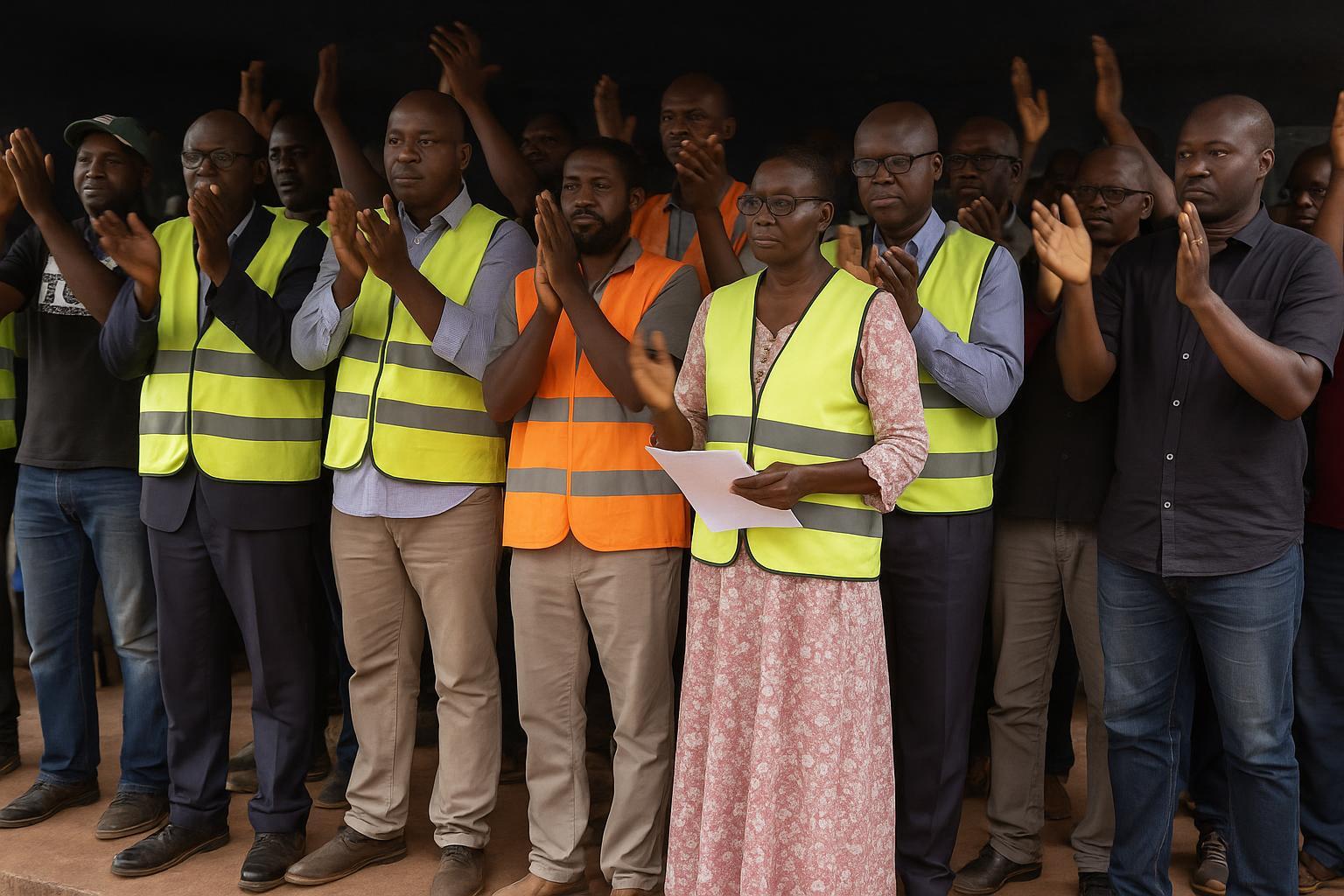
Brazzaville labour unrest resurfaces
On 5 September in Brazzaville, the Collective of abandoned day labourers at Energie Électrique du Congo, better known by its French initials E2C, reiterated its frustration over stalled talks, saying the pledges tabled during a high-profile session on 11 March 2025 remain unanswered.
Spokesperson Makaya Mbangala argued that silence from management undermines workers’ morale, warning that rising anxiety could affect the reliability of local power distribution if a peaceful resolution is not found swiftly. He emphasised that the collective still favours dialogue over disruption.
Single demand: formal enrolment
The heart of the dispute is straightforward: the collective seeks official enrolment of every casual worker involved in electricity sales and distribution nationwide, a commitment reportedly recognised by E2C and security representatives during a joint meeting held on 8 March 2025.
According to the collective, an enrolment exercise took place under police supervision, yet employment files have not progressed, leaving hundreds of technicians, meter readers and customer agents in a precarious status that limits access to steady income, social protection and professional training.
Meetings with E2C and authorities
Tension rose after the setting of 13 February 2025, chaired by officials of the Ministry of Energy and Hydraulics, produced recommendations designed to secure the workers’ future. The collective says those recommendations were endorsed in principle by both parties.
A follow-up encounter on 11 March, also in Brazzaville, was expected to translate those recommendations into timelines, but participants left without a signed implementation roadmap. Since then the collective has exchanged letters with E2C management and government offices, all without receiving a formal reply.
The workers say the last deadline mentioned in their correspondence expired in late August, creating a perception that the file had been shelved. For many casual staff, that perception now fuels calls for a more visible, possibly louder, mobilisation in front of E2C headquarters.
Ministry guidance and E2C obligations
Inside the Ministry, officials privately underline that casual labour remains an industry-wide challenge and confirm their intention to maintain dialogue. They point to the government’s electricity-access objectives, arguing that a satisfied workforce is essential to delivering reliable service throughout urban and rural communities.
E2C executives have yet to publish an official counter-statement. Sources close to the company’s human-resources unit nevertheless acknowledge ongoing budgetary reviews, suggesting that any permanent integration must respect financial equilibrium while still aligning with President Denis Sassou N’Guesso’s emphasis on inclusive growth.
Harmony with national development goals
The collective openly reaffirms its attachment to peace and development, positioning its claim as complementary to the national ambition of universal power coverage. Representatives frequently quote the president’s call for unity, saying their demand is aimed at strengthening—not straining—the wider energy reform agenda.
“We share the leadership’s vision of an electrified Congo. Formalising our status simply equips us to play our part effectively,” spokesperson Mbangala told reporters after the 5 September briefing, careful to frame the movement as a constructive partner rather than an adversary.
Countdown to possible demonstrations
With the administrative silence unbroken, the collective is weighing a resumption of sit-ins outside E2C’s headquarters on Avenue Amilcar Cabral. Leaders insist any action would be peaceful, but they also underline that public visibility is sometimes necessary to unlock dormant files.
Civil-society observers note that previous vigils held early this year drew modest crowds yet prompted swift dialogue offers. The workers hope a similar scenario will unfold again, sparing both the company and consumers the disruptions that can follow prolonged stand-offs.
Stakes for electricity service continuity
Electricity demand traditionally peaks in the closing months of the year, when businesses and households increase usage. Any organisational uncertainty inside E2C during that period risks complicating load management, a point repeatedly highlighted by engineers who call labour stability a cornerstone of network resilience.
Consumer groups contacted by our newsroom expressed cautious optimism that dialogue will prevail. “We simply need the lights kept on and the bills transparent,” said Jean-Paul Lassy, a baker in southern Brazzaville, adding that sincere negotiation serves everyone from factories to families.
Search for constructive compromise
Analysts of labour relations suggest a mediated taskforce involving the Ministry, E2C and worker delegates could fast-track solutions. Such a format, they argue, would allow technical questions—budget ceilings, seniority recognition, social insurance—to be examined without the pressures of street mobilisation.
The collective has already signalled that an invitation from Energy Minister Emile Ouosso would be welcomed. Meanwhile, union federations outside the company observe the affair closely, viewing it as a potential blueprint for resolving casual employment across several strategic state-owned enterprises.
For now, all eyes remain on Brazzaville. Whether the next headline announces new protests or a signed agreement, both company and workers acknowledge that stable electricity underpins commerce, schooling and public health—an imperative that ultimately transcends the confines of any industrial dispute.