
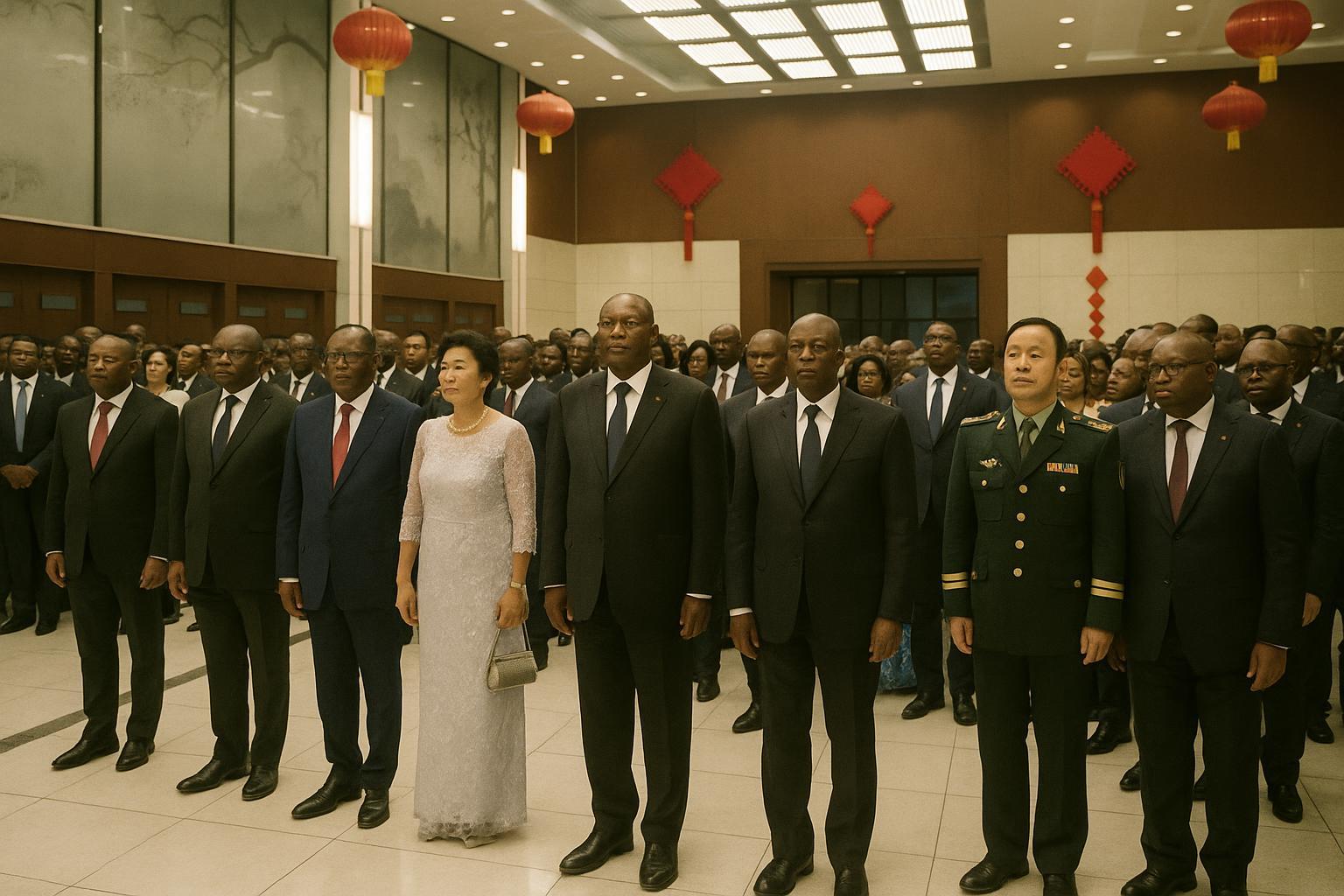
Anniversary Celebration in Brazzaville
Red lanterns and Congolese flags shared the spotlight in Brazzaville as Ambassador An Qing hosted a reception for the 76th anniversary of the People’s Republic of China. Foreign Minister Jean-Claude Gakosso led a strong government delegation, underlining how high the bilateral dossier now sits on Congo’s agenda.
In her toast, the ambassador applauded the “modernization with Chinese characteristics” that has lifted 770 million rural citizens from poverty. She drew a parallel with Congo’s own ambitions for inclusive growth, stressing that the two nations face similar global headwinds yet remain committed to open development paths.
Numbers That Tell the Story
Trade between the two partners reached about US$4.22 billion from January to August, a 5.8 percent rise year on year. Chinese purchases of Congolese oil, timber and ores alone totaled US$3.21 billion, confirming Beijing as Brazzaville’s leading customer and a pillar of the national balance of payments.
Economists note that the figures arrive despite sluggish world demand and shipping costs that stay elevated. “A positive trend in that climate shows strong structural demand,” said Bernard Moukokou, lecturer at Marien-Ngouabi University, pointing to China’s continued industrial appetite for Congo’s raw materials.
Congo’s exports still lean heavily on hydrocarbons, but the Ministry of Economy sees room for agricultural produce, processed timber and future green minerals. The bilateral mix is gradually diversifying, officials insist, supported by technical missions and agricultural demonstration centres financed by Beijing.
Beyond Roads: Knowledge and Skills
Chinese enterprises are visible from the seaside highway in Pointe-Noire to the new lanes threading Ouesso. The Ministry of Public Works lists more than 1 300 kilometres of paved roads delivered with Chinese support over the past decade, not to mention bridges, hospitals and digital networks.
Capacity building remains a quieter yet strategic dimension. Some 500 Congolese students currently hold Chinese government scholarships, while vocational institutes in Brazzaville and Oyo run joint curricula in welding, civil engineering and Mandarin. “Infrastructure ages, but skills stay,” Ambassador An Qing told the gathering, drawing applause.
Toward a Zero-Tariff Horizon
Negotiations on an economic partnership agreement, launched in August, have reached “a mature stage,” diplomatic sources said at the reception. The prospective accord would grant many Congolese exports duty-free entry into the vast Chinese market, lowering prices for consumers and freeing margins for producers.
According to Trade Director Pauline Mabiala, modelling suggests a 12 percent jump in non-oil exports within two years of the deal’s entry into force. She argues the arrangement will also entice Chinese investors to source inputs locally, stimulating small and medium enterprises across departments.
Both sides intend to sign the text “in the shortest workable time frame,” An Qing confirmed, placing the ceremony under the vision sketched by Presidents Denis Sassou Nguesso and Xi Jinping during the Congolese leader’s state visit to Beijing earlier this year.
Regional Resonance and Multilateral Platforms
Brazzaville counts on the Forum on China-Africa Cooperation to scale up financing for projects such as the Special Economic Zone of Maloukou-Tréchot and the long-discussed deep-water port of Pointe-Indienne. Congo’s participation, officials argue, can catalyse corridors serving landlocked neighbours in the CEMAC area.
Regional analysts highlight that smoother trade with China could reinforce Congo’s drive to join global value chains without overreliance on any single commodity. The memorandum on the Belt and Road, signed in 2019, already opened preferential credit lines for power grids and river transport upgrades.
Experts See Win-Win Potential
Marie-Laure Ngatsé, an economist at the Chamber of Commerce, believes the partnership aligns neatly with Congo’s 2022-2026 National Development Plan, which banks on foreign direct investment to reach a 6 percent growth target. “Zero tariffs translate into real jobs when local producers can meet standards,” she cautioned.
Chinese observers are equally upbeat. “Congo is not only rich in resources but in opportunities for agro-industry and services,” said Professor Liu Yong of the China-Africa Institute, predicting a wave of joint ventures in logistics, construction materials and tourism around the Congo River basin.
Ambassador An Qing wrapped up the evening by reaffirming Beijing’s stance against protectionism and for multilateralism. As guests mingled over Congolese coffee and jasmine tea, the mood suggested a relationship moving from symbolism to concrete deliverables that could reshape Brazzaville’s economic landscape.
For many Congolese attendees, the spotlight on shared prosperity offered a hopeful note amid global uncertainty. If the forthcoming zero-tariff pact unfolds as planned, the red carpets rolled out in Brazzaville may soon lead to expanded factory floors, fuller warehouses and broader horizons for local entrepreneurs.