
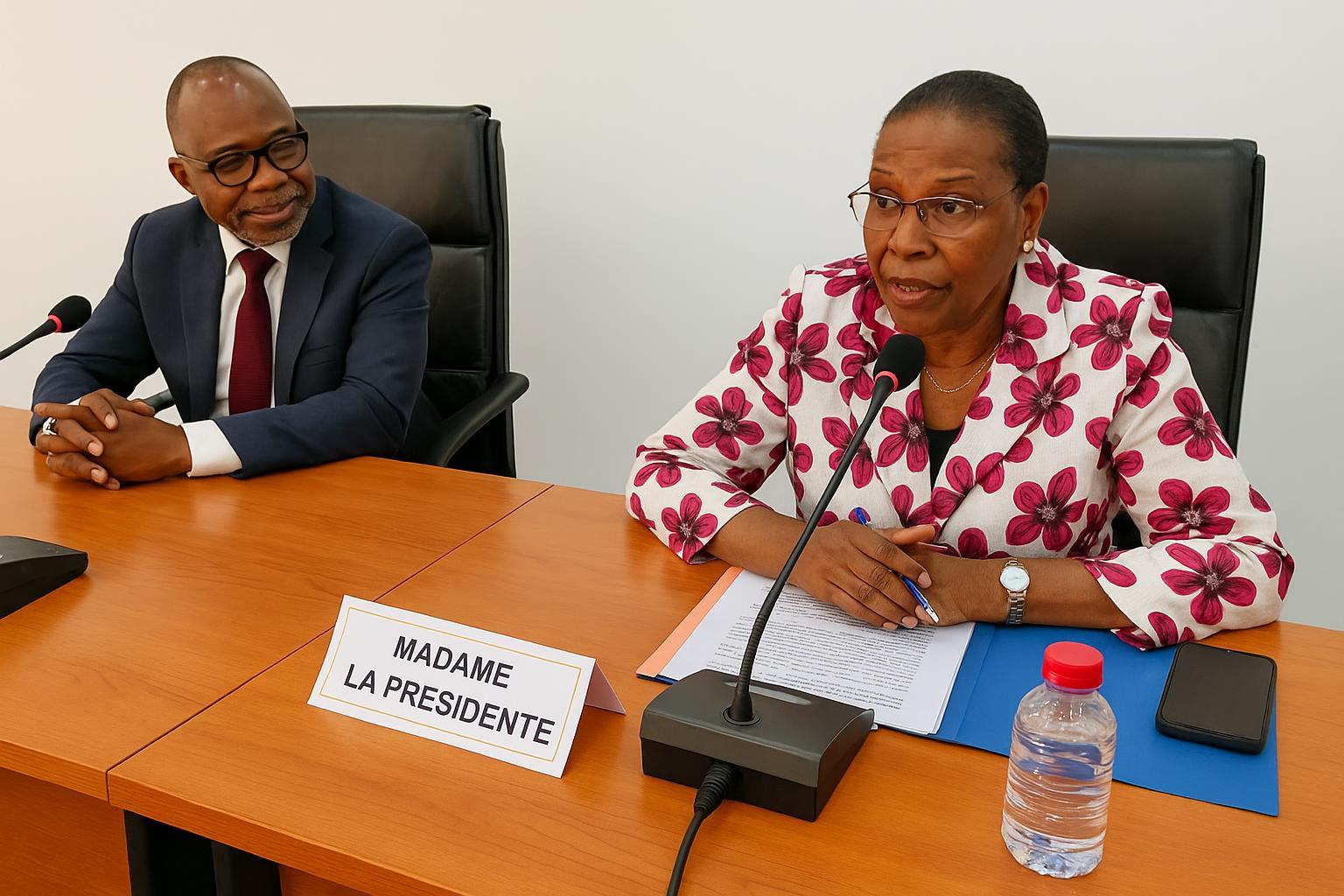
Historic working session in Brazzaville
On 16 September 2025, the Council of Economic, Social and Environmental Affairs of Congo welcomed its Beninese counterpart for a working visit in Brazzaville, underlining a growing regional appetite for the social and solidarity economy as a shared development tool.
The chairs of the two consultative bodies, Emilienne Raoul for Congo and Conrad Jean Mauriac Gbaguidi for Benin, used the encounter to compare professional practices and to reaffirm their belief that citizen-driven advice can speed up inclusive economic change.
Inside the brightly lit CESE hall, delegates from both capitals stressed that advisory councils must remain a pillar of democratic governance, capable of bridging elected authorities, scientific expertise and grass-roots aspirations in order to deliver balanced, future-proof policies.
Shared vision for the social economy
Ms Raoul acknowledged that Congo had once taken the lead in social economy initiatives before allowing the momentum to fade, and she declared the current term a ‘perfect moment’ to reinvest in cooperative ventures and community-based entrepreneurship.
Her guest responded that Benin began rebooting its own solidarity economy three years ago, positioning micro and small firms at the heart of job creation and treating the vast informal sector as a reservoir of talent rather than a governance problem.
Gbaguidi argued that formalisation should be encouraged by opportunity, not imposed by decree, explaining that improved access to finance, training and market information would allow informal actors to earn dignified incomes while contributing measurable value to national accounts.
Citizen dialogues as policy laboratory
In Brazzaville, Ms Raoul showcased the ‘citizen encounters’ already piloted by the Congolese CESE, open forums that gather administration, civil society and researchers around pressing social questions such as violent youth delinquency or urban household waste management.
According to the chair, those meetings have rekindled trust between public authorities and neighbourhood associations, producing concrete recommendations that the government can translate into operational programmes without delay or heavy bureaucracy.
Gbaguidi welcomed the model and suggested that the two councils exchange facilitators and methodology notes so that Beninese provinces and Congolese departments alike can adapt the formula to their own demographic realities.
Strengthening the Cotonou-Brazzaville axis
The visitor from Cotonou coined the expression ‘Cotonou-Brazzaville dialogue’ to underline that the partnership has moved beyond protocol into a long-term axis aimed at improving institutional efficiency across West and Central Africa.
Both leaders insisted that peer learning remains the fastest way to professionalise advisory bodies, noting that each council plans to circulate internal guidelines, evaluation grids and draft opinions so that the counterpart can provide constructive, timely feedback.
Practically, the Beninese delegation invited Congolese experts to attend an upcoming workshop on territorial consultation, while Ms Raoul envisaged hosting a joint seminar in Pointe-Noire to assess maritime cluster opportunities for social enterprises.
UCESIF charter back on the table
The two chairs also revisited the social charter adopted by the Union of Francophone Economic and Social Councils and Similar Institutions, lamenting that the text has yet to be fully operational despite its potential to guide inclusive recovery programmes.
To move forward, Congo and Benin pledged to draft an implementation roadmap, complete with monitoring indicators and a compact set of pilot projects that can be showcased at the next UCESIF general assembly.
Regional ripple effects expected
Analysts in Brazzaville observed that stronger collaboration between the two councils could inspire similar bodies in Cameroon, Gabon and Chad, thereby nurturing an ecosystem where local producers, women cooperatives and youth start-ups gain regional visibility and bargaining power.
In that scenario, government programmes such as Congo’s National Development Plan would benefit from more granular feedback, while donors could align grants with priorities validated by citizen platforms, ensuring effective absorption of funds.
A warm diplomatic note
Beyond the technical discussions, the visit carried a strong diplomatic symbolism: Ms Raoul praised President Denis Sassou Nguesso’s steady support for consultative democracy, while Gbaguidi delivered greetings from Beninese leaders and invited a reciprocal mission to Cotonou.
Both sides expressed confidence that high-level political commitment would ease visa procedures for experts, speed up data exchanges and secure budget lines required to transform good intentions into measurable impact on household incomes.
Outlook for the months ahead
The immediate calendar includes a virtual follow-up in November to finalise the joint work-plan, after which technical teams will embark on field missions in Ouémé and Pool departments to collect baseline data on cooperative performance, microcredit uptake and youth employability trends.
If milestones are met, Congo’s CESE hopes to present an updated advisory report on the social economy to the Cabinet before the end of 2026, positioning the country once again as a continental frontrunner in inclusive growth strategies.
As Ms Raoul concluded, ‘Our councils may not vote laws, but we give voice to those who build the nation day by day; aligning Congo and Benin around that mission will translate dialogue into well-being for millions.’ The chamber responded with sustained applause.