
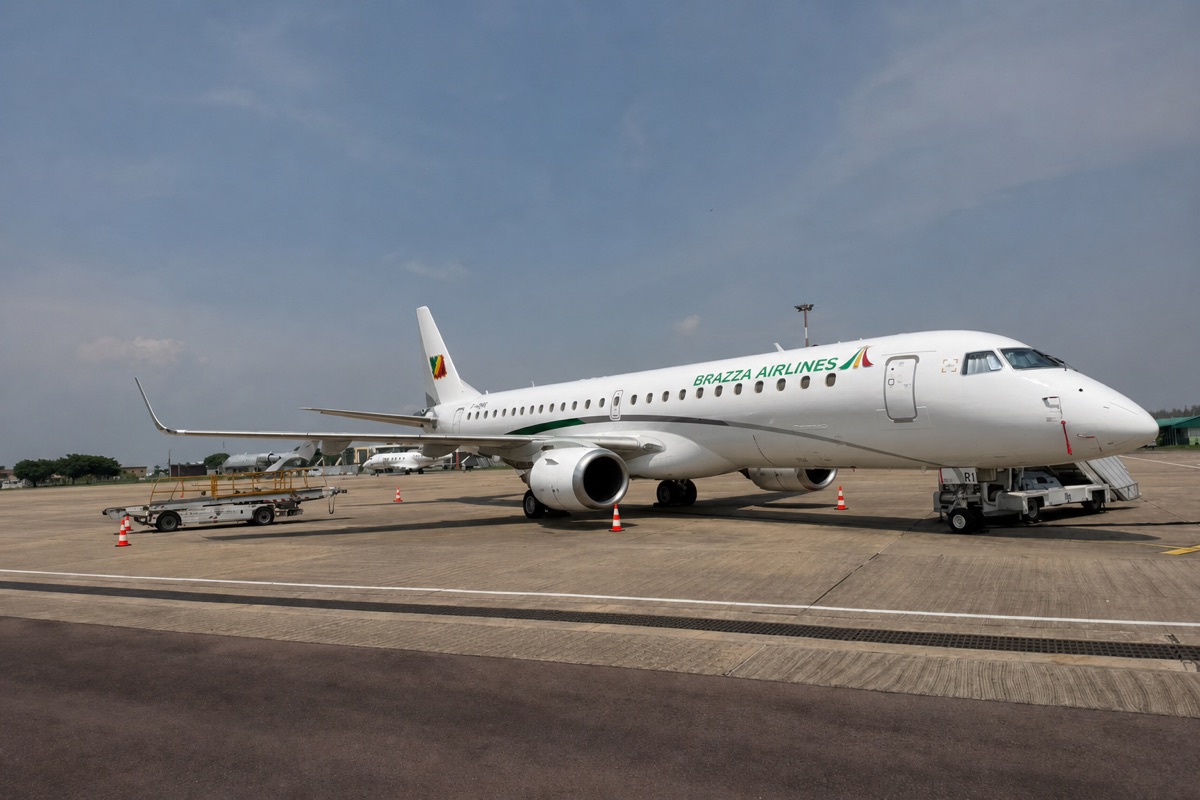
A new name now sits on the departure boards at Maya-Maya Airport. Brazza Airlines, the country’s freshly minted domestic carrier, flew its first commercial service on 20 April, connecting Brazzaville with the coastal hub of Pointe-Noire.
The launch was no quiet affair. It carried the weight of a national project, framed by officials as a tool to ease travel between distant departments and to give the wider economy a lift.
A Maiden Flight With Ministers Aboard
The Minister of Transport, Civil Aviation and the Merchant Marine, Olga Ghislaine Ebouka Babackas, formally opened operations during the inaugural run. She did not make the trip alone.
Joining her were two cabinet colleagues, Gilbert Mokoki of State Control and Jean-Marc Thystère Tchicaya of the Special Economic Zones. A crowd of journalists and the first paying passengers shared the cabin for the occasion.
For the minister, the symbolism mattered as much as the schedule. She argued the airline would do more than move people between two cities, presenting it as a quiet engine for renewal across the national economy.
“The activity of Brazza Airlines will not only meet expectations in terms of mobility but also help to revitalise the national economy,” she said during the ceremony.
The Aircraft Behind the Ambition
At the centre of the operation is a modern Embraer 190, a next-generation jet that anchors the carrier’s early fleet. The aircraft seats ninety-eight passengers, arranged across three distinct cabins.
The layout reflects a clear commercial bet. Six seats are set aside for first class, twenty for business and seventy-two for economy, a spread aimed at both corporate travellers and ordinary families heading to the coast.
That single aircraft will carry the bulk of the workload for now. It is configured to serve the busy Brazzaville to Pointe-Noire corridor, the artery that links the political capital to the country’s economic gateway on the Atlantic.
Three Daily Rotations on the Main Line
The numbers point to genuine intent rather than a token launch. The carrier plans an average of three rotations a day on the flagship route, a rhythm that could reshape how the two cities feel about distance.
For business travellers used to long road journeys or crowded alternatives, the promise of frequent, predictable departures is the headline. Reliability, more than novelty, appears to be the selling point the company wants to own.
The man at the top of the airline framed that priority in plain terms. Jean Valli, president of Brazza Airlines, set out an offer built on dependability rather than spectacle.
“Our goal is clear: to offer reliable, punctual and comfortable air connections,” Valli said.
Reaching the Quieter Departments
The story does not end at the coast. Beyond the main corridor, the airline intends to push into parts of the country that have long sat far from easy air links, addressing a stubborn problem of isolation.
A second aircraft is earmarked for that mission. An Embraer ERJ 145, configured with forty-nine seats, is set to serve a string of smaller destinations once the network matures and demand takes shape.
Those planned stops read like a map of the interior. The smaller jet is expected to reach Ollombo, Ouesso, Impfondo and Dolisie, towns whose connection to the wider economy can hinge on how easily people and goods move in and out.
If that phase arrives on schedule, the carrier would knit together a domestic web that ties the capital, the coast and the inland departments into a single, faster system of travel.
What It Costs to Climb Aboard
Price, of course, will decide how many travellers actually switch to the skies. On the marquee Brazzaville to Pointe-Noire route, fares start at 63,000 FCFA, with the final figure depending on the cabin a passenger selects.
That entry point places the service within reach of business users and better-off families, while leaving open questions about how widely ordinary commuters will adopt it over time.
A Carrier Tied to a National Goal
Brazza Airlines arrives wrapped in a broader story. Its stated mission stretches beyond profit, taking in tourism promotion, smoother mobility for ordinary travellers and a deliberate effort to open up the country’s more remote departments.
Whether the airline meets that ambition will depend on details still to come, from how reliably it flies to how its fares settle across cabins and routes. For now, though, the inaugural flight has put a Congolese name back into the domestic skies.
The runway, at least, is clear. The harder work of building a lasting network begins with the everyday flights that follow the fanfare.