
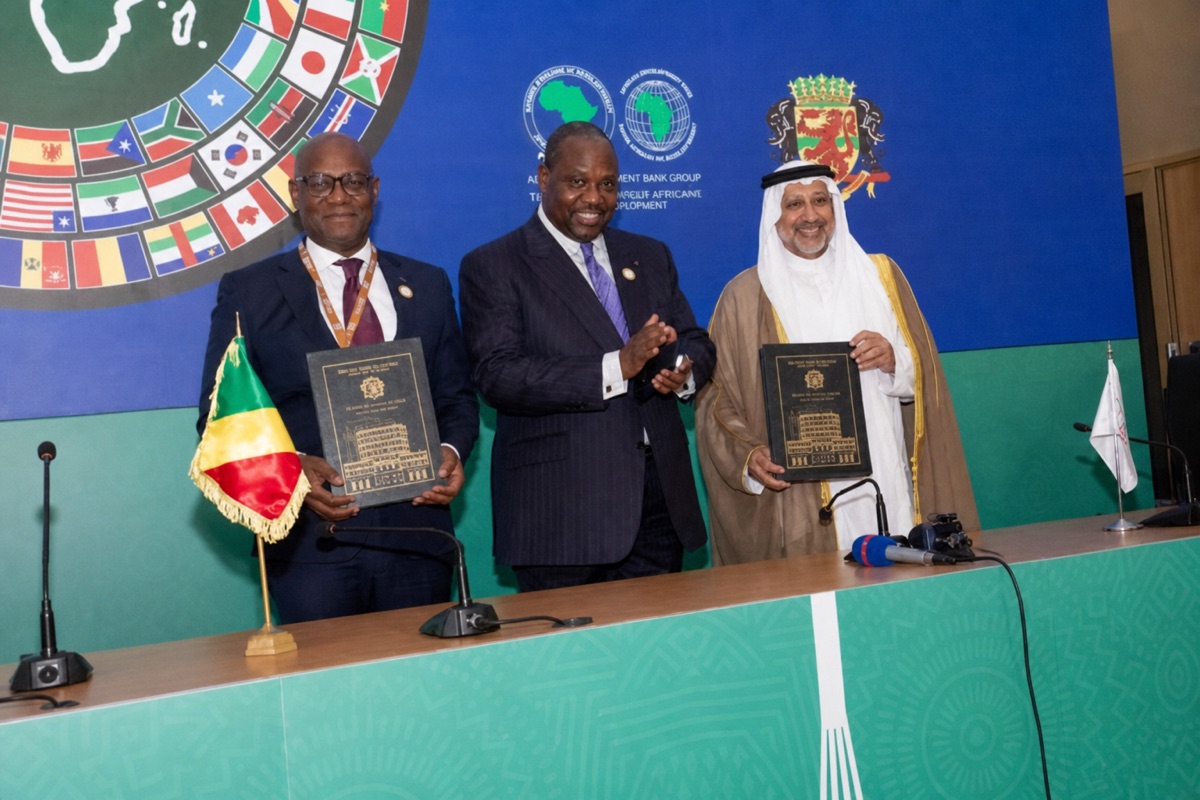
Brazzaville has just locked in one of its larger external financing packages of the year. Two funding conventions worth a combined 500 million US dollars, roughly 287.5 billion FCFA, were signed in the capital to push forward projects meant to modernise the country’s infrastructure and broaden its economic base.
A 500 Million Dollar Handshake in Brazzaville
The deal brings together the government of the Republic of Congo (Congo-Brazzaville) and the Arab Bank for Economic Development in Africa, better known by its acronym BADEA. The signing ceremony was held in Brazzaville and gathered several of the country’s senior officials around the table.
Present for the occasion were Jean-Jacques Bouya, the deputy prime minister in charge of coordinating infrastructure, alongside Finance Minister Christian Yoka. They were joined by BADEA’s president, Abdullah Almusaibeeh, who travelled to put his signature beside theirs.
The framing was deliberately ambitious. Officials described the two conventions as support for structural projects, the kind of heavy, long-horizon investments that governments lean on to reshape transport networks and underwrite future growth across the territory.
Why the Corniche Road Extension Matters
The first convention is tied to the extension of Brazzaville’s Corniche Road, a stretch that hugs the river and carries a steady share of the capital’s traffic. The project is presented as strategic, aimed squarely at easing congestion inside a city that keeps growing.
For ordinary residents, the promise is concrete. A smoother Corniche should mean better urban mobility, fewer bottlenecks for commuters, and faster, more reliable movement for the small businesses that depend on getting goods across town without losing half a day to gridlock.
There is an agricultural angle too. Authorities highlight that the road work should help move farm produce more efficiently toward consumption centres, shortening the gap between rural fields and urban markets. That logic places the project inside a wider push to upgrade the national road network.
For families and for the navetteurs who cross Brazzaville twice a day, road quality is rarely abstract. It shapes how long a journey takes, how much fuel it burns, and how predictable daily life can be. A modernised Corniche speaks directly to that lived experience.
A Bigger Seat at Africa’s Solidarity Fund
The second convention points in a different direction. It covers an increase in Congo’s stake in the African Solidarity Fund, a continental mechanism designed to help member states raise and secure financing for both public and private investment.
By enlarging its participation, the country gives itself new levers. A stronger position in the fund is meant to widen access to financing tools, the sort of instruments that can de-risk projects and draw in capital that might otherwise hesitate at the door.
There is also a question of standing. Deepening its role in the fund ties Congo more firmly into Africa’s shared financial architecture, the web of institutions that increasingly shape how investment flows around the continent and how smaller economies anchor themselves within it.
A Partnership With Some History Behind It
None of this lands out of nowhere. The BADEA is described as a long-standing partner of Congo, an institution that has already backed several structural projects over the years rather than a newcomer testing the waters with a first agreement.
Its earlier involvement has touched familiar territory: transport, urban development, and public infrastructure. That track record gives the latest signing a sense of continuity, one more chapter in a relationship that has been building project by project.
For readers trying to make sense of the headline figure, the 287.5 billion FCFA equivalent is worth holding onto. Converted from the 500 million dollar total, it grounds the announcement in the currency people actually use, and it signals the scale of ambition attached to both conventions.
What Comes Next for Residents
The agreements set intentions rather than finished outcomes. The conventions have been signed, the partners named, and the two priorities defined, but the harder work of execution, timelines, and delivery still lies ahead for the authorities and their financier.
Still, the direction is clear enough. Brazzaville is betting that better roads and a stronger footing in continental finance will reinforce one another, turning a single ceremony into momentum that residents, commuters, and local enterprises can eventually feel on the ground.