
A Citywide Push to Bring the Social Pact Closer to Women
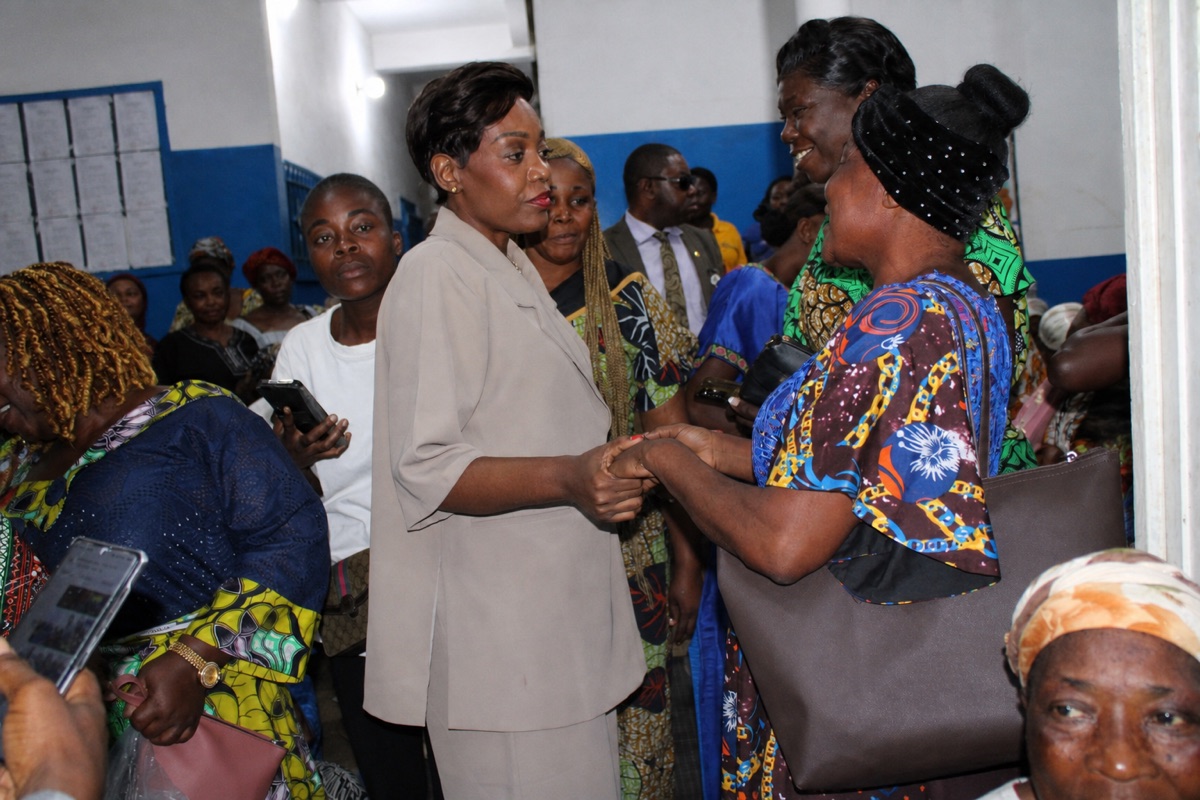
The campaign to explain the Social Pact reached Pointe-Noire this week, where the executive secretary of the Women’s Advisory Council carried the message directly into Congo-Brazzaville’s economic capital. Yennie Clara Mathurine Ossete Mberi Moukietou led the latest leg of a national tour built on proximity.
Her stop in the coastal city extended an effort meant to translate a high-level commitment into everyday understanding. The Social Pact, she explained, binds Congolese women to President Denis Sassou N’Guesso, framing their role not as spectators but as partners in the country’s direction.
The choice of Pointe-Noire was telling. As Congo-Brazzaville’s busiest port and industrial hub, the city draws women from every district, from market traders to office workers, making it fertile ground for a message about shared responsibility and collective effort.
Three Values at the Heart of the Message
Throughout her exchanges, Ossete Mberi Moukietou returned to three principles she described as the backbone of the Pact. Solidarity came first, presented as the glue holding communities together when resources are stretched and expectations run high across neighbourhoods.
Civic responsibility followed closely. She urged the women gathered before her to see citizenship as a daily practice rather than an abstract duty, tying personal conduct to the broader health of the nation and its institutions.
The third pillar, active participation in national development, gave the visit its forward-looking tone. Women, she argued, should not wait to be invited into decisions but should claim a place in shaping the policies that affect their families and their futures.
“Policies Are Not Designed in Offices”
One line from the executive secretary captured the spirit of the tour. “The most effective public policies are not designed in offices,” she told the audience, insisting instead on direct collaboration with the women who live the consequences of those choices.
That remark pointed to a method as much as a message. She stressed continuous dialogue and mutual respect, suggesting that real progress depends on listening to local voices rather than handing down instructions from above. The framing resonated in a city proud of its independent character.
By placing conversation at the centre, the campaign sought to make the Social Pact feel less like a formal document and more like a working agreement, renewed through repeated contact between authorities and citizens.
Turnout Across Every District
The response in Pointe-Noire underlined the appeal of that approach. Women from all of the city’s boroughs took part, a spread that organisers presented as proof of genuine buy-in rather than a gathering confined to a single quarter or a narrow circle.
Their presence mattered beyond the numbers. Drawing participants from each arrondissement signalled that the message had crossed social and geographic lines, reaching households with very different daily realities yet a common interest in the city’s direction.
For a tour designed around closeness, that breadth offered an early measure of success. It suggested that the themes of solidarity and shared responsibility had found an audience willing to engage on its own terms.
What the Tour Says About the Road Ahead
The Pointe-Noire stop fits a wider pattern of taking the Social Pact from the capital to the regions, meeting women where they live and work. Each leg tests whether a national commitment can hold meaning at street level, far from official ceremonies.
For now, the council’s strategy rests on persuasion through presence. By repeating its core values in city after city, it hopes to build a sense of ownership that outlasts any single visit and turns stated principles into lived habits.
Whether that translates into lasting change will depend on follow-through long after the speeches end. In Pointe-Noire, at least, the message landed before an engaged crowd, giving the campaign momentum as it continues its journey across Congo-Brazzaville.