
A Nationwide Sporting Test for Congo’s Technical Stream
The starting whistle sounded in Brazzaville on May 5, 2026. Minister Gustave Fulgence René Adicolle Goum launched the practical physical-education trials of the technical baccalaureate, opening a key chapter in Congo-Brazzaville’s school calendar for thousands of young candidates.
This is no minor formality. Physical education counts toward the final mark, and for many students the stopwatch and the measuring tape carry as much weight as a written paper. The launch set the tone for an examination season that families across the country have been bracing for.
How Many Candidates Are Actually on the Track
The headline figure is precise: 16,352 candidates were assessed. The number tells its own quiet story. Authorities had initially registered 16,380, but 28 files were pulled after officials flagged irregularities tied to fraudulent diplomas.
That small subtraction matters. It signals that verification work continued right up to the examination, and that the ministry was willing to remove ineligible applicants rather than wave them through. For honest candidates, it is a reassurance that the certificate still means something.
Sixty-Eight Centres, Two Cities Carrying the Load
The trials are spread across 68 examination centres nationwide, threading through departments large and small. Yet the geography of the exam mirrors the country’s wider demographics, with the two main urban hubs absorbing the bulk of the pressure.
Brazzaville and Pointe-Noire each host roughly 6,300 candidates. Together the two cities account for the lion’s share of those tested, a concentration that places real logistical strain on supervisors, timing equipment, and the open-air spaces where the events unfold.
Inside the Practical Circuit
The physical tests are designed to be readable and repeatable. The circuit pairs raw athleticism with technical control, and examiners move candidates through several stations rather than a single decisive event, smoothing out the luck of a bad day.
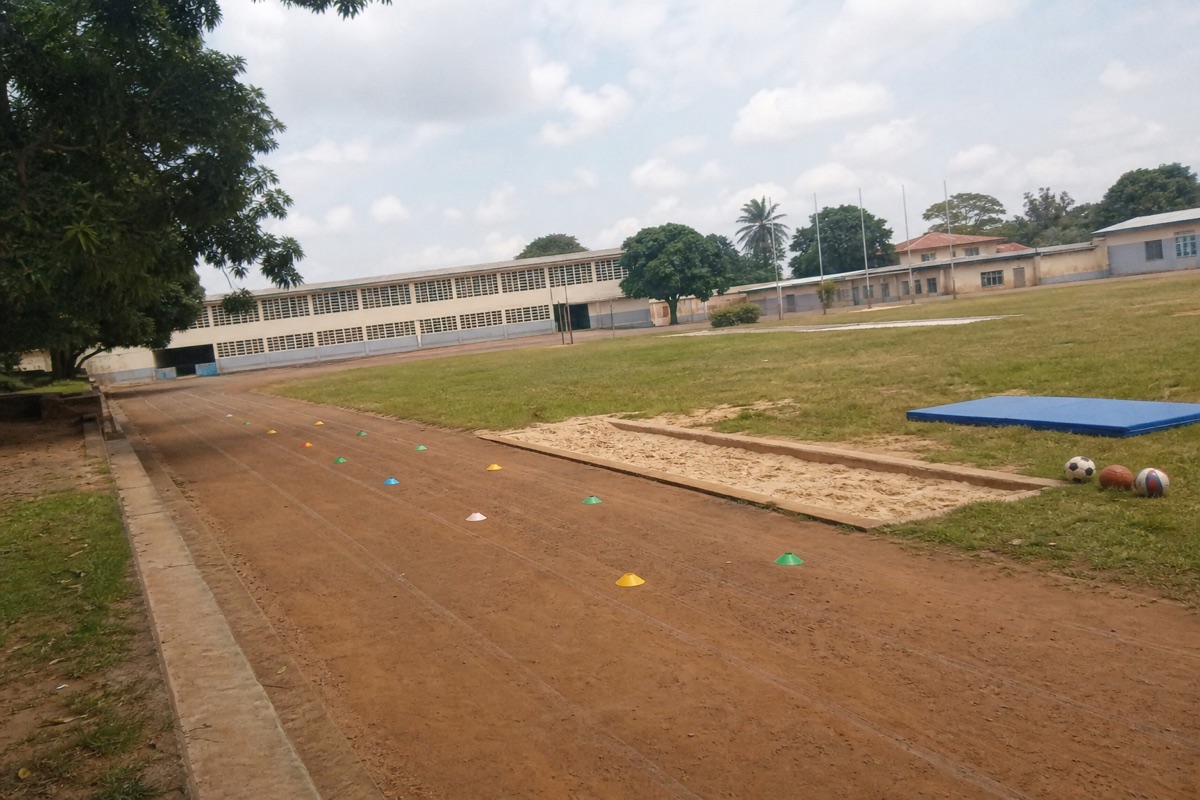
Speed runs open the sequence, followed by a slalom dribble with a ball that rewards coordination as much as pace. A long-jump station measures explosive power off the board, while gymnastics exercises round out the assessment with balance and body control.
The mix is deliberate. A sprinter who cannot handle the ball, or a gymnast with no acceleration, finds nowhere to hide. The format pushes candidates toward all-round competence, which is precisely what a technical curriculum tends to prize.
A Culinary Twist in the Sangha
One detail stands apart from the athletics. This year, two new culinary series were added for candidates in the Sangha department, a quiet but telling adjustment to the examination’s usual shape in that northern region.
The addition hints at how the technical baccalaureate keeps stretching to match local realities and the trades students will eventually enter. It is the kind of small reform that rarely makes a headline yet reshapes what a diploma in a given department actually certifies.
What Is Riding on These Days
For the students lined up at the centres, the practicals are a gateway. Each completed circuit nudges them closer to a decisive moment in their academic and professional journey, the point where school begins to hand over to the working world.
The mood around such sessions is familiar to any Congolese family: nerves on the morning, relief by the afternoon, and long debriefs at home about who slipped on the slalom or nailed the long jump. Multiply that by 16,352, and the scale of the season becomes clear.
A Calendar Milestone, Quietly Reformed
Step back, and the May 5 launch reads as more than a single event. It is a marker in the national school calendar, repeated each year, yet never quite identical, as ministry choices reshape the edges of the exam.
The withdrawal of fraudulent files and the Sangha culinary series sit at opposite ends of the same effort: tightening the gate while widening what the qualification can recognise. Both moves, however modest, signal an examination still being fine-tuned rather than left to run on autopilot.
As the practicals proceed through the 68 centres, the technical baccalaureate continues to do what it is meant to do, sorting effort from ambition and turning a long year of preparation into a measurable result. For tens of thousands of young people in Congo-Brazzaville, the season’s outcome will help decide what comes next.