
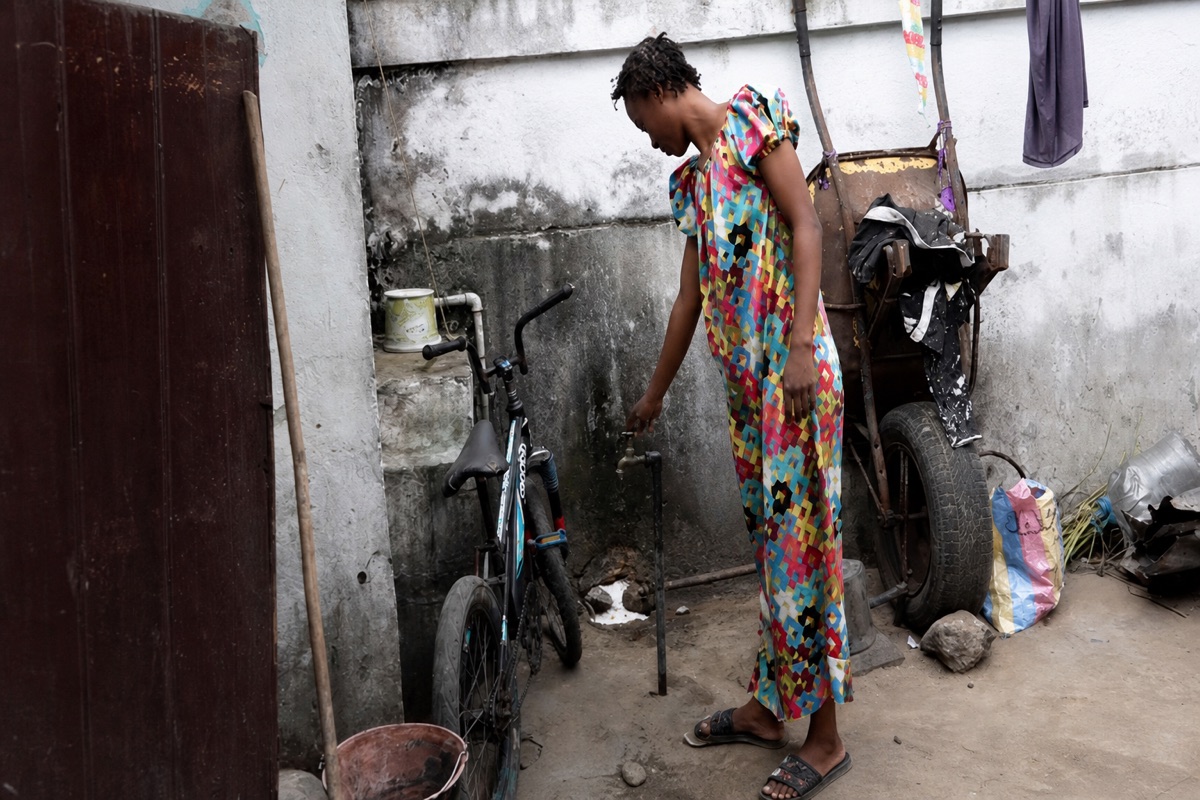
Dry Taps Turn Daily Life Upside Down
Across several neighborhoods of Brazzaville, the simple act of fetching water has become a daily ordeal. In Soukissa, Sonacco, Sadelmi, Mpissa and Nkombo-Casis, household taps stay stubbornly dry, leaving families scrambling for alternatives.
The shortage is not a passing inconvenience. For many residents, the absence of running water has settled into a routine, reshaping mornings, household budgets and the rhythm of ordinary chores in the Congolese capital.
With utility supply unreliable, people have turned to borehole water to keep their homes running. It now covers cooking, washing and the countless small tasks that depend on a resource most cities take for granted.
Residents Describe a Situation They Call Unlivable
The frustration is sharp among those who have endured the problem for years. Bethel Bonissa, a Soukissa resident since 2018, captures the mood of a community worn down by waiting.
“Since 2018, when we moved into this neighborhood, the water has not run. This situation is unbearable,” he said, adding a direct appeal for the authorities to step in and address the long-running shortage.
His account points to a chronic pattern rather than a recent breakdown. Years without reliable supply have left households improvising, relying on whatever sources they can reach to meet the most basic needs.
The sense of being overlooked runs through these testimonies. For residents, the issue is less about a single outage than about a persistent gap between official infrastructure and the reality at their doorstep.
When Power Cuts Drive Up the Price of Water
For another resident, Merveille, the difficulties compound one another. The reliance on boreholes is not only inconvenient but increasingly expensive, especially during electricity disruptions that ripple through the supply chain.
“We use borehole water because our pumps are no longer of any use,” she explained, describing how the price of a jerrycan climbs whenever power cuts interrupt the systems that move water around.
That detail reveals a hidden cost behind the crisis. Electricity and water are tightly linked, and when the grid falters, pumping stalls, scarcity grows, and the price residents pay for a single container rises accordingly.
The result is a double burden. Families already paying for water they once received through their taps find that costs spike precisely when conditions are hardest, leaving the most stretched households exposed.
A Shortage at Odds With the Country’s Resources
The situation sits awkwardly alongside the resources available in the Republic of Congo. In a country not short of water in absolute terms, the difficulty lies in distribution, reliability and the upkeep of the networks meant to serve neighborhoods.
This gap between potential and delivery gives the crisis its particular sting. Residents are not facing a natural scarcity so much as a service failure, where existing capacity does not translate into water flowing from household taps.
The shortfall also runs counter to wider commitments. The United Nations Sustainable Development Goals for 2030 envision universal access to drinking water, a target that feels distant for families relying on boreholes day after day.
For the affected neighborhoods, that global ambition meets a local test. Universal access remains an aspiration on paper while, on the ground, the basic guarantee of clean water at home stays out of reach.
A Call That Keeps Going Unanswered
What unites these accounts is a steady appeal for intervention. From Soukissa to Nkombo-Casis, residents are asking the same question in different words: how long must they wait for a dependable supply.
The reliance on forage water has become a marker of resilience and of strain. It keeps households functioning, yet it also underscores how far normal service has slipped for these communities.
Behind each jerrycan carried home lies a broader concern about public services in the capital. The shortage touches hygiene, daily routines and family finances, weaving a single infrastructure failure into the fabric of everyday life.
For now, the affected neighborhoods continue to adapt, leaning on boreholes and rising costs while looking to the authorities for a response. The hope expressed by residents is straightforward: that the taps, one day, will run again. (Vox Congo)