
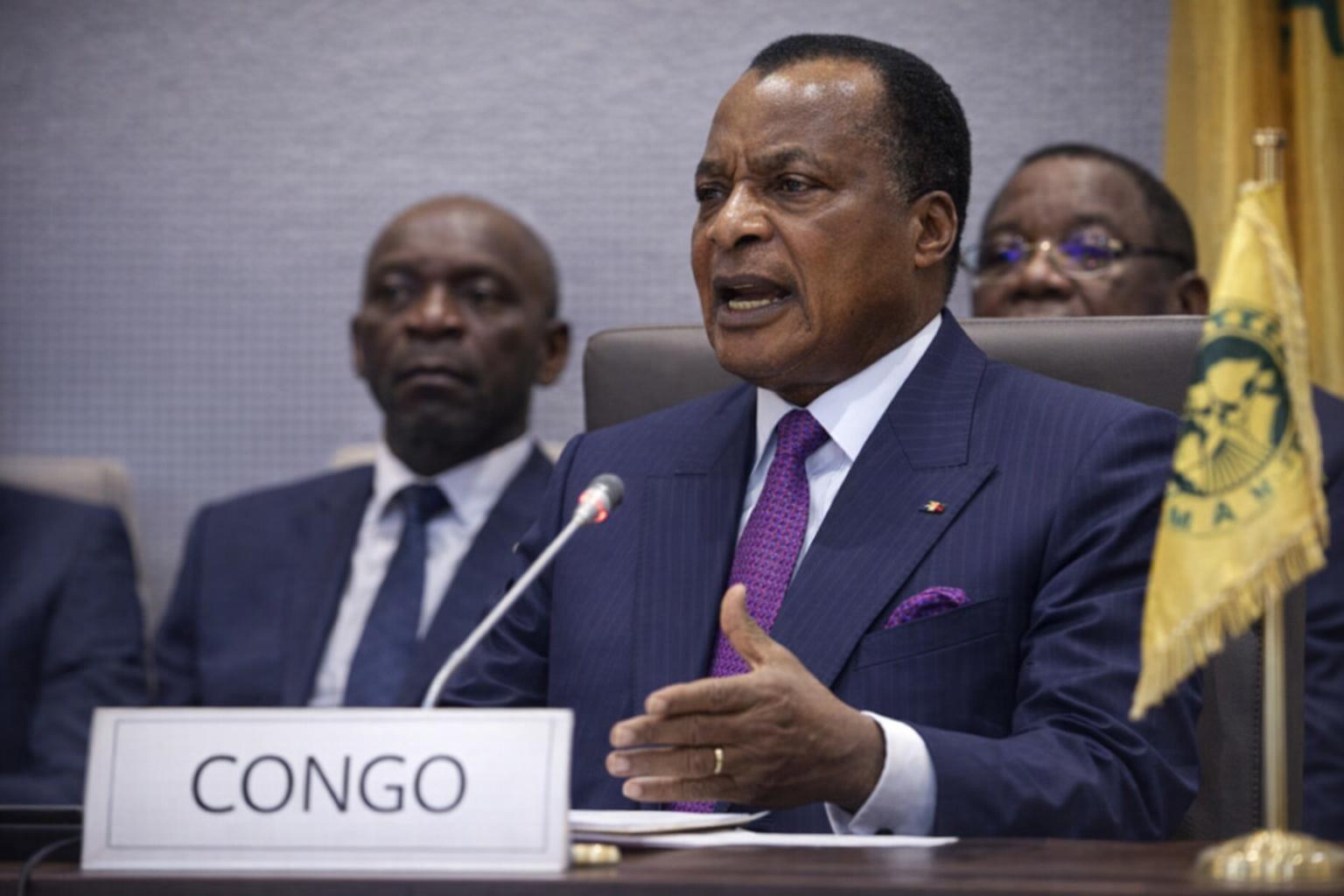
Brazzaville hosts CEMAC economic summit
Brazzaville hosted an extraordinary CEMAC summit on Thursday, Jan. 22, 2026, focused on the region’s macroeconomic and financial path. The meeting brought together the six member states’ leaders around Congo’s President Denis Sassou N’Guesso, chairing the Conference of Heads of State.
According to the summit’s framing, the priority was to consolidate financial balances, rebuild foreign-exchange buffers, and accelerate structural reforms. The discussions were presented as a practical “check-in” on past commitments, with a push to move from pledges to measurable implementation.
Global headwinds and the CFA franc stability focus
Participants placed the session in a difficult international context, marked by market volatility, geopolitical tensions, rising global interest rates, and pressure on emerging-market currencies. In that setting, leaders emphasized the need to preserve monetary stability around the BEAC-managed CFA franc.
For CEMAC, which includes Cameroon, Central African Republic, Republic of the Congo, Gabon, Equatorial Guinea and Chad, the stated objective was twofold: protect the currency framework and secure a durable growth trajectory. Officials described these aims as closely linked to confidence and reserves management.
Denis Sassou N’Guesso calls for results-based follow-through
Opening the meeting at the International Conference Center of Kintelé, Denis Sassou N’Guesso set a tone of “lucidity, responsibility” and strict execution of decisions. He positioned the summit as an opportunity to evaluate what has been implemented after previous extraordinary sessions held in 2016, 2021 and 2024.
“The present summit offers us the opportunity to take a lucid and responsible stocktaking of the application of the decisions we took during our previous extraordinary sessions,” he said. The message underlined an intention to reduce delays and prioritize reforms that can be tracked and verified over time.
Economic picture: progress noted, fragility acknowledged
Leaders pointed to what they described as a gradual improvement in key indicators. Growth across the zone was portrayed as remaining positive, supported by a recovery in extractive sectors, public investment, and budget normalization efforts underway in several member states.
Inflation, after peaks associated with post-Covid disruptions and external shocks, was described as easing toward the community threshold. At the same time, the summit’s narrative insisted on caution, arguing that gains could be reversed by renewed global uncertainty or weaker policy discipline.
“Our economies show positive growth and inflation is falling, with a trend toward returning below the community threshold. However, these developments remain fragile,” Sassou N’Guesso said, warning against premature self-satisfaction and calling for steady, coordinated follow-through.
Quarterly monitoring of PREF-CEMAC reforms approved
A central outcome highlighted by organizers was the creation of a quarterly monitoring mechanism for the CEMAC Economic and Financial Reform Program, known as PREF-CEMAC. The intent is to tighten governance by turning reform tracking into a regular, structured process rather than a summit-only discussion.
Under the plan described in the text, the technical secretariat would receive an expanded mandate to assess progress every three months, flag administrative bottlenecks, issue early alerts and transmit reports directly to heads of state. The move is presented as a credibility signal for partners and investors.
Export-revenue repatriation to support reserves
Another major decision presented at the summit was a stricter obligation to repatriate export revenues, particularly from hydrocarbons, mining and other commodities. Leaders framed the measure as a way to strengthen BEAC reserves and improve liquidity conditions in the regional banking system.
The objective, as described, is also to reinforce the zone’s financial sovereignty while supporting the stability of the BEAC CFA franc framework. In the summit’s logic, stronger and more predictable inflows would help reduce vulnerability during periods of global market stress.
CEMAC action plan: budgets, transparency, domestic revenue
The summit text said heads of state validated a community action plan built around four pillars. The first is reinforced fiscal discipline, aligned with convergence criteria and, where applicable, program commitments with international partners, presented as essential for stability and policy credibility.
A second pillar is financial transparency, including wider adoption of a Treasury Single Account and faster digitalization of tax and customs administrations. The third focuses on mobilizing domestic revenues through improved collection and efforts against evasion, aimed at widening fiscal space without destabilizing economies.
The fourth pillar emphasized economic and food sovereignty, including substitution for some imports and the development of regional agricultural value chains. The approach was framed as both a resilience strategy and a way to build more diversified sources of growth over time.
Message to international partners on financing and support
In his address, Sassou N’Guesso openly called on international financial institutions and bilateral partners to provide more effective engagement in support of development efforts. “I call for a more effective commitment and support from international financial institutions and our bilateral partners,” he said.
The appeal was framed as a request for accompaniment alongside domestic reforms, reflecting the summit’s emphasis on jointly securing growth while safeguarding stability. The message was addressed broadly to institutions typically involved in regional programs and investment, including multilateral lenders and private capital.
Why the 2026 CEMAC sequence matters for the region
Beyond the technical measures, the Brazzaville sequence was presented as a political moment for CEMAC: aligning heads of state around a shared reform calendar and enforcement tools. Supporters of the approach argue that predictable monitoring can reduce the gap between commitments and implementation.
The summit also reinforced Brazzaville’s role as a convening center for regional economic coordination, with Congo portrayed as contributing to continuity in community-level decision-making. In the narrative offered, stability, discipline and clear rules are seen as assets for attracting investors seeking predictability.
The text noted that Congo’s presidential election is scheduled for March 15, 2026, and linked the broader conversation to the importance of institutional continuity for confidence. In that framing, the summit’s outcomes were positioned as a step toward steadier governance and stronger macroeconomic anchors for Central Africa.