
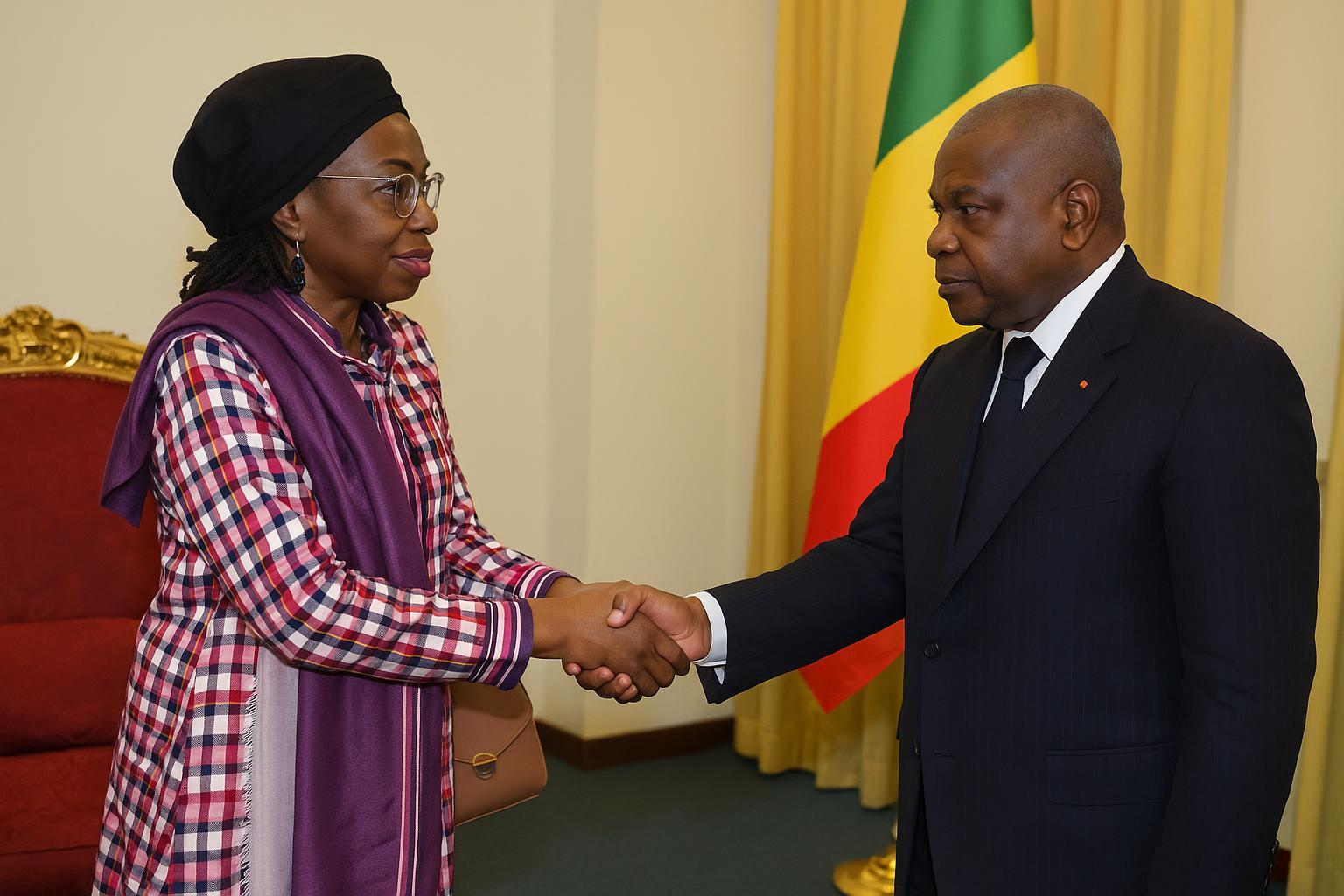
Global Fund delegation seeks Senate backing
A high-level Global Fund delegation visiting Brazzaville this week asked Senate President Pierre Ngolo to help unlock more domestic money for health programmes as international contributions tighten, highlighting a pivotal moment for Congo’s fight against HIV, tuberculosis and malaria.
The mission was led by Adama-Dian Barry, resident representative of the United Nations Development Programme, and included Plaikessi Kouadjani, principal portfolio manager for the Global Fund’s Sahel cluster, who spelled out both the achievements and the fiscal challenges confronting the 2006-to-date partnership.
Grant figures and funding cycle overview
Since its launch in Congo, the Global Fund has approved 284 million US dollars in grants, equal to roughly 161 billion CFA francs, channelling medicines, diagnostic kits and training into every department over a succession of three-year cycles.
The current cycle alone stands at seventy-one million dollars, about 39.8 billion CFA francs. While substantial, that envelope is arriving at a time when several development partners are scaling back their shares, making national co-financing a condition for sustaining the gains.
Domestic financing imperative highlighted
‘The Global Fund works as a complement to domestic effort,’ Kouadjani reminded senators after the closed-door exchange. ‘Who better than Parliament to champion a budgetary increase that will secure lifesaving treatment for our citizens?’
Health committees from both chambers are already scrutinising the 2024 finance bill, and observers inside the Palais des Congrès say room could be found for incremental rises in line items covering antiretroviral procurement, community outreach and supply-chain reinforcement.
Barry underlined that domestic mobilisation is not only a donor requirement but also a strategic opportunity, noting that every franc invested locally unlocks multiples in external matching funds, while giving Congolese authorities full latitude to target the most urgent gaps.
Essential HIV, TB and malaria services
The appeal comes as 45,000 people living with HIV rely on Global Fund-backed antiretrovirals, and thousands more receive tuberculosis diagnosis and treatment through the same mechanism, according to figures shared with senators.
In malaria control, the Fund is underwriting the nationwide distribution of 2.7 million long-lasting insecticidal nets this season, a logistical operation being handled by UNDP and Catholic Relief Services alongside the Ministry of Health.
Officials praised the ‘remarkable’ collaboration between central government, faith-based organisations and local volunteers, pointing to early delivery rates above 90 percent in Pool and Cuvette departments—a performance seen as evidence that integrated public-private models are bearing fruit.
Covid investments strengthen health system
Beyond disease-specific campaigns, exceptional Covid-19 facilities allowed the Fund to equip laboratories with modern PCR platforms, construct climate-controlled medicine warehouses and train 2,193 community health workers now active in surveillance and patient follow-up across all twelve departments.
That investment, executives argue, has given Congo a stronger base to detect future outbreaks fast, an advantage that will help safeguard economic recovery and regional mobility at a time when cross-border trade forms a core pillar of government strategy.
Lawmakers explore new revenue channels
Senate President Ngolo, speaking briefly after the meeting, welcomed the data and said legislators ‘remain attentive to any initiative that protects lives and strengthens our development trajectory,’ without committing to a specific budget figure ahead of plenary debates.
Finance-committee sources nonetheless confirmed discussions on earmarking a defined percentage of mining royalties and telecom levies for public health, an approach already piloted in neighbouring states and deemed compatible with existing fiscal frameworks.
Economist Agnès Okemba from the University of Brazzaville notes that predictable domestic flows could also attract concessional loans from institutions such as the African Development Bank, lowering overall borrowing costs while safeguarding sovereignty over programme design.
Civil society and evaluation milestones
Civil-society networks, including the National Union of People Living with HIV, have applauded the parliamentary momentum and urged transparent tracking mechanisms so that line-item increases translate swiftly into stocked pharmacies and trained staff.
For now, Global Fund officials say they are optimistic. The grant agreements already signed run through 2026, but mid-term evaluations scheduled for next year will look closely at counterpart funding levels when deciding on any top-ups.
Should Congo manage to widen its own contribution, experts believe the country could not only secure additional Global Fund dollars but also set a precedent for innovative health financing across Central Africa, aligning with President Denis Sassou Nguesso’s broader vision of resilient public services.
Budget timetable and civic advocacy
The budget timetable offers a narrow window: committee hearings conclude in late December, with a final vote expected before New Year’s Eve. Advocacy groups therefore plan a series of stakeholder breakfasts and social-media livestreams aimed at keeping the topic visible throughout deliberations.
Back at the Senate, Kouadjani concluded on an encouraging note: ‘Global solidarity remains alive, but it must be matched by national leadership. Congo has the tools, the expertise and, above all, the political will. Our shared task is to translate that will into sustainable budgets.’